CrossFit Benchmark WODs List for Beginners
CrossFit benchmark WODs are the standardized tests that measure your fitness progress over time. They stay the same every time you do them, which means you can compare your results from month to month and see exactly how much stronger, faster, and fitter you have become. If you are new to CrossFit, knowing which benchmarks to tackle first — and how to scale them — gives you a clear starting point.
What Are CrossFit Benchmark WODs?
A benchmark WOD is a repeatable workout with a fixed structure. Unlike daily programming that changes every session, benchmarks are designed to be retested every 3 to 6 months so you can track progress objectively.
There are two main categories:
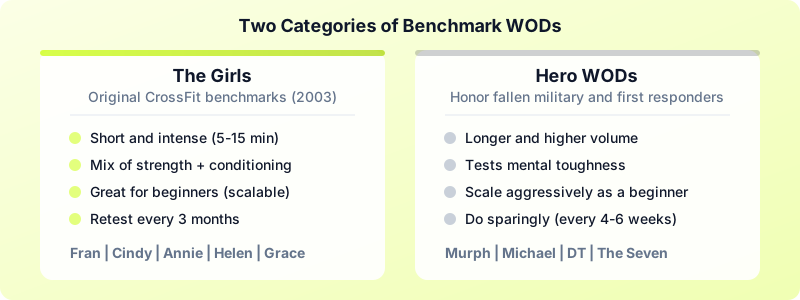
The Girls — Named after women (like hurricanes), these were the original CrossFit benchmarks introduced in 2003. They test different combinations of strength, gymnastics, and conditioning. Most Girls WODs are short and intense, lasting 5 to 15 minutes.
Hero WODs — Named in honor of fallen military personnel and first responders. These are longer, higher volume, and significantly more demanding. Beginners should approach Hero WODs with caution and always scale appropriately.
Both types serve the same purpose: giving you a standardized measuring stick for your fitness. When you first start CrossFit as a beginner, these benchmarks help you set realistic baselines and track improvement over time.
The Best Girls WODs for Beginners
Not all Girls WODs are equally accessible. Here are five that work well for beginners, listed from most approachable to most challenging.
Cindy (AMRAP 20 minutes)
- 5 pull-ups, 10 push-ups, 15 air squats
- Why it works for beginners: Uses only bodyweight movements. The AMRAP format lets you work at your own pace. A good beginner target is 8 to 12 rounds.
- Scale: Use ring rows instead of pull-ups and knee push-ups if needed.
Annie (For Time)
- 50-40-30-20-10 reps of double-unders and sit-ups
- Why it works for beginners: Only two movements. Most athletes finish in under 10 minutes. Teaches pacing and rhythm.
- Scale: Replace double-unders with single-unders at a 2:1 ratio (100-80-60-40-20).
Helen (3 Rounds for Time)
- 400m run, 21 kettlebell swings (53/35 lbs), 12 pull-ups
- Why it works for beginners: Combines running, hip hinge, and pulling — three fundamental movement patterns.
- Scale: Lighten the kettlebell to 26 or 18 lbs. Use ring rows for pull-ups.
Fran (21-15-9 For Time)
- Thrusters (95/65 lbs) and pull-ups
- Why it works for beginners: Only 45 total reps of each movement. Short but intense — typically under 10 minutes even for beginners.
- Scale: Use 45 or 55 lb thrusters and banded pull-ups. Focus on consistent movement rather than speed.
Grace (30 Clean and Jerks for Time)
- 30 clean and jerks at 135/95 lbs
- Why it works for beginners: Single movement focus lets you practice one skill repeatedly. Tests both technique and conditioning.
- Scale: Drop the weight to 65 or 75 lbs. Prioritize form on every rep.
Beginner-Friendly Hero WODs
Hero WODs are tougher by design. These three have the simplest movement patterns and scale well for newer athletes.
Murph (For Time)
- 1-mile run, 100 pull-ups, 200 push-ups, 300 squats, 1-mile run
- Scale: Cut the reps in half (50 pull-ups, 100 push-ups, 150 squats). Partition the work into manageable sets — 20 rounds of 5 pull-ups, 10 push-ups, and 15 squats is a common approach. Skip the weight vest.
Michael (3 Rounds for Time)
- 800m run, 50 back extensions, 50 sit-ups
- Scale: Reduce to 2 rounds or substitute Superman holds for back extensions. This is one of the most accessible Hero WODs because it avoids heavy barbell work.
The Seven (7 Rounds for Time)
- 7 handstand push-ups, 7 thrusters (135 lbs), 7 knees-to-elbows, 7 deadlifts (245 lbs), 7 burpees, 7 kettlebell swings (70 lbs), 7 pull-ups
- Scale: Halve the weight on all barbell movements. Replace handstand push-ups with seated dumbbell presses. Use hanging knee raises instead of knees-to-elbows.
Reserve Hero WODs for special occasions. The high volume increases injury risk if you do them too often. Once every 4 to 6 weeks is plenty. Make sure you have a solid fitness base before attempting any Hero WOD — at least 3 to 6 months of consistent CrossFit training is a reasonable minimum.
When you do take on a Hero WOD, treat it as a test of mental grit as much as physical capacity. Break the work into small, manageable chunks. Pace yourself from the start instead of sprinting the first round and crashing by round three.
How to Scale Benchmark WODs as a Beginner
Scaling is not cheating — it is smart training. Every experienced CrossFit athlete scaled their workouts at some point. The goal is to match the intended stimulus of the workout, not to suffer through movements you cannot do safely.
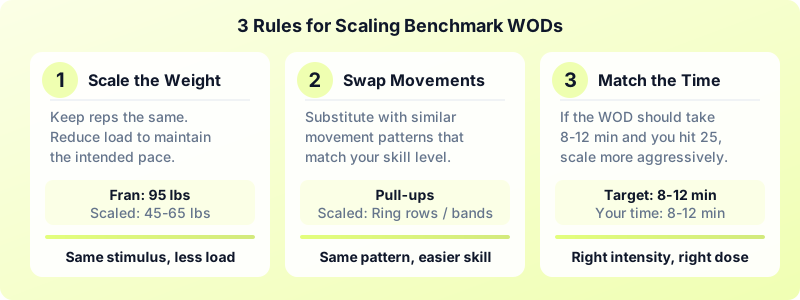
Scale the weight, not the reps. If Fran calls for 95 lb thrusters and that is too heavy, drop to 65 or 45 lbs. Keep the 21-15-9 rep scheme intact so you experience the same pacing challenge.
Substitute movements of similar patterns. Pull-ups become ring rows or banded pull-ups. Handstand push-ups become dumbbell presses or pike push-ups. Double-unders become single-unders.
Maintain the time domain. If a workout is meant to take 8 to 12 minutes and you are still going at 25 minutes, the scaling is not aggressive enough. Adjust so you finish in the intended timeframe.
Record everything. Write down your scaled version, your time, and how it felt. This lets you compare apples to apples when you retest in 3 months.
How to Time and Track Your Benchmark WODs
Accurate timing is essential for benchmarks. A few seconds of difference can be the gap between your old PR and a new one.
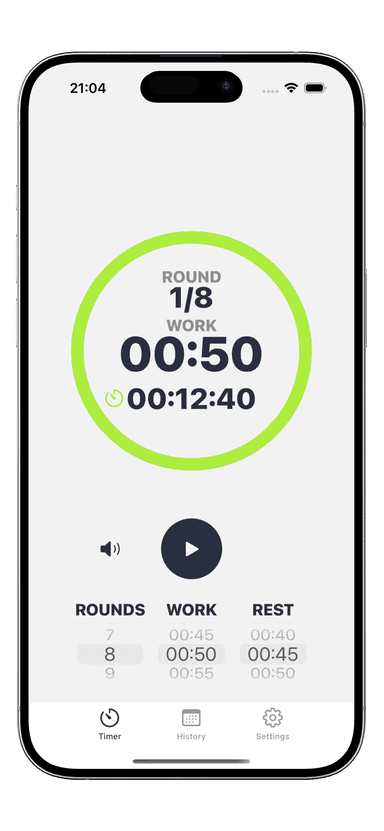
Use your Interval Timer to time For Time workouts with a simple countdown or stopwatch mode. For EMOM workouts like Chelsea, set up minute-long intervals that beep when each new round starts. For AMRAPs like Cindy, set a 20-minute countdown and count rounds as you go.
The workout history feature logs every session automatically. When you retest a benchmark 3 months later, you can pull up your original time and see exactly how much you have improved. That data turns vague progress into concrete proof.
Start with one benchmark per month. Retest the same ones every quarter. Over a year, you will build a complete picture of your fitness from multiple angles — strength, endurance, gymnastics, and conditioning.
Download Interval Timer and time your CrossFit benchmark WODs with precision to track every personal record.