AMRAP Workout Meaning and Examples: Full Guide

You see "AMRAP 12" written on the whiteboard and everyone starts moving with urgency. If you are new to CrossFit or functional fitness, those five letters can be confusing. This guide covers the complete AMRAP workout meaning and examples for every fitness level so you can walk in confident and ready to work.
AMRAP stands for As Many Rounds (or Reps) As Possible. You get a fixed time window, a list of exercises with specific rep counts, and one simple goal — complete as many full rounds as you can before the clock runs out. Your score is your total rounds and reps.
It is one of the most popular workout formats in CrossFit, and for good reason. AMRAPs are time-efficient, scalable, and give you a concrete number to beat next time.
What Does AMRAP Mean in a Workout?
AMRAP has two common applications:
Round-Based AMRAP (Most Common)
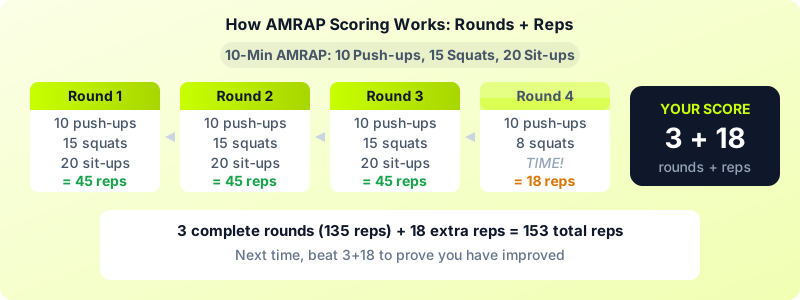
You cycle through a circuit of exercises continuously for a set time. Each complete cycle counts as one round. When time runs out, your score is the total rounds plus any extra reps in an incomplete round.
For example, a 10-minute AMRAP of 10 push-ups, 15 squats, and 20 sit-ups means you rotate through those three exercises as many times as possible in 10 minutes. If you complete 4 full rounds and get through the push-ups and 8 squats in round 5, your score is "4 rounds + 18 reps."
Rep-Based AMRAP
Less common but used in strength training. You perform as many reps as possible of a single exercise until form breaks down or a time cap is reached. This is often written as "AMRAP bench press at 135 lbs."
The round-based format is what most people mean when they say AMRAP, and it is the focus of this guide.
How AMRAP Workouts Work
Running an AMRAP is straightforward, but strategy matters more than you might think.
Step 1: Read the workout. Note the time cap, exercises, and rep counts. Calculate how long one round should take. If a 12-minute AMRAP has 30 reps per round, aim for 1.5-2 minutes per round as a baseline.
Step 2: Start the timer. When the clock starts, begin your first exercise. Move through the circuit in order, completing all prescribed reps before moving to the next exercise.
Step 3: Pace yourself. The biggest mistake in AMRAPs is going all-out in round 1 and crashing by round 3. Start at 80% effort and build intensity as you learn your pace. Sustainable speed beats sprinting and resting.
Step 4: Track your score. Count completed rounds and any extra reps when time expires. Write it down — this number is your benchmark for next time.
Step 5: Beat your score. Repeat the same AMRAP in 4-6 weeks. More rounds means measurable improvement in fitness, strength, or endurance.
The Pacing Strategy
Smart athletes break AMRAPs into thirds:
- First third: establish rhythm at moderate effort (70-80%)
- Middle third: maintain pace, resist the urge to slow down
- Final third: push harder, increase effort to 90-95%
This negative-split approach consistently produces higher scores than starting fast and fading.
4 AMRAP Workout Examples for Every Level
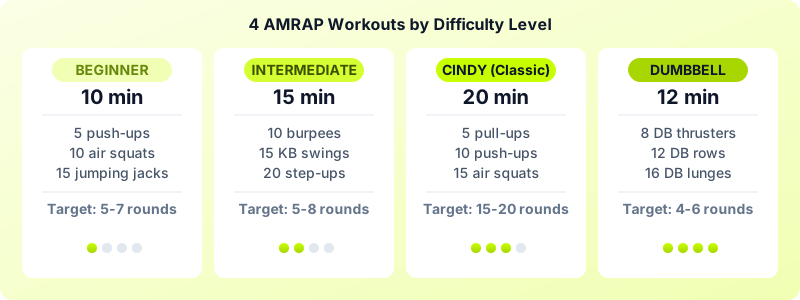
Example 1: Beginner AMRAP (10 Minutes)
As many rounds as possible in 10 minutes:
- 5 push-ups (modify to knees if needed)
- 10 air squats
- 15 jumping jacks
Target: 5-7 rounds. Simple movements, moderate total reps per round. Perfect for your first AMRAP experience.
Example 2: Intermediate AMRAP (15 Minutes)
As many rounds as possible in 15 minutes:
- 10 burpees
- 15 kettlebell swings
- 20 box step-ups (or alternating lunges)
Target: 5-8 rounds. Higher rep count and more demanding exercises increase the conditioning challenge.
Example 3: The Classic "Cindy" (20 Minutes)
As many rounds as possible in 20 minutes:
- 5 pull-ups (or ring rows)
- 10 push-ups
- 15 air squats
Target: Beginners aim for 10-15 rounds, intermediate 15-20 rounds, advanced 20+ rounds. Cindy is one of the most famous CrossFit benchmark workouts and a perfect test of functional fitness.
Example 4: Dumbbell AMRAP (12 Minutes)
As many rounds as possible in 12 minutes:
- 8 dumbbell thrusters
- 12 dumbbell rows (6 per arm)
- 16 dumbbell lunges (8 per leg)
Target: 4-6 rounds with moderate weight. This combines strength and conditioning in a single workout that you can do at home or in the gym.
If you prefer a format with built-in rest periods, compare AMRAPs to EMOM workouts which structure rest into every minute.
Benefits of AMRAP Training
AMRAP is not just another acronym — it delivers specific training benefits that other formats do not.
Measurable progress. Your round count is an objective fitness score. When you go from 5 rounds to 7 rounds on the same workout, that is undeniable improvement. No guessing, no subjective feelings — just numbers.
Built-in intensity scaling. Two athletes can do the same AMRAP and get completely different workouts. A beginner might complete 4 rounds in 12 minutes. An advanced athlete might hit 9. Both worked at their maximum capacity for the full duration.
Time efficiency. A 15-minute AMRAP can burn 13-17 calories per minute according to research on high-intensity circuit training. That is 200-250 calories in a quarter hour — comparable to 30-40 minutes of running.
Mental toughness. The open-ended structure of AMRAP creates a unique psychological challenge. There is no predetermined finish line — you push until time runs out. This builds mental resilience that transfers to competition and everyday life.
Cardiovascular and muscular endurance. The continuous movement with minimal rest keeps your heart rate elevated while accumulating serious training volume. A 20-minute AMRAP of Cindy totals 300+ reps for advanced athletes.
For a different type of high-intensity training, try a HIIT workout with structured work and rest intervals.
How to Time and Track Your AMRAP
Accurate timing is essential for AMRAPs. You need a countdown timer that alerts you when time is up so you can focus entirely on the workout.
Timer Setup
- Mode: countdown timer
- Duration: match the AMRAP time cap (10, 12, 15, or 20 minutes)
- Alert: loud beep or vibration at the end
- Optional: halfway alert to help with pacing
With Interval Timer, set a single countdown interval for your AMRAP duration. The app alerts you when time expires and logs the session in your workout history. You can also set a halfway alert to remind yourself to check your pace.
For more complex workouts that combine AMRAP and EMOM segments, set up your interval timer with multiple intervals in sequence.
Tracking Your Score
Record three things after every AMRAP:
- Rounds + reps (your score)
- Workout details (exercises, reps, weight used)
- How you felt (pacing strategy, where you slowed down)
Interval Timer saves your workout history automatically, making it easy to compare scores across weeks and months.
Now you know the full AMRAP workout meaning and examples to get started. Pick a workout from the list above, set your timer, and see how many rounds you can stack. Your score today becomes the number to beat tomorrow.
Download Interval Timer and time your first AMRAP with countdown alerts, workout history tracking, and Apple Watch support to keep your score visible on your wrist.