HIIT Workout for Beginners at Home: Your First Session
Starting a HIIT workout for beginners at home can feel intimidating when every video online shows athletes sprinting, jumping, and collapsing in a pool of sweat. But here is the truth: your first session does not need to look like that. All you need is your bodyweight, a small space, and a timer.
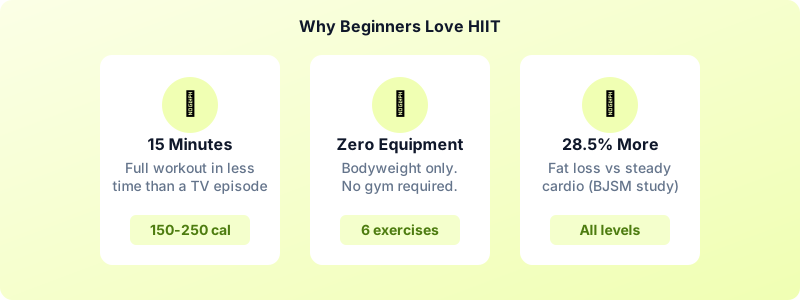
High-intensity interval training works by alternating short bursts of hard effort with recovery periods. Even at a beginner level, a 15-minute HIIT session can burn 150-250 calories and keep your metabolism elevated for hours afterward. And you can do it right in your living room.
What Makes HIIT Perfect for Beginners?
HIIT is one of the best workout formats for beginners because the structure does the thinking for you. Instead of wandering through random exercises and wondering when to stop, the timer tells you exactly when to work and when to rest.
Here is why beginners thrive with HIIT at home:
- Short sessions — Most beginner HIIT workouts last 10-20 minutes. You do not need an hour to see results.
- No equipment needed — Bodyweight exercises like squats, push-ups, and high knees are all you need for an effective beginner HIIT workout.
- Scalable intensity — You control how hard you push. A jumping jack at 80% effort for you is just as valid as a burpee at 100% effort for someone else.
- Built-in rest — Unlike running or cycling where you have to pace yourself the entire time, HIIT gives you scheduled recovery between every work interval.
A 2019 study in the British Journal of Sports Medicine found that HIIT produced 28.5% greater reductions in body fat compared to moderate-intensity continuous training. That result held true across fitness levels — including complete beginners.
Your First HIIT Workout at Home (No Equipment)
This beginner-friendly HIIT session uses six bodyweight exercises that require zero equipment and minimal space. The entire workout takes 15 minutes.
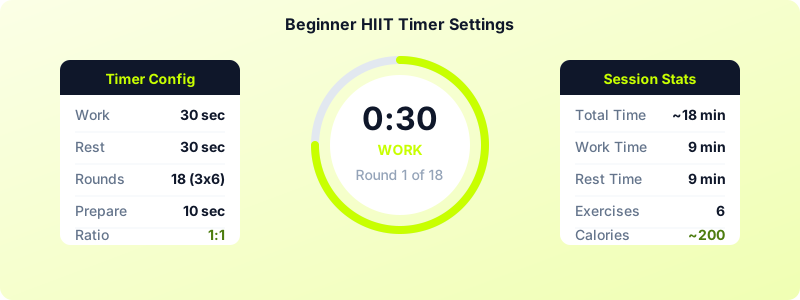
Timer settings: 30 seconds work, 30 seconds rest, 6 exercises, 3 rounds.
The exercises:
-
Bodyweight squats — Stand with feet shoulder-width apart. Lower your hips until your thighs are parallel to the floor. Push through your heels to stand back up. Keep your chest lifted and core tight throughout.
-
Incline push-ups — Place your hands on a chair, couch, or countertop. Lower your chest toward the surface, then push back up. This is easier than floor push-ups and builds the same muscles.
-
High knees (marching pace) — Stand tall and drive your knees up to hip height, one at a time. As a beginner, march at a controlled pace rather than sprinting. Speed up as you get comfortable.
-
Reverse lunges — Step one foot backward and lower your back knee toward the floor. Push through your front heel to return to standing. Alternate legs each rep.
-
Plank hold — Hold a plank position on your forearms or hands. Keep your body in a straight line from head to heels. If 30 seconds is too long, drop to your knees after 15 seconds.
-
Jumping jacks (or step-out jacks) — Perform traditional jumping jacks. If the impact bothers your joints, step one foot out to each side instead of jumping.
Rest for 60-90 seconds between rounds. By the end of three rounds, you will have completed 18 work intervals totaling 9 minutes of active exercise.
How to Set Up Your Timer for Beginner HIIT
The right timer settings make your first HIIT workout seamless. Here is how to configure each setting for a beginner-friendly experience:
Work interval: 30 seconds. This gives you enough time to perform 8-12 reps of each exercise without rushing. As you get stronger over 2-3 weeks, you can increase this to 35 or 40 seconds.
Rest interval: 30 seconds. A 1:1 work-to-rest ratio is the sweet spot for beginners. It gives your heart rate time to drop before the next effort. If you feel completely gassed after each work interval, increase rest to 45 seconds.
Rounds: 3. Three rounds of six exercises equals 18 total intervals — plenty for your first few weeks. Add a fourth round in Week 3 or 4 when the workout starts feeling manageable.
Prepare countdown: 10 seconds. This gives you time to get into position before the first exercise starts. Use it to take a deep breath, set your feet, and focus.
If you need help configuring these settings, check out our guide on how to set up your interval timer for step-by-step instructions.
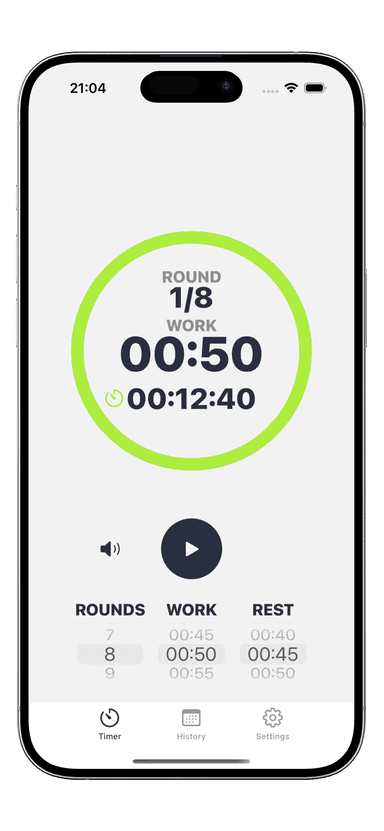
Interval Timer makes this setup simple — just enter your work time, rest time, and number of rounds. Save it as a preset called "Beginner HIIT" so you can start your workout in two taps next time.
Beginner HIIT Mistakes That Slow Your Progress
Avoid these common errors that trip up most beginners in their first few weeks:
Going too hard on day one. You do not need to train at 100% intensity in your first session. Aim for 70-80% effort during work intervals. You should be breathing hard but still able to maintain proper form.
Skipping rest periods. Rest exists for a reason — it lets your muscles recover so you can maintain quality in the next interval. Cutting rest short leads to sloppy form and higher injury risk.
Doing HIIT every day. Your muscles need 48 hours to recover from high-intensity training. Two to three HIIT sessions per week is ideal for beginners. Fill the other days with walking, stretching, or light movement.
Choosing exercises that are too advanced. Burpees, box jumps, and tuck jumps are not beginner exercises. Stick with squats, lunges, push-ups, and marching high knees until you build a solid foundation.
Not warming up first. Spend 3-5 minutes warming up with light movement before you hit start on your timer. Arm circles, leg swings, and a brisk walk around the room prepare your joints and muscles for the work ahead.
How to Progress Your HIIT Workout Each Week
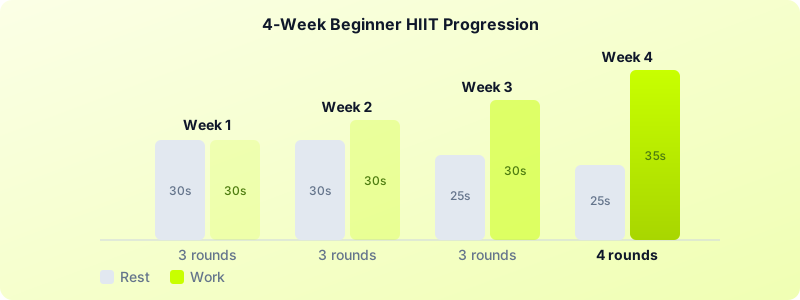
Your body adapts quickly to interval training. Use this four-week progression plan to keep challenging yourself without overdoing it:
Week 1-2: 30 seconds work / 30 seconds rest / 3 rounds. Focus on learning each exercise with good form. Rate of perceived exertion: 6-7 out of 10.
Week 3: 30 seconds work / 25 seconds rest / 3 rounds. Shorten rest by 5 seconds. This small change increases the total work density without adding volume.
Week 4: 35 seconds work / 25 seconds rest / 4 rounds. Extend work by 5 seconds and add a fourth round. Your total workout time grows from 15 minutes to about 20 minutes.
Beyond Week 4: Continue adjusting one variable at a time. Add a round, shorten rest, extend work, or swap in harder exercise variations. The key is changing only one thing per week so your body has time to adapt.
Track each workout in your training history so you can see exactly how your timer settings have progressed. That visual proof of improvement is one of the best motivators to keep going.
Your First HIIT Session Starts Now
You do not need a gym membership, fancy equipment, or years of experience to start a HIIT workout for beginners at home. You need 15 minutes, enough floor space to do a lunge, and a timer that keeps you honest.
Download Interval Timer and load the beginner HIIT preset — then press start and let the timer guide your first session from warm-up to cool-down.