What Is Tabata Training? The Complete Guide

What is tabata training, and why does a workout that lasts only four minutes deliver results that rival hour-long cardio sessions? Tabata is a specific high-intensity interval training protocol: 20 seconds of all-out effort followed by 10 seconds of rest, repeated for 8 rounds. That is 4 minutes of total work, and it is backed by decades of exercise science proving it improves both aerobic and anaerobic fitness simultaneously.
Developed by Japanese researcher Dr. Izumi Tabata in 1996, this protocol was originally designed for Olympic speed skaters. Today it is one of the most popular and time-efficient workout formats in the world. Here is everything you need to know to understand it, try it, and benefit from it.
The Origin of Tabata Training
The tabata protocol was born at the National Institute of Fitness and Sports in Tokyo. Dr. Izumi Tabata was analyzing training methods used by head coach Koichi Irisawa with the Japanese Olympic speed skating team. The athletes were doing short, brutally intense intervals on stationary bikes, and the results were extraordinary.
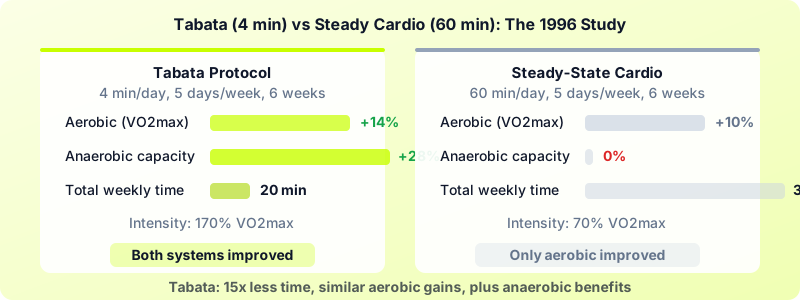
In 1996, Dr. Tabata published the landmark study that put the protocol on the map. His team compared two groups over six weeks. Group one performed moderate-intensity cycling at 70% of VO2max for 60 minutes, five days per week. Group two performed the 20-on, 10-off protocol at 170% of VO2max for just four minutes, five days per week.
The results were remarkable. The moderate-intensity group improved their aerobic capacity but saw zero improvement in anaerobic capacity. The tabata group improved their aerobic capacity by a similar amount and increased their anaerobic capacity by 28%. Four minutes of tabata matched 60 minutes of steady cardio for aerobic gains — and crushed it for anaerobic fitness.
How the Tabata Protocol Works
The tabata protocol follows a strict structure that never changes:
- Work interval: 20 seconds at maximum intensity
- Rest interval: 10 seconds of complete rest
- Rounds: 8
- Total time: 4 minutes
The key word is maximum intensity. Dr. Tabata's original study used 170% of VO2max — a pace so intense that most subjects could barely complete the final two rounds. If you can comfortably finish all 8 rounds, you are not going hard enough.
What makes tabata different from regular HIIT? The difference between tabata and HIIT comes down to structure and intensity. HIIT is a broad category with flexible work-rest ratios. Tabata is one specific HIIT protocol with fixed 20/10 intervals at near-maximal effort. Every tabata workout is HIIT, but not every HIIT workout is tabata.
The 2:1 work-to-rest ratio is critical. The 10-second rest is short enough that your body never fully recovers between rounds. This forces both your aerobic and anaerobic energy systems to work simultaneously — which is the secret behind tabata's dual benefit.
You can use any exercise for tabata as long as it allows you to reach true maximal effort. Cycling, sprinting, burpees, mountain climbers, and kettlebell swings are all popular choices. Check out these tabata exercises for beginners if you are just getting started.
Science-Backed Benefits of Tabata Training
Three decades of research have confirmed what Dr. Tabata discovered in 1996. Here are the proven benefits:
Improved VO2max. VO2max is the gold standard measure of cardiovascular fitness. A 2023 meta-analysis found that tabata-style training improved VO2max by an average of 12.9% over 4-8 weeks. For context, most steady-state cardio programs improve VO2max by 5-10% over the same timeframe.
Increased anaerobic capacity. Your anaerobic system powers short, explosive movements — sprinting, jumping, lifting heavy. The original study showed a 28% increase in anaerobic capacity, and subsequent research has consistently replicated this finding.
Enhanced fat oxidation. A 2025 study published in Scientific Reports found that two cycles of tabata (8 minutes total) maximized fat oxidation during the post-exercise recovery period. Participants burned significantly more fat in the 10 minutes after exercise compared to a single cycle.
Time efficiency. Four minutes of tabata provides measurable fitness improvements. Even if you add a warm-up and cool-down, the total session is under 15 minutes. No other training method delivers comparable results in less time.
EPOC afterburn effect. The extreme intensity creates a large oxygen debt that your body must repay after the workout. This excess post-exercise oxygen consumption (EPOC) elevates your metabolic rate for hours after the session, burning additional calories at rest.
Who Should and Should Not Do Tabata
Tabata is powerful, but it is not for everyone. Be honest about where you fall on this spectrum.
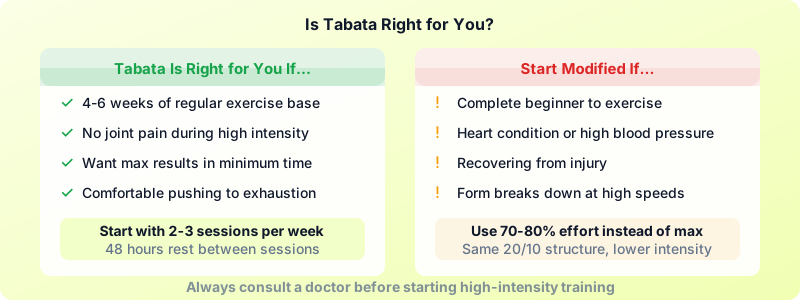
Tabata is right for you if:
- You have at least 4-6 weeks of regular exercise under your belt
- You can sustain high-intensity effort without joint pain
- You want maximum results in minimum time
- You are comfortable pushing to true exhaustion
Tabata is not ideal if:
- You are a complete beginner with no exercise base
- You have heart conditions or uncontrolled blood pressure
- You are recovering from an injury
- You cannot maintain proper form at high speeds
Start with modified tabata if you are new. Instead of 170% of VO2max, aim for 70-80% of your max heart rate. The structure stays the same — 20 seconds on, 10 seconds off, 8 rounds — but the intensity is manageable. As your fitness improves over 2-3 weeks, gradually increase your effort level.
Limit tabata to 2-3 sessions per week. The protocol creates significant stress on your muscles and nervous system. Allow at least 48 hours between tabata sessions. Fill the remaining days with strength training, mobility work, or light cardio.
How to Start Tabata Training With a Timer
A precise timer is non-negotiable for tabata. The 20/10 intervals must be exact — guessing the timing defeats the purpose of the protocol.
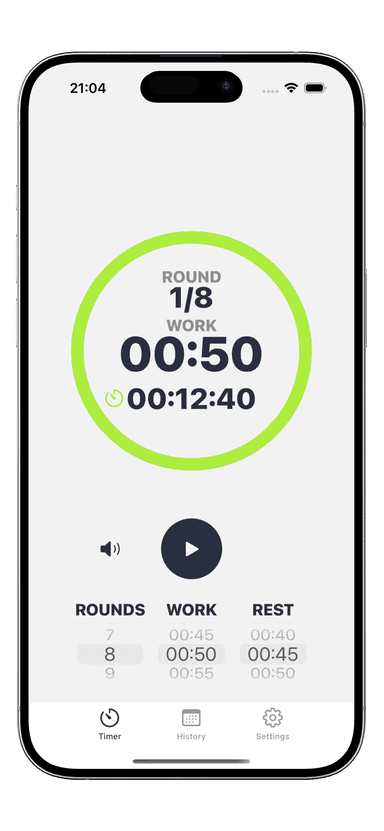
Set up your timer. Open your Interval Timer app and configure: 20 seconds work, 10 seconds rest, 8 rounds. Save this as your "Tabata" preset. The total countdown will read 4 minutes.
Choose your exercise. For your first tabata session, pick a single full-body exercise you can perform safely at high speed. Bodyweight squats, mountain climbers, or rowing machine sprints are excellent starting choices.
Follow this session structure:
- Warm up for 3-5 minutes with light cardio and dynamic stretches
- Start your tabata timer
- Go all-out for 20 seconds when the work buzzer sounds
- Rest completely for 10 seconds when the rest buzzer sounds
- Repeat for all 8 rounds
- Cool down for 3-5 minutes with walking and light stretching
Progress over time. Once a single 4-minute tabata feels manageable, try a 4-minute tabata workout with different exercises each round. Advanced practitioners can stack 2-3 tabata blocks with 2 minutes of rest between blocks for a 12-15 minute session.
The Interval Timer app tracks every tabata session in your workout history, so you can see your frequency and ensure you are getting adequate recovery between sessions.
Tabata training proves that effective workouts do not require hours of your time. Four minutes of genuine all-out effort, timed precisely, delivers results that most people spend ten times longer trying to achieve.
Download Interval Timer and set up the perfect 20/10 tabata timer for your next session.