Tabata vs HIIT: What Is the Difference?
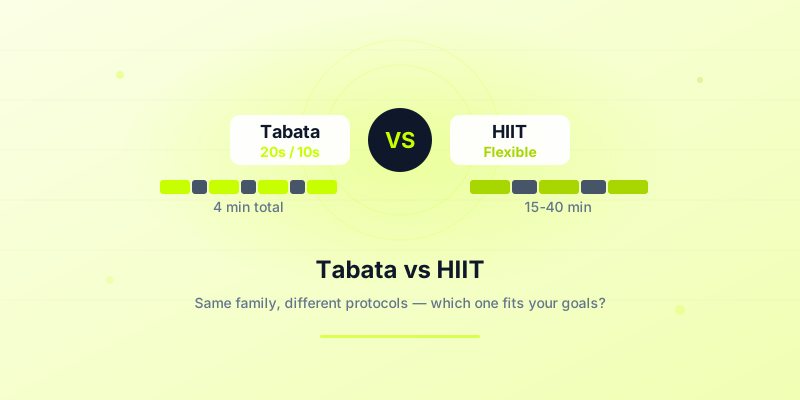
Tabata and HIIT get used interchangeably so often that most people assume they are the same thing. They are not. Tabata is a specific type of HIIT with a fixed structure, while HIIT is a broad category that includes dozens of interval formats. Understanding what makes Tabata vs HIIT different — and what is the difference in terms of results — helps you pick the right protocol for your goal and your schedule.
The short version: all Tabata is HIIT, but not all HIIT is Tabata. The details below explain why that distinction matters for your training.
What Is HIIT and How Does It Work?
HIIT stands for high-intensity interval training. It describes any workout that alternates between bursts of near-maximal effort and periods of low-intensity recovery or complete rest.
The format is intentionally flexible. A HIIT session can use work intervals anywhere from 20 seconds to 4 minutes, rest intervals from 10 seconds to 2 minutes, and total session lengths from 10 to 40 minutes. You can run, cycle, swim, lift weights, or do bodyweight circuits — all under the HIIT umbrella.
What defines HIIT is not the specific timing but the intensity pattern: push hard, recover, repeat. Your heart rate during work intervals should hit 80-95% of your max. During rest, it drops back down before the next burst.
This oscillation trains your cardiovascular system, boosts VO2max, and creates a significant afterburn effect (EPOC) that keeps your metabolism elevated for hours after you stop. For a structured starting point, try a beginner HIIT workout with 30-second work and 30-second rest intervals.
What Is Tabata and Where Did It Come From?
Tabata is a specific HIIT protocol created by Japanese researcher Dr. Izumi Tabata in 1996. His original study compared moderate-intensity steady-state cardio (70% VO2max for 60 minutes) to a high-intensity interval protocol (170% VO2max for 4 minutes) — and the interval group improved both aerobic and anaerobic fitness more than the endurance group.
The Tabata protocol follows a rigid formula:
- 20 seconds of all-out effort (close to 100% max intensity).
- 10 seconds of complete rest.
- Repeat 8 times for a total of 4 minutes.
That is it. No flexibility in timing, no moderate-intensity option. The 2:1 work-to-rest ratio and the demand for maximum effort are what make Tabata distinct — and brutally effective.
In practice, most people stack 2-4 Tabata blocks with 1-2 minutes of rest between them, creating a 12-20 minute session. Each block can target different exercises or muscle groups. For exercise ideas, check the beginner Tabata exercises guide.
Tabata vs HIIT: The Key Differences
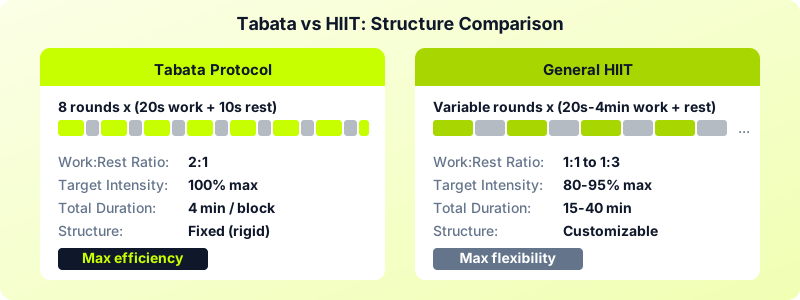
Here is a side-by-side breakdown of how these two protocols compare:
| Feature | Tabata | General HIIT | |---|---|---| | Work interval | 20 seconds (fixed) | 20 seconds to 4 minutes | | Rest interval | 10 seconds (fixed) | 15 seconds to 2 minutes | | Work:rest ratio | 2:1 | 1:1 to 1:3 | | Target intensity | 100% max effort | 80-95% max effort | | Session length | 4 minutes per block | 15-40 minutes | | Flexibility | Rigid protocol | Highly customizable | | Best for | Time efficiency, anaerobic power | Overall fitness, adaptable goals |
The biggest practical difference is flexibility. HIIT adapts to any fitness level — you can adjust intervals, rest periods, and intensity to match your current ability. Tabata demands the same structure every time. You can scale the exercise choice (bodyweight squats instead of jump squats), but the 20/10 timing and 8-round format stay constant.
The second difference is intensity. True Tabata requires genuine all-out effort — the kind where speaking a full sentence during the work interval is impossible. Many HIIT formats use a sustainable high intensity (80-90% max) that allows for longer sessions.
Which Burns More Fat — Tabata or HIIT?
Both protocols are excellent for fat loss, but they achieve it through slightly different mechanisms.
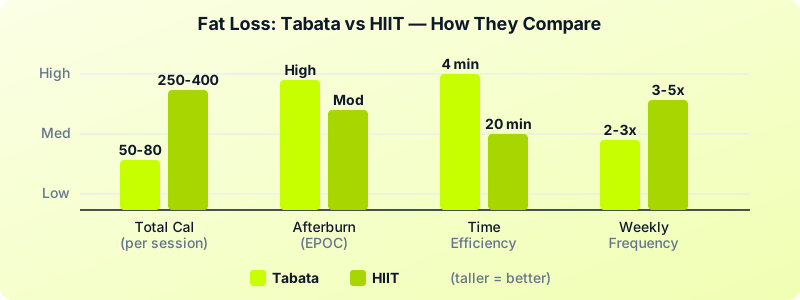
Total calories during the session: A 20-minute HIIT workout burns approximately 250-400 calories depending on body weight and intensity. A single 4-minute Tabata block burns roughly 50-80 calories. Even stacking three Tabata blocks (12 minutes) rarely matches a full-length HIIT session for total calorie expenditure.
Afterburn effect (EPOC): This is where Tabata fights back. The extreme intensity of 20/10 intervals at max effort creates a larger EPOC response relative to session length. A 2024 study found that the Tabata group exhibited a significantly higher fat oxidation rate compared to a standard HIIT group during both exercise and recovery phases.
The practical verdict:
- If you have 20-30 minutes, HIIT burns more total calories and is sustainable 3-4 times per week.
- If you have 4-12 minutes, Tabata is more time-efficient per minute of exercise.
- For maximum fat loss results, alternate both throughout the week. Your body adapts to repeated stimuli, so varying the protocol keeps results coming.
Neither protocol works without consistency. The best fat-loss workout is the one you actually do three times a week.
How to Set Up Your Timer for Both
Programming either protocol into a timer takes about 30 seconds. Here is how to set up your interval timer for each:
Tabata timer setup:
- Work interval: 20 seconds
- Rest interval: 10 seconds
- Rounds: 8 (one block = 4 minutes)
- For multiple blocks: add a 60-second rest between blocks and repeat
HIIT timer setup (beginner-friendly 1:1 ratio):
- Work interval: 30 seconds
- Rest interval: 30 seconds
- Rounds: 12-15 (total 12-15 minutes)
- Add a 3-minute warm-up and cool-down timer
HIIT timer setup (advanced):
- Work interval: 40 seconds
- Rest interval: 20 seconds
- Rounds: 10-12 (total 10-12 minutes)
- Higher intensity with shorter rest
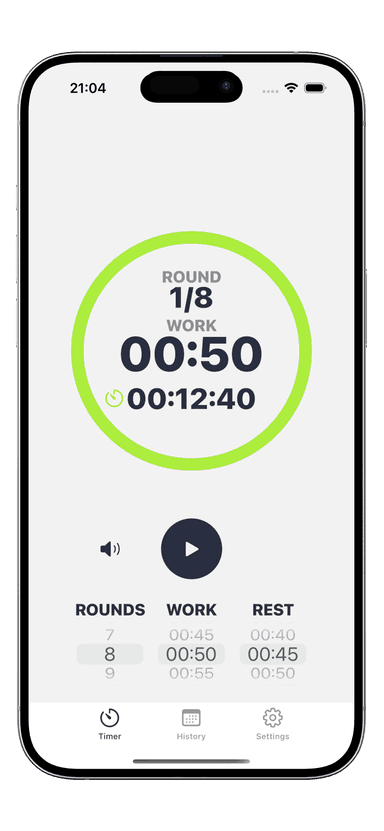
The Interval Timer app has a built-in Tabata preset, so you can start a classic 20/10 session with a single tap. For HIIT, save your preferred intervals as custom presets and switch between them depending on the day.
The best approach is not choosing Tabata or HIIT exclusively — it is using both at the right times. Train Tabata on short days when you need maximum efficiency. Train HIIT on days when you have more time and want a longer burn. Your timer handles the structure; you handle the effort.
Download Interval Timer and switch between Tabata and HIIT workouts with one tap.