HIIT Workout for Seniors Over 60: Low-Impact Interval Training Guide
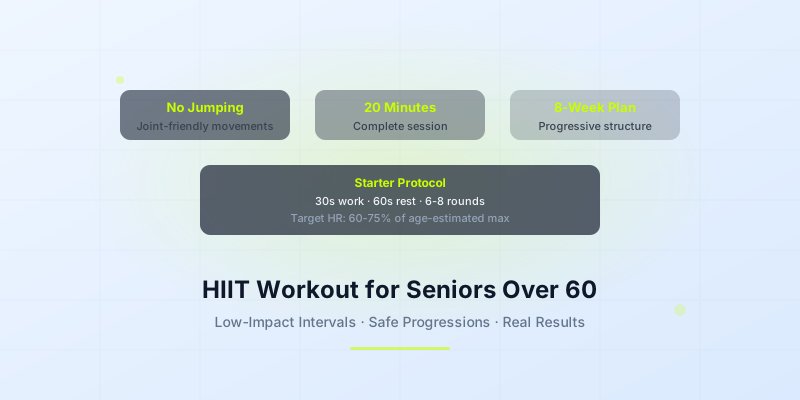
HIIT for seniors over 60 is not the same as HIIT for a 30-year-old. The principles are identical — alternating higher-effort intervals with recovery — but the movements, intensities, and recovery periods adapt to an older body's needs. Done correctly, interval training is one of the most effective tools available for maintaining cardiovascular health, muscle mass, and functional fitness as you age.
Here's the science, the safe movement options, and a practical low-impact HIIT protocol specifically designed for people over 60.
Why Interval Training Is Especially Valuable After 60
Aging brings predictable physiological changes that interval training directly counteracts:
VO2 max declines at approximately 10% per decade after age 30 in sedentary individuals. Regular interval training slows this decline significantly — and can partially reverse it. Studies show that adults over 65 who performed interval training 3 times per week improved VO2 max by 6-12% over 12 weeks.
Muscle mass decreases (sarcopenia) accelerates after 60. Interval training that includes resistance elements — bodyweight squats, step-ups, resistance band work — provides the muscle stimulus needed to slow this process.
Metabolic rate slows. Interval training generates the afterburn effect (EPOC) that steady-state walking does not, helping maintain healthy body composition over time.
Balance and coordination can be maintained and improved through regular movement variety. HIIT that includes single-leg work, directional changes, and functional patterns builds proprioception alongside cardiovascular fitness.
The key difference for seniors: intensity is relative. A "hard" interval for a 65-year-old who hasn't exercised in years might be brisk walking that elevates heart rate to 70-75% of maximum. That's sufficient to generate adaptation. The goal is elevated effort relative to your baseline — not matching what you could do at 35.
Low-Impact Movements for Senior HIIT
The following movements provide cardiovascular challenge without high joint impact. None require jumping, running, or heavy equipment.
Lower body:
- Seated leg raises (chair-assisted)
- Standing squats to chair (sit-to-stand)
- Side steps / lateral shuffles
- Step-ups on a low, stable platform (4-6 inches)
- Marching in place (knees lifted)
Upper body:
- Resistance band rows
- Wall push-ups or countertop push-ups
- Overhead press with light dumbbells (2-5 kg)
- Arm circles and shoulder mobility flows
Full body (low impact):
- Standing mountain climbers (hands on wall or counter)
- Slow-motion standing burpees (no jump, no floor work)
- Sit-to-stand with arm reach
- Walking lunges (short stride, hand on wall for balance)
What to avoid initially: Floor-based exercises requiring kneeling or getting up and down from the floor — these are appropriate progressions once base fitness improves, not starting points for those returning to exercise.
Low-Impact Senior HIIT Protocol
This 20-minute protocol is appropriate for adults over 60 who are moderately active (walking regularly) but new to structured interval training.
Warm-up (5 minutes):
- 2 minutes gentle marching in place
- 1 minute arm circles and shoulder rolls
- 1 minute slow leg swings (hold chair for balance)
- 1 minute slow sit-to-stands
Interval block (10 minutes):
- Work: 30 seconds moderate effort
- Rest: 60 seconds easy walking or standing
- Rounds: 6-8
Movement rotation across rounds:
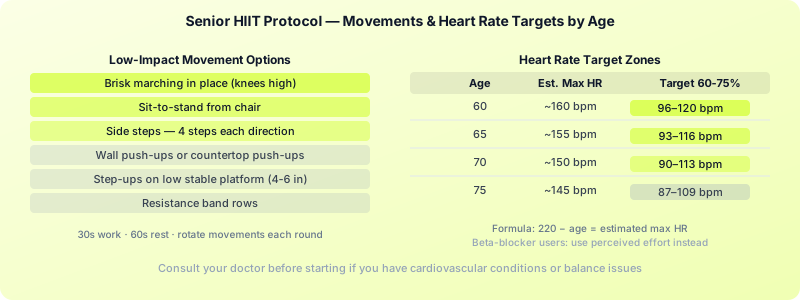
- Brisk marching (knees high)
- Sit-to-stand (from chair)
- Side steps (4 steps each direction)
- Wall push-ups
- Step-ups on low platform
- Resistance band rows (or seated arm press)
Cool-down (5 minutes):
- 2 minutes slow walking
- 3 minutes gentle stretching (hamstrings, hip flexors, shoulders)
Total session: ~20 minutes. Heart rate target during work intervals: 60-75% of age-estimated maximum (roughly 220 minus your age).
Setting Up an Interval Timer for Senior Training
The work/rest cycle in senior HIIT tends to have longer rest periods than standard HIIT. A 1:2 work-to-rest ratio (30 seconds work, 60 seconds rest) is appropriate for beginners. Progress to 1:1 (30/30) over 6-8 weeks as fitness improves.
Setting these intervals manually is difficult and distracting during a workout. An interval timer provides audio cues — a beep or voice prompt — that tell you when to start and stop each interval without watching a screen.
Timer settings for the protocol above:
- Work interval: 30 seconds
- Rest interval: 60 seconds
- Rounds: 8
- Preparation countdown: 10 seconds before first interval
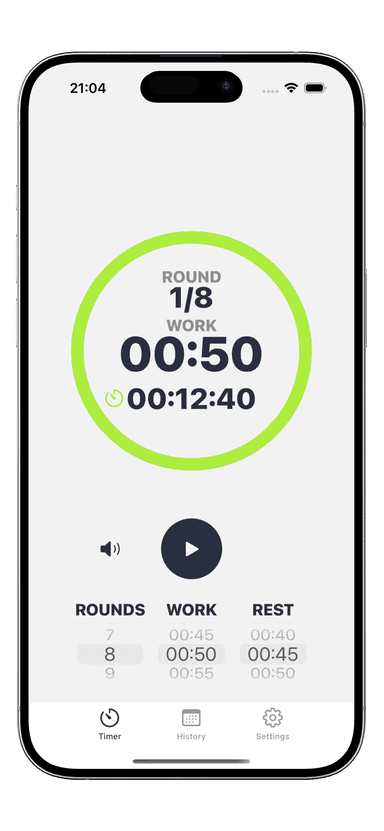
The Interval Timer app runs on iPhone and can be set on a nearby surface so you hear the audio cues clearly. No need to hold or watch the phone during the session.
Heart Rate Monitoring for Safety
For seniors, monitoring heart rate adds an important safety layer. The age-estimated maximum heart rate formula (220 minus age) gives a rough ceiling:
- Age 60: max ~160 bpm, target zone 96-128 bpm (60-80%)
- Age 65: max ~155 bpm, target zone 93-124 bpm
- Age 70: max ~150 bpm, target zone 90-120 bpm
- Age 75: max ~145 bpm, target zone 87-116 bpm
During work intervals, aim for the upper half of your target zone. During rest, let heart rate drop back toward the lower end before the next interval begins.
Consult your doctor before starting if you have cardiovascular disease, have been sedentary for more than a year, take beta-blockers (which affect heart rate response), or have any condition affecting balance or joint stability.
Progression Over 8 Weeks
The how to program your own workout schedule framework applies here — start conservatively, build gradually, and reassess every two weeks.
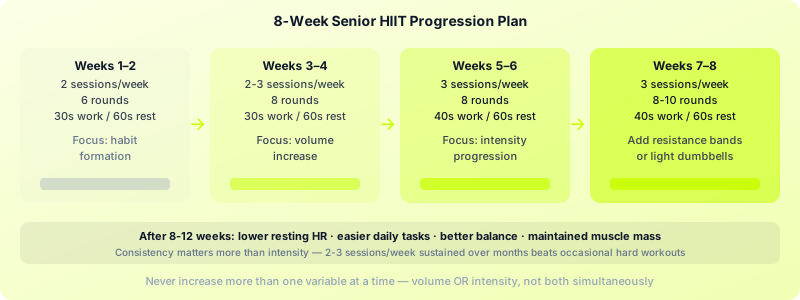
Weeks 1-2: 2 sessions per week, 6 rounds, 30s/60s work-rest ratio Weeks 3-4: 2-3 sessions per week, 8 rounds, same ratio Weeks 5-6: 3 sessions per week, 8 rounds, progress to 40s/60s Weeks 7-8: 3 sessions per week, add one slightly more challenging movement per session (e.g., replace wall push-ups with countertop push-ups)
After 8 weeks, most people are ready to introduce light resistance (resistance bands or 2-4 kg dumbbells) and progress toward the dumbbell HIIT format using lighter weights.
Benefits You Can Expect After 8-12 Weeks
Research consistently shows that adults over 60 who complete 8-12 weeks of structured interval training achieve:
- Improved resting heart rate (lower = better cardiovascular efficiency)
- Easier completion of daily tasks (climbing stairs, carrying groceries)
- Better balance and reduced fall risk
- Maintained or improved muscle mass compared to same-age peers
- Improved insulin sensitivity and metabolic health markers
The critical factor is consistency. Two to three sessions per week, maintained over months, produces cumulative results that no single hard workout session can replicate.
Download Interval Timer to run structured senior HIIT intervals — set your 30/60 work-rest cycle and let the audio guide each interval so you can focus entirely on movement quality.