Kettlebell Swing HIIT Workout: Timed Interval Protocols That Work
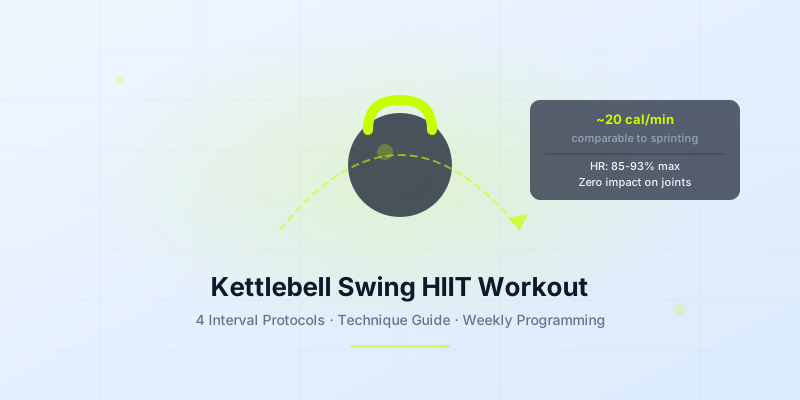
The kettlebell swing is one of the most efficient exercises in existence. A single movement trains the posterior chain (glutes, hamstrings, lower back), builds cardiovascular fitness, and burns calories at a rate comparable to running — all in a movement you can do in a living room with one piece of equipment. When combined with timed HIIT intervals, it becomes a complete conditioning tool.
Here's the technique, the research, and the interval protocols to structure effective kettlebell swing HIIT sessions.
Why the Kettlebell Swing Works for HIIT
The swing is a hip hinge movement driven by explosive hip extension. It's not a squat, and it's not an arm exercise — the bell is propelled by glute and hamstring power, not shoulder lifting.
What makes it exceptional for HIIT:
- High muscle recruitment: The posterior chain is the largest muscle group in the body. Training it with explosive movement generates significant metabolic demand and calorie burn.
- Cardiovascular demand at low joint stress: Studies show heart rate during kettlebell swings reaches 85-93% of maximum — equivalent to sprint intervals — without the impact loading of running.
- Power development: The explosive hip hinge builds hip power that transfers directly to running, jumping, and athletic performance.
- Short rest tolerance: Unlike barbell lifting, swings can be sustained through timed intervals without complete CNS failure, making them ideal for HIIT structure.
A 2010 study in the Journal of Strength and Conditioning Research found that a 20-minute kettlebell snatch protocol burned approximately 20 calories per minute — comparable to elite-level cross-country skiing.
Kettlebell Swing Technique
Before programming intervals, the swing must be learned correctly. Poor technique — especially a squatty swing where the bell drops between the knees — loads the lower back instead of the glutes.
The hip hinge setup:
- Stand with feet shoulder-width apart, kettlebell on the floor about 30cm in front of you
- Hinge at hips (not squat) — push your hips back while keeping a flat back
- Grip the handle with both hands, thumbs wrapped around fingers
- Tilt the bell toward you by pulling the handle — this loads the lats and creates tension
The swing:
- Take a short backswing, letting the bell swing between your legs (not below the knees — between the upper thighs)
- Explosively drive hips forward — snap the glutes at the top
- The bell floats to chest/shoulder height; you're not pulling it up with your arms
- Let gravity bring it back down, hinging at hips to absorb the backswing
- Immediately drive hips forward again for the next rep
Key cues: "Hike, hinge, hips" — hike the bell back, hinge at the hips, then drive hips forward. The arms remain relatively passive; they guide the bell rather than lift it.
Kettlebell Size Guidelines
Starting too heavy destroys technique; too light removes the training stimulus.
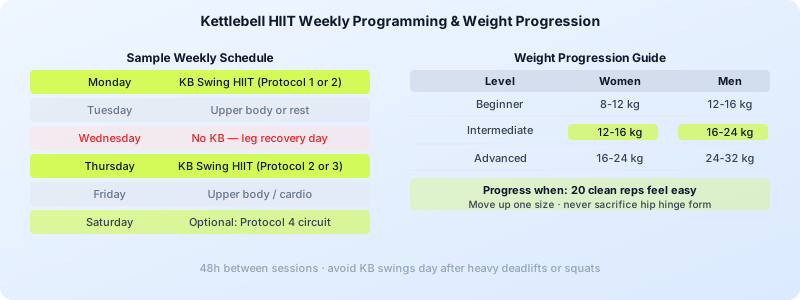
| Fitness Level | Women | Men |
|---|---|---|
| Beginner | 8-12 kg | 12-16 kg |
| Intermediate | 12-16 kg | 16-24 kg |
| Advanced | 16-24 kg | 24-32 kg |
For HIIT intervals specifically, use a weight where you can perform 15-20 consecutive swings with perfect form. If form breaks before 15 reps, the weight is too heavy for interval work.
Kettlebell Swing HIIT Protocols
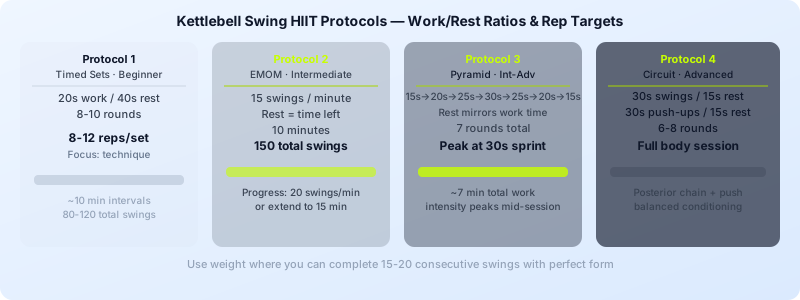
Protocol 1: Simple Timed Sets (Beginner)
Structure:
- Work: 20 seconds of swings
- Rest: 40 seconds
- Rounds: 8-10
- Total time: ~10 minutes of intervals (15-20 min with warm-up/cool-down)
Target: 8-12 swings per 20-second interval. Focus on technique over speed.
Protocol 2: 10-Minute Swing Challenge (Intermediate)
Based on the "Russian kettlebell challenge" format:
- Every minute on the minute (EMOM): perform 15 swings
- Remaining time in the minute = rest
- Duration: 10 minutes (= 150 total swings)
As fitness improves, increase to 20 swings per minute or extend to 15 minutes.
Protocol 3: Swing/Rest Pyramid (Intermediate-Advanced)
- Round 1: 15s swing / 45s rest
- Round 2: 20s swing / 40s rest
- Round 3: 25s swing / 35s rest
- Round 4: 30s swing / 30s rest
- Round 5: 25s swing / 35s rest
- Round 6: 20s swing / 40s rest
- Round 7: 15s swing / 45s rest
Total: ~7 minutes of intervals. The ascending-descending pyramid pushes intensity at the peak while managing fatigue.
Protocol 4: Swing + Complementary Movement Circuit (Advanced)
Pair swings with an upper-body movement to create a complete conditioning circuit:
- 30s kettlebell swings
- 15s rest
- 30s push-ups or overhead press
- 15s rest
- Repeat 6-8 rounds
This format balances the posterior-chain dominance of swings with pressing work, creating a more complete session. Similar in structure to the dumbbell HIIT approach but with higher power output on the swing component.
Using an Interval Timer for Kettlebell HIIT
Timed kettlebell sets require precise interval management. Counting reps while breathing hard and maintaining swing form is difficult — a timer that handles the countdown means you focus entirely on technique and effort.
Timer setup for Protocol 2 (EMOM):
- Interval: 60 seconds repeating
- Alert at start of each minute (or set work/rest: 30s work / 30s rest if you prefer a visual split)
- Rounds: 10
Timer setup for Protocol 3 (Pyramid):
- Build each round manually as a custom sequence in your timer app
- Alternatively: set 15s/45s for the first two rounds, switch to 30s/30s at the peak
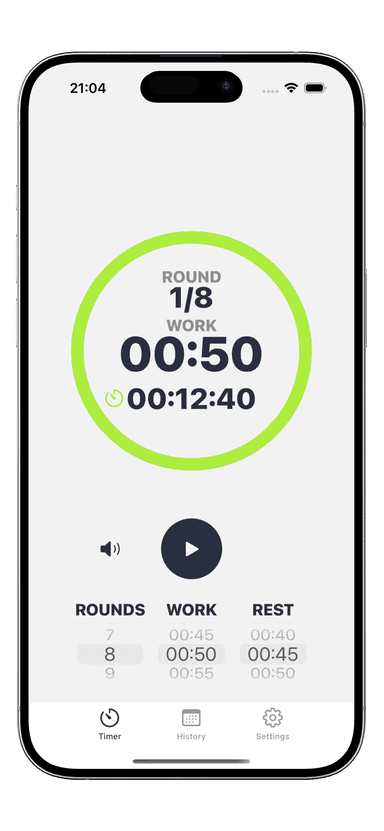
The Interval Timer app handles both EMOM and custom round sequences. Set the protocol before your session, place the phone nearby, and let audio cues guide each interval.
Programming Kettlebell Swing HIIT Into Your Week
Kettlebell swings are a posterior chain exercise — they tax the same muscles as deadlifts and Romanian deadlifts. Plan your week accordingly.
Avoid: Programming swing sessions the day after heavy squat or deadlift training. Glutes and hamstrings need 48 hours.
Pair well with: Upper body training on the same day (push-ups, rows, pressing). The swing handles lower body and cardio; upper body work rounds out the session.
Frequency: 2-3 sessions per week is appropriate for intermediate trainees. Beginners should start with 2.
As part of a structured weekly workout schedule, kettlebell swing sessions work well on the same days as other HIIT formats — alternating with stair climbing, cycling intervals, or bodyweight HIIT to vary movement patterns while maintaining training frequency.
What to Expect
After 2-4 weeks: Grip strength improves noticeably. Lower back soreness (from hip hinge loading) diminishes as glute strength catches up.
After 4-8 weeks: Hip power increases — this manifests as faster acceleration in running, higher jumps, and improved athletic movement patterns. Resting heart rate typically drops 4-8 bpm with consistent training.
After 8-12 weeks: Most intermediate trainees are ready to progress weight (one kettlebell size up) or add the single-arm swing variation, which dramatically increases the challenge by removing bilateral support and adding rotational demand.
The kettlebell swing rewards consistent, technically sound practice more than any other common HIIT exercise. A well-executed swing at moderate weight beats a sloppy heavy swing every session.
Download Interval Timer to structure your kettlebell swing intervals — build your EMOM or timed set protocol once and let the audio manage each round while you focus on power and form.