Plyometric Exercises for HIIT: The Complete Exercise List with Protocols
Plyometric exercises — movements that involve rapid stretch-shortening cycles of the muscles — are the foundation of effective HIIT training. They produce high power output in short bursts, elevate heart rate quickly, and build explosive athletic capacity that steady-state cardio never develops.
Here's the complete list of plyometric exercises organised by intensity level, with timed HIIT protocols to put them into practice.
What Makes an Exercise Plyometric
A plyometric movement has three phases:
- Eccentric loading — rapid muscle lengthening under load (the sink into a squat before jumping)
- Amortization — brief transition point where force is absorbed
- Concentric explosion — rapid muscle shortening driving the explosive movement (the jump itself)
The shorter the amortization phase, the more plyometric the movement. A slow, controlled squat-then-jump is not truly plyometric. A fast, reactive jump where you immediately rebound off the floor is.
For HIIT purposes, this means the explosive phase should be as quick and powerful as possible, with ground contact time minimised on lower body movements.
The Complete Plyometric Exercise List by Intensity
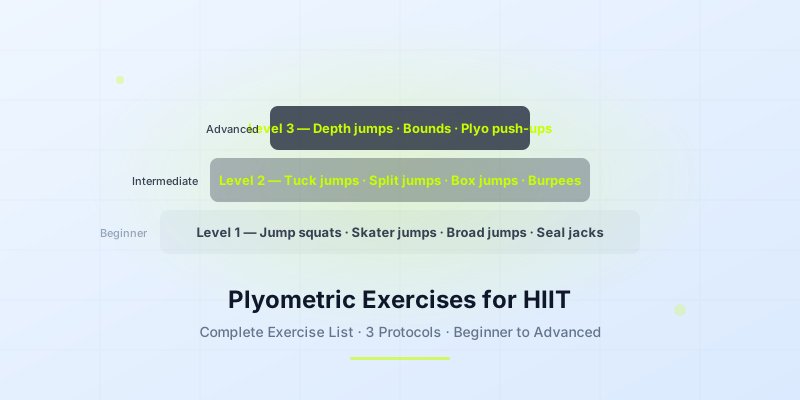
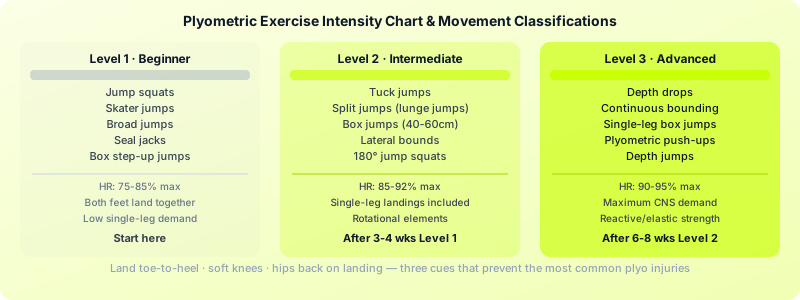
Level 1: Beginner Plyometrics (Low Impact Entry Points)
Jump squat: From a squat position, explode upward and land softly back into the squat. Focus on soft landings and full hip extension at the top. Start here if new to plyometrics.
Box step-up jump: Step up onto a low box (30-40cm), drive the trailing knee up as you step, then step back down. Adds height and hip drive without bilateral jump impact.
Skater jumps: Lateral single-leg bounds, landing on one foot and immediately bounding to the other side. Lower-impact than vertical jumps, trains lateral power.
Broad jumps: Two-footed horizontal jumps covering as much distance as possible. Land softly, reset, repeat.
Seal jacks: Like jumping jacks but arms sweep forward and back horizontally. Reduces shoulder joint stress vs. overhead jacks.
Level 2: Intermediate Plyometrics
Tuck jumps: Jump vertically and pull both knees toward the chest at the peak. Requires core strength and hip flexor power. More demanding than basic jump squats.
Split jumps (lunge jumps): From a lunge, explosively switch legs mid-air, landing in the opposite lunge. High metabolic demand, trains single-leg power.
Box jumps: Jump onto a box (40-60cm) with two feet, step down carefully. Land in a partial squat position, not fully upright. Focus on soft box landing.
Lateral bounds: Maximum-effort single-leg horizontal bounds to each side, emphasising distance covered per bound.
Burpee variations: The standard burpee with an explosive jump is a full-body plyometric combining upper and lower body power.
180-degree jump squats: Jump squat with a half-rotation in the air, landing facing the opposite direction. Adds rotational demand.
Level 3: Advanced Plyometrics
Depth drops: Step off a box (40-60cm) and absorb the landing with maximum stiffness — this teaches the nervous system to rapidly switch from eccentric absorption to concentric output.
Continuous bounding: Running with exaggerated strides, maximising air time per stride. Requires significant single-leg power and landing mechanics.
Single-leg box jumps: Box jumps performed off and onto one leg. High ankle, knee, and hip demands.
Plyometric push-ups: Push-ups where the explosive press lifts hands off the floor. Clapping push-ups are the most common variation.
Depth jumps: Step off a box, immediately jump as high as possible upon landing — the most demanding reactive plyometric. Not appropriate until box jumps and depth drops are well established.
Plyometric HIIT Protocols
Protocol 1: Beginner Plyometric Circuit (Level 1 Exercises)
Timer setup: 30s work / 30s rest, 6 exercises, 2 rounds
- Jump squats
- Skater jumps
- Broad jumps (walk back to start)
- Seal jacks
- Box step-up jumps
- Lateral shuffles
Total work time: 12 minutes. Heart rate target: 75-85% max.
Protocol 2: Intermediate Power HIIT (Level 1-2 Mix)
Timer setup: 40s work / 20s rest, 5 exercises, 3 rounds
- Tuck jumps
- Split jumps
- Skater jumps (max distance)
- Box jumps
- Burpees
Total work time: 15 minutes. Heart rate target: 85-90% max.
Protocol 3: Advanced Plyometric HIIT (Level 2-3)
Timer setup: 20s work / 10s rest (Tabata structure), 4 exercises, 2 sets each
Set 1: Depth drops + lateral bounds (alternating 20s/10s, 8 rounds) Rest: 2 minutes Set 2: Plyometric push-ups + single-leg box jumps (alternating, 8 rounds)
Total time: ~20 minutes. Extremely high intensity — not appropriate for beginners.
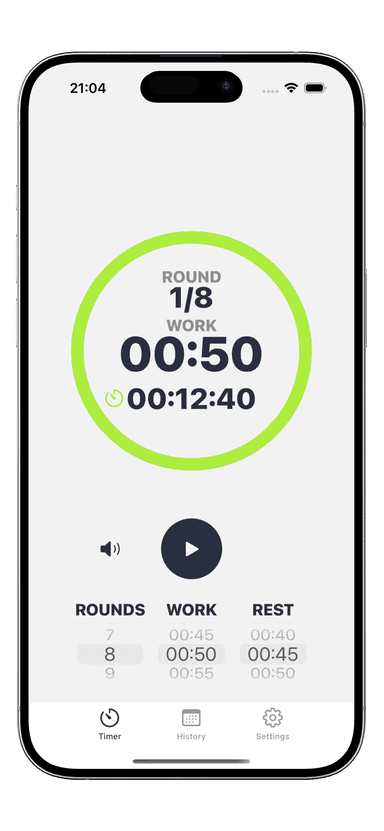
The Interval Timer app handles all three protocols. Set the work/rest cycle once, place the phone nearby, and let the audio guide each interval. For the advanced protocol with multiple exercise switches, the distinct audio tones for each interval segment help you track where you are in the sequence.
Programming Plyometrics Into Your Training Week
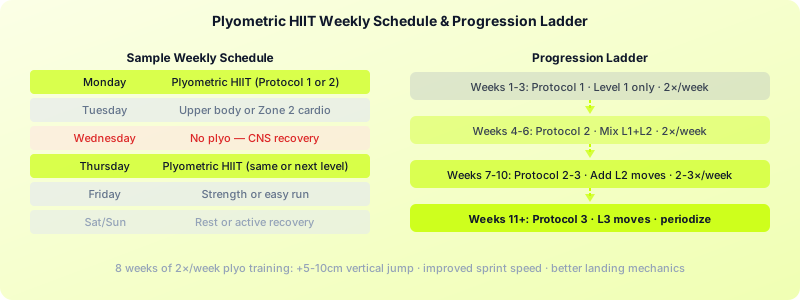
Plyometric training is neurologically demanding. Unlike steady-state cardio, the explosive movements tax the central nervous system significantly and require longer recovery.
Key rules:
- Never program plyometrics two days in a row
- Avoid combining heavy lower body strength training on the same day as lower body plyometrics
- Beginners: 2 plyometric sessions per week maximum
- Advanced: 2-3 sessions per week with adequate Zone 2 training on other days
Plyometric HIIT pairs naturally with how to program your own workout schedule — treat it like a hard HIIT session and build it into your weekly structure the same way you would any high-intensity training day.
If you're returning from a break or new to jumping, start with Level 1 exercises for 2-3 weeks before progressing. Ankle, knee, and hip joints need time to adapt to landing forces before increasing intensity.
Safety and Landing Mechanics
Plyometrics done poorly produce injuries. Three cues prevent the most common problems:
Land toe-to-heel: Foot contacts should begin at the ball of the foot, rolling back to the heel. Flat-footed or heel-first landings transfer excessive force to the knee.
Soft knees on landing: Knees should track over the toes and absorb impact by bending — never lock out knees on landing.
Hip hinge on landing: After box jumps and vertical jumps, the landing position should resemble a partial squat with hips back — not an upright, knees-forward position which loads the patella tendon excessively.
Consistent plyometric training produces rapid improvements in jump height, sprint speed, and change-of-direction ability. Studies show 8 weeks of twice-weekly plyometric training improves vertical jump by 5-10cm in recreational athletes — and cardiovascular adaptations come simultaneously from the HIIT structure.
Download Interval Timer to run structured plyometric HIIT sessions — set your work/rest cycle and let the audio cues manage each interval so you can focus entirely on explosive effort and landing technique.