Tabata 20/10 Workout: The Complete Protocol Guide
The tabata 20 seconds on 10 seconds off workout is one of the most time-efficient training methods ever studied. In just 4 minutes, this protocol can improve both your aerobic and anaerobic fitness more effectively than 60 minutes of moderate cardio — but only if you do it right.
Developed by Japanese researcher Dr. Izumi Tabata in 1996, the original protocol produced remarkable results: a 14% increase in aerobic capacity and a 28% increase in anaerobic capacity over just six weeks. The secret is not the timing alone — it is the combination of precise intervals and maximum intensity.
This guide covers the science, the best exercises, and three complete workouts you can start today.
What Is the Tabata 20/10 Protocol?
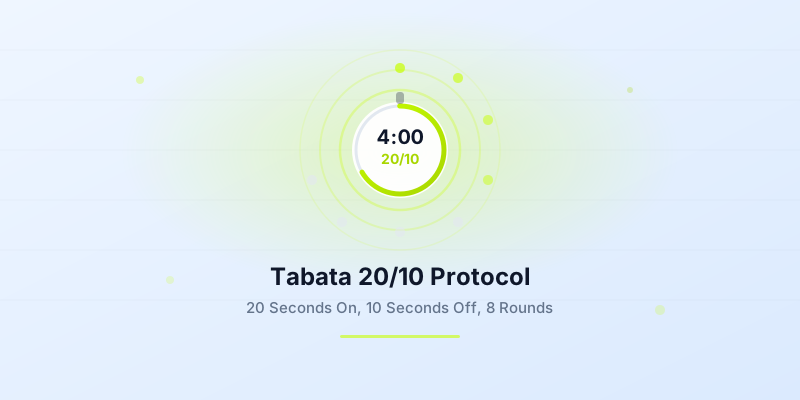
The Tabata protocol follows a strict structure:
- 20 seconds of all-out effort (170% of VO2 max in the original study)
- 10 seconds of complete rest
- 8 rounds total
- 4 minutes per block
That is it. Eight rounds of 20 seconds on, 10 seconds off, and you are done with one block. The simplicity is deceptive — those 4 minutes will feel like the longest of your life if you push the intensity where it belongs.
The 2:1 work-to-rest ratio is what separates Tabata from other interval protocols. Most HIIT workouts use a 1:1 or 1:2 ratio. Tabata flips this, giving you twice as much work as rest. Understanding your work-to-rest ratio helps you appreciate why this protocol hits differently.
The result is an oxygen debt that your body spends hours repaying, boosting your metabolism long after the workout ends.
Why 20 Seconds On and 10 Seconds Off Works
The 20/10 timing is not arbitrary. Dr. Tabata tested multiple interval combinations and found that this specific ratio produced the optimal training stimulus.
20 seconds is long enough to reach peak intensity. It takes your body 5-8 seconds to ramp up to maximum output. That leaves 12-15 seconds of actual peak effort — enough to trigger significant metabolic and cardiovascular adaptation.
10 seconds is short enough to prevent full recovery. Your heart rate drops slightly but never returns to baseline. By round 3 or 4, you start each work interval with an already elevated heart rate, which compounds the training effect.
The accumulated fatigue is the point. Each round gets harder than the last. By rounds 6-8, you are operating on pure willpower and anaerobic reserves. This progressive overload within a single session is what drives adaptation.
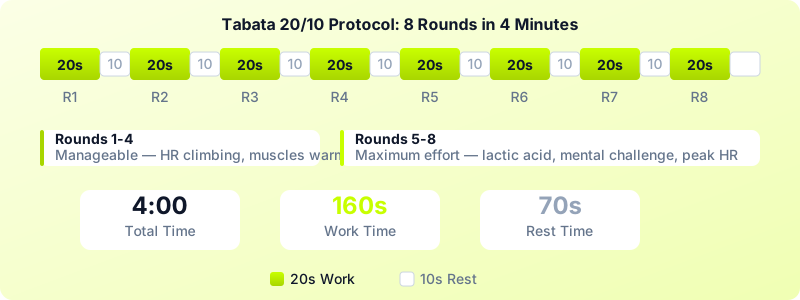
Here is what happens to your body across the 8 rounds:
- Rounds 1-2: Heart rate climbs, breathing accelerates, feels manageable
- Rounds 3-4: Lactic acid builds, muscles start burning, breathing is heavy
- Rounds 5-6: Fatigue sets in, form requires concentration, mental challenge begins
- Rounds 7-8: Maximum effort feels nearly impossible, heart rate peaks, every second counts
If rounds 7 and 8 feel comfortable, you are not pushing hard enough.
Best Exercises for a Tabata 20/10 Workout
Not every exercise works for Tabata. You need movements that allow maximum intensity without complex technique that breaks down under fatigue.
Top Bodyweight Exercises
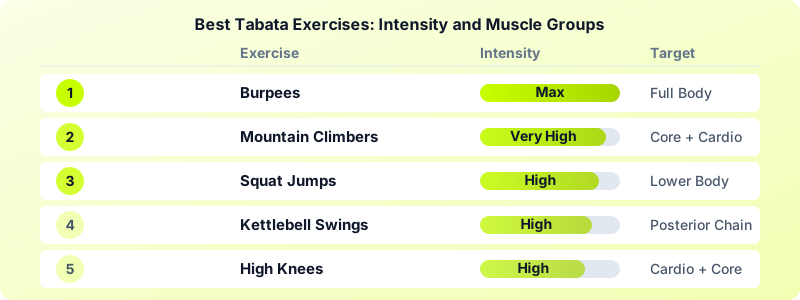
- Burpees: the gold standard for full-body Tabata intensity
- Mountain climbers: high speed, low impact on joints
- Squat jumps: explosive lower-body power
- High knees: cardio-focused, easy to push to maximum
- Jumping lunges: lower body and balance challenge
Equipment-Based Exercises
- Kettlebell swings: posterior chain power with cardio demand
- Battle ropes: upper body and core at high intensity
- Rowing sprints: full-body, joint-friendly, measurable output
- Cycling sprints: low impact, high intensity, easy to track watts
- Box jumps: explosive power with a plyometric component
Exercises to Avoid in Tabata
Skip heavy barbell lifts, complex Olympic lifts, and any exercise where form deterioration could cause injury. When you are gasping for air in round 7, you want simple, repeatable movements.
3 Complete Tabata Workouts You Can Do Today
Each workout follows the strict 20/10 protocol. If you are new to Tabata, start with Workout 1 and progress from there. Check out our beginner Tabata exercises guide if this is your first time.
Workout 1: Single-Exercise Tabata (4 Minutes)
Pick one exercise and do it for all 8 rounds:
Exercise: Burpees (or mountain climbers for lower impact)
| Round | Work | Rest |
|---|---|---|
| 1-8 | 20 seconds all-out | 10 seconds complete rest |
Total time: 4 minutes. This is the purest form of Tabata and the best way to test your intensity. Count your reps in round 1 and round 8 — if the drop is less than 30%, you can push harder.
Workout 2: Alternating Tabata (4 Minutes)
Alternate between two exercises every round:
- Odd rounds (1, 3, 5, 7): Squat jumps
- Even rounds (2, 4, 6, 8): Push-ups
This gives each muscle group a partial break while keeping overall intensity high. You will get more total work done compared to a single-exercise Tabata.
Workout 3: Multi-Block Tabata (16 Minutes)
Four Tabata blocks with 60 seconds rest between blocks:
- Block 1: Mountain climbers (8 rounds of 20/10)
- Rest: 60 seconds
- Block 2: Kettlebell swings (8 rounds of 20/10)
- Rest: 60 seconds
- Block 3: High knees (8 rounds of 20/10)
- Rest: 60 seconds
- Block 4: Burpees (8 rounds of 20/10)
Total time: 19 minutes including rest. This is a serious session — do not attempt it until you can complete a single-block Tabata at true maximum effort.
How to Set Up Your Timer for Tabata
Precise timing is non-negotiable for Tabata. Even a few extra seconds of rest changes the metabolic demand of the protocol. You need a timer that handles the 20/10 pattern automatically.
Timer Settings
- Work interval: 20 seconds
- Rest interval: 10 seconds
- Rounds: 8 (for single block) or 8 per block for multi-block
- Preparation countdown: 10 seconds (to get in position)
- Alert type: sound or vibration at each transition
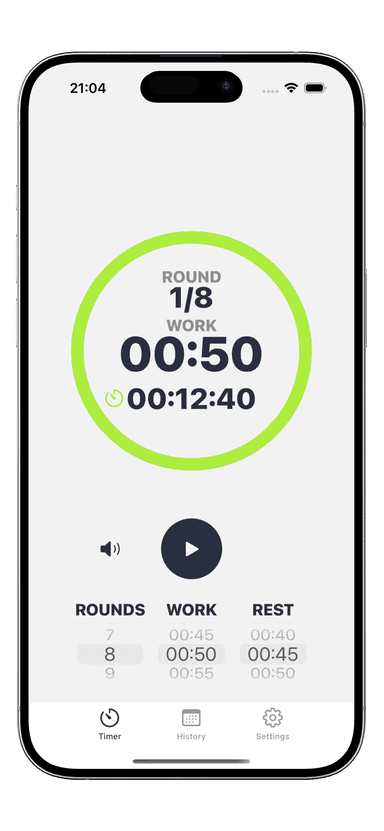
With Interval Timer, you can save the Tabata protocol as a preset and launch it with one tap. The app handles all transitions automatically, so you focus entirely on effort — not clock-watching.
For multi-block workouts, set up your interval timer with a 60-second rest period between blocks.
Tracking Your Progress
Count your reps each round. Over weeks, you should see your round-1 rep count increase and the drop-off between round 1 and round 8 decrease. Interval Timer logs your workout history, making it easy to spot trends and know when to progress.
The tabata 20 seconds on 10 seconds off workout is deceptively simple — 4 minutes of work that can transform your fitness. Respect the intensity, track your numbers, and let the timer keep you honest.
Download Interval Timer and set up the Tabata 20/10 protocol in seconds — with automatic round counting, vibration alerts, and workout history built in.