HIIT Work to Rest Ratio: A Complete Guide
Every HIIT workout lives or dies by one number: the work to rest ratio. Get it right and you torch calories, build endurance, and recover just enough to push hard again. Get it wrong and you either coast through intervals that are too easy or burn out halfway through the session. Understanding your HIIT work to rest ratio is the single fastest way to unlock better results from the same exercises you already do.
What Is a Work-to-Rest Ratio?
A work-to-rest ratio compares the length of your effort period to the length of your recovery period. If you sprint for 30 seconds and then walk for 30 seconds, your ratio is 1:1. Sprint for 40 seconds and rest for 20, and you are working at a 2:1 ratio.
The first number always represents work. The second represents rest. A higher first number means more time under tension. A higher second number means more recovery between efforts.
This ratio controls three things in your workout:
- Intensity demand — Shorter rest forces your body to work at a higher heart rate throughout the session.
- Energy system targeted — Different ratios tap into different fuel systems (aerobic vs. anaerobic).
- Total training volume — The ratio determines how many quality intervals you can complete before fatigue takes over.
A 2017 study published in the Journal of Strength and Conditioning Research found that manipulating work-to-rest ratios changed both heart rate response and rate of perceived exertion significantly, even when total work time stayed constant. The ratio matters more than most people realize.
Common HIIT Work-to-Rest Ratios and When to Use Them
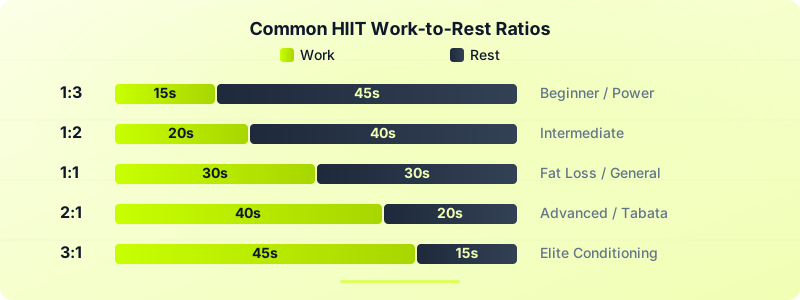
Not all HIIT ratios are created equal. Here are the five most common ratios, who they suit, and what they feel like in practice.
1:3 — Recovery-heavy (e.g., 15s work / 45s rest)
Best for true beginners and explosive power training. The long rest allows full ATP recovery between efforts, so every interval can be maximum intensity. Sprint coaches use this ratio for speed development because the athlete can hit top-end power each rep.
1:2 — Moderate recovery (e.g., 20s work / 40s rest)
A solid starting point for anyone new to interval training. You get enough recovery to maintain form but start feeling cardiovascular demand by round four or five. If you are following a beginner HIIT workout, this ratio keeps intensity manageable while still building your aerobic base.
1:1 — Equal work and rest (e.g., 30s work / 30s rest)
The most popular ratio in group fitness classes and general conditioning. It creates a strong cardiovascular stimulus without being punishing. Most people can sustain a 1:1 ratio for 20-30 minutes, making it ideal for anyone wondering about the ideal HIIT duration for fat loss.
2:1 — Work-heavy (e.g., 40s work / 20s rest)
An advanced ratio that keeps your heart rate pinned in the upper zones. You never fully recover between intervals, which drives adaptations in lactate clearance and aerobic capacity. The classic Tabata protocol (20s on / 10s off) uses this ratio at near-maximal effort.
3:1 — Minimal rest (e.g., 45s work / 15s rest)
Reserved for well-conditioned athletes. This ratio demands sustained output with almost no recovery. It builds muscular endurance and mental toughness but requires excellent movement quality to avoid form breakdown.
How to Choose the Right Ratio for Your Goals
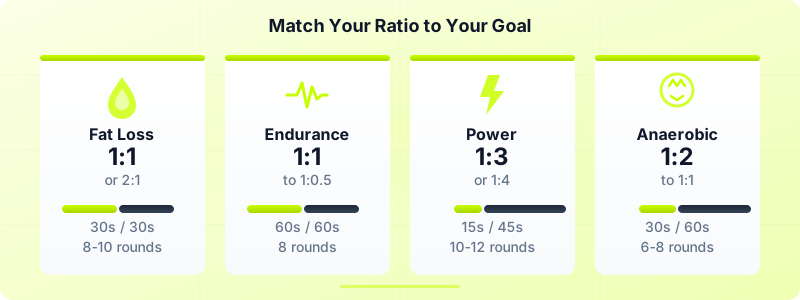
Your ideal ratio depends on what you want to achieve. Here is a breakdown by training goal.
Fat Loss: 1:1 or 2:1
Fat loss comes down to total caloric expenditure and EPOC (excess post-exercise oxygen consumption). A 1:1 ratio lets you sustain 20-30 minutes of work, maximizing total calories burned. A 2:1 ratio cranks up EPOC — research shows HIIT can elevate your metabolism for 12-24 hours post-workout, and higher work-to-rest ratios amplify this effect.
Practical setup: 30 seconds work / 30 seconds rest for 8-10 rounds. Total session time: 20 minutes including warm-up. For a complete breakdown of which HIIT timer intervals work best for weight loss, check out our dedicated guide.
Endurance and Aerobic Capacity: 1:1 to 1:0.5
Building your cardiovascular engine requires sustained time at 80-90% of max heart rate. Longer work intervals (60-120 seconds) with equal or shorter rest drive VO2max improvements. A 2019 meta-analysis found that intervals of 60 seconds or longer produced greater aerobic gains than shorter bursts.
Practical setup: 60 seconds work / 60 seconds rest for 8 rounds. Progress to 60 seconds work / 30 seconds rest over 4-6 weeks.
Power and Speed: 1:3 or 1:4
Explosive movements like box jumps, kettlebell swings, and sprints require full phosphocreatine recovery between efforts. This takes 60-90 seconds. Short work intervals (10-20 seconds) at absolute maximum effort followed by long rest develop raw power without accumulating fatigue.
Practical setup: 15 seconds all-out effort / 45 seconds rest for 10-12 rounds.
Anaerobic Capacity: 1:2 to 1:1
Training your body to tolerate and clear lactate requires work intervals of 20-40 seconds at 90-100% effort. Recovery should be long enough to attempt another hard effort but short enough that lactate levels stay elevated. This is where conditioning happens — your body learns to perform under metabolic stress.
Practical setup: 30 seconds work / 60 seconds rest for 6-8 rounds. Reduce rest by 5 seconds each week.
Work-to-Rest Ratios by Workout Type
Different training formats use specific ratios by design. Knowing these helps you pick the right timer preset.
Tabata (2:1) — 20 seconds work / 10 seconds rest, 8 rounds. Total: 4 minutes. Originally designed for elite speed skaters, this protocol has become one of the most studied formats in exercise science. It demands near-maximal effort every round.
EMOM training (variable) — Every Minute On the Minute workouts flip the ratio concept. You perform a set number of reps, then rest for whatever time remains in that minute. Faster reps mean more rest. Your ratio changes dynamically based on your speed and fatigue level.
Circuit training (1:1 to 1:2) — Rotating through 4-8 exercises with equal work and rest periods. The variety of movement patterns allows different muscle groups to recover while others work, so a 1:1 ratio feels more sustainable than it would with a single repeated exercise.
Sprint intervals (1:3 to 1:5) — Pure speed work uses the longest rest periods. A 10-second all-out sprint followed by 50 seconds of walking gives your nervous system and phosphocreatine stores time to fully reset.
Boxing rounds (varies) — Traditional boxing uses 3-minute rounds with 1-minute rest (3:1). Training rounds often use 2-minute or 90-second intervals with 30-second breaks, creating a roughly 3:1 to 6:1 work-to-rest ratio.
Setting Up Your Ratios in an Interval Timer
Knowing the right ratio is only half the battle. You need a timer that lets you program exact work and rest durations, track your rounds, and alert you when each phase changes.
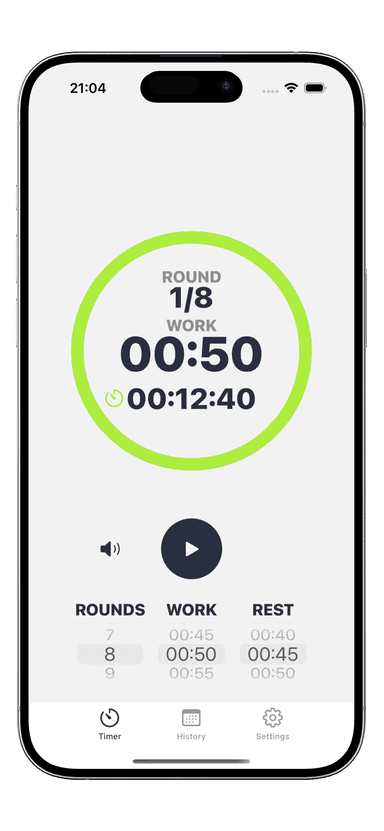
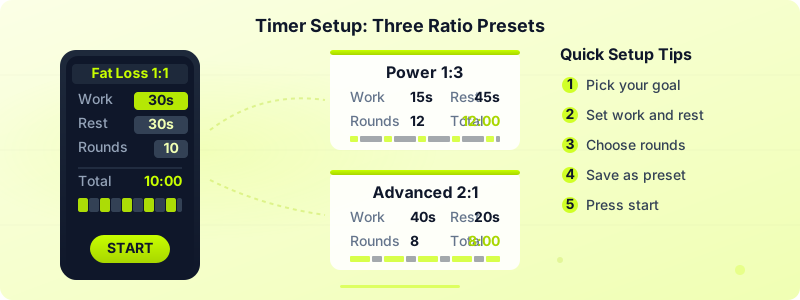
Here is how to set up three common ratio configurations in Interval Timer:
Fat Loss Setup (1:1)
- Work: 30 seconds
- Rest: 30 seconds
- Rounds: 10
- Total time: 10 minutes of intervals (plus warm-up and cool-down)
Power Setup (1:3)
- Work: 15 seconds
- Rest: 45 seconds
- Rounds: 12
- Total time: 12 minutes of intervals
Advanced Conditioning (2:1)
- Work: 40 seconds
- Rest: 20 seconds
- Rounds: 8
- Total time: 8 minutes of intervals
Save each configuration as a preset so you can switch between training goals without reprogramming your timer every session. Interval Timer lets you name and store unlimited presets, so you can build a library of ratios tailored to your weekly training plan.
Match Your Ratio to Your Reality
The best HIIT work to rest ratio is the one that matches your current fitness level and your specific goal. Start with more rest than you think you need. A 1:2 ratio builds a strong foundation without crushing you. As your conditioning improves over 3-4 weeks, shorten rest by 5-10 seconds per interval and track how your heart rate responds.
Do not chase advanced ratios for the sake of looking tough. A well-executed 1:1 session will always beat a sloppy 3:1 session where your form falls apart by round three.
Download Interval Timer and set up your first work-to-rest ratio preset — then let the timer handle the counting while you focus on the effort.