10-Minute HIIT Workout With No Rest: Full Guide
What if you could get an entire workout done in 10 minutes flat — no breaks, no downtime, just continuous effort from start to finish? A 10 minute HIIT workout no rest format does exactly that, and the results might surprise you.
Research shows that a 10-minute high-intensity session can deliver cardiovascular benefits comparable to a 50-minute moderate workout. By removing rest intervals entirely, you compress maximum effort into the shortest possible window, making this format perfect for busy mornings, lunch breaks, or days when motivation is low.
Here is your complete guide to the no-rest HIIT workout — what it is, how to do it safely, and when to use it.
What Is a No-Rest HIIT Workout?
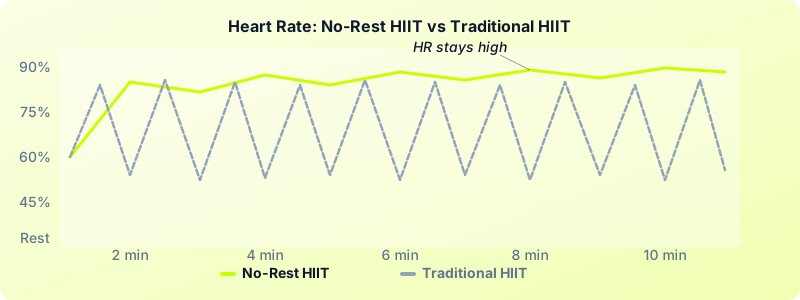
A traditional HIIT workout alternates between high-intensity bursts and recovery periods. A no-rest HIIT workout removes the recovery periods entirely, keeping you moving for the full duration.
Instead of stopping between exercises, you alternate between high-intensity and lower-intensity movements. The "rest" comes from switching to a less demanding exercise — not from standing still.
Here is how it compares:
- Traditional HIIT: 30 seconds all-out, 30 seconds standing rest, repeat
- No-rest HIIT: 30 seconds all-out, 30 seconds active movement (marching, light stepping), repeat
The key difference is that your heart rate never drops to baseline. It stays elevated throughout the entire 10 minutes, which increases total calorie burn and cardiovascular demand.
This format is also called continuous HIIT, non-stop HIIT, or density training. Whatever the name, the principle is the same — keep moving.
Benefits of a 10-Minute Non-Stop HIIT Session
Why skip the rest periods? Here are the specific advantages of continuous HIIT.
Higher calorie burn per minute. Without rest periods stealing time, every second of your workout contributes to energy expenditure. A 10-minute no-rest session can burn 80-150 calories depending on your weight and intensity — roughly the same as 20-25 minutes of jogging.
Stronger cardiovascular adaptation. Keeping your heart rate in the 80-90% zone continuously forces your cardiovascular system to work harder and adapt faster. Studies show this approach improves aerobic capacity efficiently.
Better time efficiency. Ten minutes is ten minutes. There is no padding with rest intervals, no total session time of 20 minutes for 10 minutes of actual work. You start, you work, you are done.
Lower barrier to entry. The biggest obstacle to exercise is time. Everyone can find 10 minutes, even on the busiest days. This removes the excuse entirely.
Improved mental toughness. Pushing through continuous work builds discipline that carries over to longer workouts and other areas of life.
If you are new to HIIT and want to start with a more traditional format first, try this beginner HIIT workout with standard rest periods.
The Complete 10-Minute No-Rest HIIT Workout
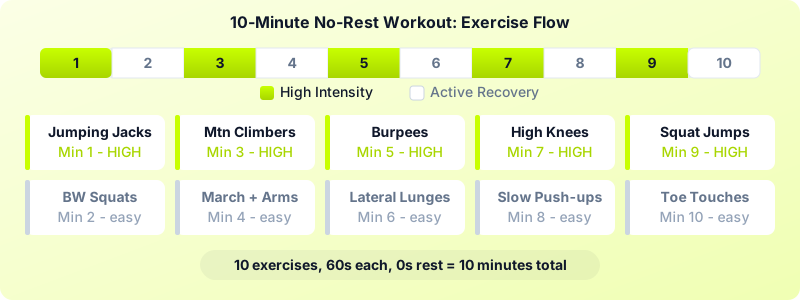
This workout uses 10 exercises performed for 60 seconds each, back to back, with zero rest. High-intensity moves alternate with active recovery moves so you can sustain the full 10 minutes.
The Workout
| Minute | Exercise | Intensity |
|---|---|---|
| 0:00-1:00 | Jumping jacks | High |
| 1:00-2:00 | Bodyweight squats | Active recovery |
| 2:00-3:00 | Mountain climbers | High |
| 3:00-4:00 | Standing marches with arm circles | Active recovery |
| 4:00-5:00 | Burpees (modified or full) | High |
| 5:00-6:00 | Lateral lunges (alternating) | Active recovery |
| 6:00-7:00 | High knees | High |
| 7:00-8:00 | Slow push-ups | Active recovery |
| 8:00-9:00 | Squat jumps | High |
| 9:00-10:00 | Standing toe touches | Active recovery |
Execution Tips
Pace your high-intensity minutes at 85-90% effort. You should be breathing hard but not gasping.
During active recovery minutes, keep moving at about 50-60% effort. The goal is to bring your heart rate down slightly without stopping.
If an exercise feels too easy during high-intensity rounds, increase your speed. If it feels impossible, swap for a lower-impact variation — step-outs instead of jumps, knee push-ups instead of full.
How to Set Up Your Timer for No-Rest HIIT
Even though there are no rest periods, you still need a timer to signal exercise transitions. Without it, you will lose track of intervals and either rush through or drag out certain exercises.
Timer Configuration
Set up your interval timer with these settings:
- Intervals: 10
- Work time: 60 seconds per interval
- Rest time: 0 seconds
- Total time: 10 minutes
- Alert: sound or vibration at each transition
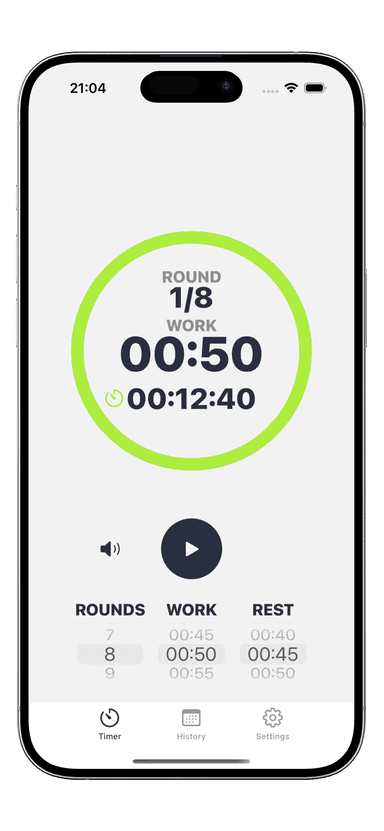
Using Interval Timer, you can save this as a custom workout and launch it with one tap. The app alerts you at each 60-second mark so you know exactly when to switch exercises — no clock-watching required.
Alternative Timer Setup (30-Second Segments)
If you prefer shorter exercise bursts, set your timer to 20 intervals of 30 seconds each. This lets you alternate between 30-second high-intensity bursts and 30-second active recovery moves for the same 10-minute total.
You can set up your interval timer with either configuration in under a minute.
When to Use No-Rest HIIT and When to Add Rest
The no-rest format is powerful, but it is not the right choice for every situation.
Use No-Rest HIIT When:
- You have exactly 10 minutes and need maximum efficiency
- You want to improve cardiovascular endurance specifically
- You are doing a bodyweight-only workout with exercise variety
- You are at an intermediate or advanced fitness level
- You want a mental challenge to break workout monotony
Add Rest Periods When:
- You are a complete beginner still building a fitness base
- You are lifting heavy weights or doing plyometrics that require maximal power output
- You are training more than 15-20 minutes total
- You feel dizzy, nauseous, or unable to maintain form
- You are targeting specific HIIT timer intervals for weight loss that require defined rest periods
Recovery Between Sessions
No-rest HIIT is demanding. Limit it to 3-4 sessions per week with at least one full rest day between sessions. Your muscles and nervous system need 48 hours to recover from high-intensity continuous work.
Pair your no-rest HIIT days with walking, stretching, or light yoga on off days for a balanced weekly routine.
The 10 minute HIIT workout no rest format proves that effective training does not require an hour at the gym. Set your timer, commit to 10 minutes of continuous effort, and let the results speak for themselves.
Download Interval Timer and create your custom no-rest HIIT workout with automatic exercise transitions, vibration alerts, and workout history to track every session.