Active Recovery Workout Between HIIT Days
You crushed yesterday's HIIT session. Today your muscles ache, your legs feel heavy, and the couch is calling. But sitting still all day is not the fastest path to recovery. An active recovery workout between HIIT days keeps blood flowing to damaged muscle fibers, flushes metabolic waste, and reduces stiffness — all without adding training stress.
Research shows that low-intensity movement after high-intensity training clears lactate faster than complete rest. The key is choosing the right exercises at the right intensity. Go too hard and you delay recovery. Go too easy and you miss the benefits. This guide gives you a structured active recovery routine that hits the sweet spot.
What Is Active Recovery and Why Does It Matter?
Active recovery means performing light, low-impact exercise on your rest days instead of doing nothing. The goal is to elevate your heart rate to 30-60% of your maximum — enough to boost circulation without triggering a new stress response.
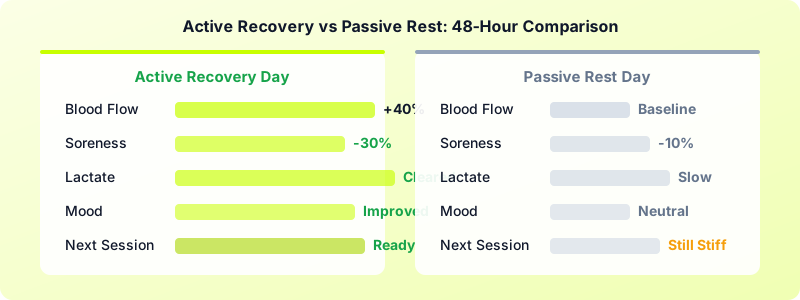
When you do HIIT, your muscles develop micro-tears that need repair. Blood delivers the oxygen, amino acids, and nutrients that fuel that repair. Light movement increases blood flow by 20-40% compared to lying on the couch, which means your muscles get more recovery fuel, faster.
Active recovery also reduces delayed onset muscle soreness (DOMS). A study published in the Journal of Strength and Conditioning Research found that participants who did 20 minutes of light cycling between intense sessions reported 30% less soreness than those who rested passively.
The mental benefits matter too. A gentle movement session breaks the cycle of stiffness and dread. Instead of dreading your next HIIT workout, you show up feeling loose, mobile, and ready to push.
Best Active Recovery Exercises Between HIIT Days
Not all light exercise qualifies as active recovery. Here are the best options ranked by effectiveness:
Walking for 20-30 minutes. The simplest and most accessible option. Walk at a comfortable pace where you can hold a full conversation. Aim for 3,000 to 5,000 steps. Walking outdoors adds the bonus of fresh air and sunlight, which support vitamin D production and mood.
Light swimming or pool walking. Water provides gentle resistance while supporting your body weight. The hydrostatic pressure from being submerged helps reduce swelling and inflammation. Even 15 minutes of easy laps makes a noticeable difference.
Yoga or gentle stretching. A 20-minute yoga flow targeting your hips, hamstrings, and shoulders opens up the areas that HIIT tightens most. Focus on poses you can hold comfortably — child's pose, pigeon pose, supine twists. Avoid power yoga or hot yoga, which are too intense for recovery days.
Light cycling at low resistance. Set a stationary bike to minimal resistance and pedal at an easy cadence for 15-20 minutes. Keep your effort below 50% of your max. Your legs should feel like they are waking up, not working.
Foam rolling for 10-15 minutes. Spend 60-90 seconds on each major muscle group — quads, hamstrings, glutes, calves, and upper back. Roll slowly and pause on tender spots. Foam rolling increases blood flow to fascia and helps restore range of motion.
A 30-Minute Active Recovery Routine You Can Follow
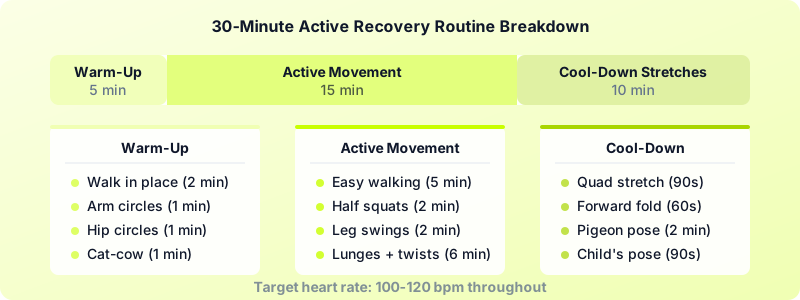
Here is a complete recovery day workout you can do at home with no equipment. Each phase serves a specific purpose in the recovery process.
Warm-up (5 minutes):
- Walk in place or gentle marching — 2 minutes
- Arm circles forward and backward — 1 minute
- Hip circles, 10 each direction — 1 minute
- Cat-cow stretches — 1 minute
Active movement (15 minutes):
- Easy walking or light step-ups — 5 minutes
- Bodyweight squats at half depth, slow tempo — 2 minutes
- Standing leg swings, 10 each leg — 2 minutes
- Light lunges with no added weight — 3 minutes
- Gentle torso rotations — 3 minutes
Cool-down stretching (10 minutes):
- Standing quad stretch — 45 seconds per side
- Seated forward fold — 60 seconds
- Pigeon pose — 60 seconds per side
- Supine spinal twist — 45 seconds per side
- Child's pose — 90 seconds
- Deep breathing in savasana — 90 seconds
Keep your heart rate in the 100-120 bpm range throughout. If you feel your breathing get heavy or your muscles start to burn, you are going too hard.
How to Time Your Active Recovery With an Interval Timer
Structure makes recovery sessions more effective. Without a timer, most people either rush through the routine or skip sections entirely.
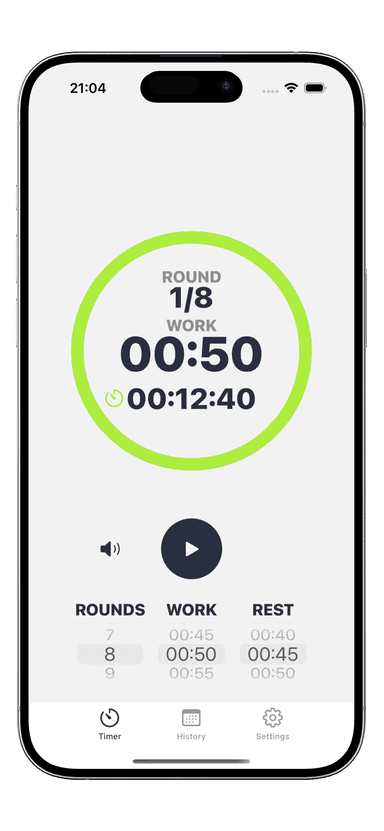
Set up timed stretching holds. Program your Interval Timer app with 45-second work intervals and 15-second transitions. This keeps each stretch at the optimal duration for flexibility gains without the guesswork of counting in your head.
Use round alerts for phase changes. Set three rounds in your timer — one for warm-up, one for active movement, and one for cool-down stretching. The audio alert tells you when to shift gears so you spend the right amount of time in each phase.
Track your rest periods between intervals. On active recovery days, your rest periods can be shorter since the intensity is low. A 45-on, 15-off pattern works well for cycling between different stretches and movements.
Log the session. Even recovery days count. The Interval Timer app records your session in your workout history, so you can see your full training week at a glance — HIIT days and recovery days included.
When to Skip Active Recovery and Take Full Rest
Active recovery is powerful, but it is not always the right call. Take a full rest day instead when:
- You have signs of overtraining like elevated resting heart rate, persistent joint pain, or disrupted sleep
- You are sick or fighting an infection — your immune system needs all available resources
- You completed three or more HIIT sessions in the past four days
- Your muscles are still significantly sore from a session two days ago
- You feel mentally exhausted and dread even light movement
A good rule of thumb: if you cannot complete a 10-minute walk without discomfort, your body needs full rest, not active recovery.
Try adding a mobility routine for rest days on those complete rest days — even five minutes of gentle mobility keeps your joints healthy without taxing your recovery.
The best training weeks balance intensity with intentional recovery. Use your HIIT days to push hard, your active recovery days to rebuild, and your rest days to fully recharge.
Download Interval Timer and program your active recovery routine with timed intervals to make every rest day count.