Rest Period Between HIIT Intervals: How Long?
Getting your rest period between HIIT intervals right can make or break your workout. Too short, and you burn out before the session ends. Too long, and your heart rate drops so far that you lose the metabolic benefits that make HIIT so effective. The sweet spot depends on your fitness level, your goals, and the type of intervals you are running.
Why Rest Periods Matter in HIIT Training
HIIT works because it pushes your body into an oxygen deficit during the work phase. Your rest period is where partial recovery happens — just enough to let you hit the next interval hard, but not so much that your heart rate returns to baseline.
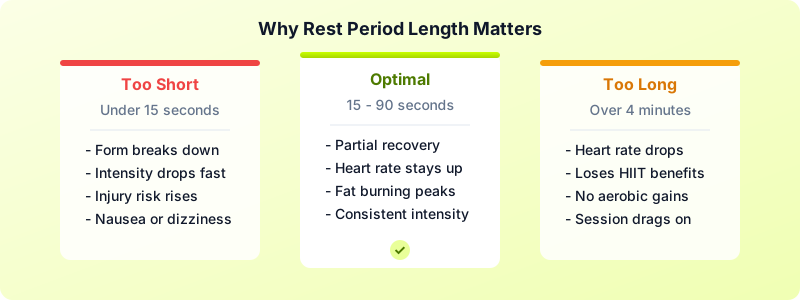
Research shows that rest periods that are too long (four minutes or more between intervals) can eliminate the aerobic gains you are training for. When your heart rate drops too far between efforts, your body loses the elevated metabolic state that drives fat burning and cardiovascular adaptation.
On the flip side, cutting rest too short leads to form breakdown, increased injury risk, and diminishing intensity across your rounds. You end up doing moderate-effort work instead of true high-intensity training.
How Long Should You Rest Between HIIT Intervals?
The most common rest period between HIIT intervals falls between 15 and 90 seconds. Where you land in that range depends on your work-to-rest ratio and fitness level.
Here are the standard ratios and what they mean in practice:
- 1:3 ratio (e.g., 20 seconds work / 60 seconds rest) — Best for true beginners or very high-intensity efforts like all-out sprints
- 1:2 ratio (e.g., 30 seconds work / 60 seconds rest) — The go-to starting point for most people new to HIIT
- 1:1 ratio (e.g., 30 seconds work / 30 seconds rest) — Intermediate level, the most popular HIIT structure
- 2:1 ratio (e.g., 40 seconds work / 20 seconds rest) — Advanced, demands strong cardiovascular fitness
- 4:1 ratio (e.g., 20 seconds work / 10 seconds rest) — Tabata protocol, reserved for experienced athletes
A practical rule: if you cannot maintain at least 80% of your max effort on the last round, your rest periods are too short. If you feel fully recovered before the rest period ends, they are too long.
Rest Period Guidelines by Fitness Level
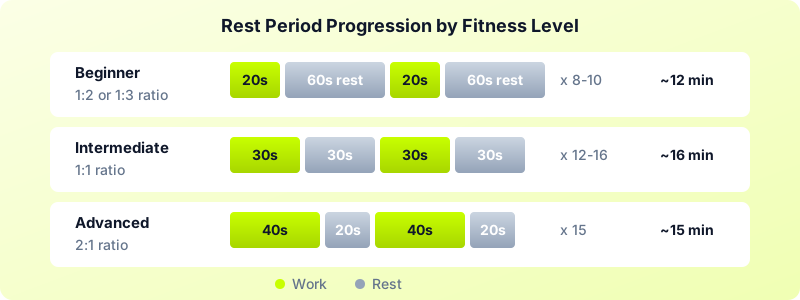
Your ideal HIIT rest time changes as your conditioning improves. Here is a progression framework:
Beginners (0-3 months of HIIT)
Start with a 1:2 or 1:3 work-to-rest ratio. A typical beginner session looks like 20 seconds of work followed by 40-60 seconds of rest, repeated for 8-10 rounds. Your total session runs about 10-15 minutes. The goal at this stage is learning proper form and building a baseline.
If you are just starting out, try a beginner HIIT workout to get the movement patterns down before worrying about optimizing rest times.
Intermediate (3-12 months)
Move to a 1:1 ratio. Work for 30 seconds, rest for 30 seconds. You can also try 40 seconds on, 20 seconds off. Aim for 12-16 rounds in a 15-20 minute session. At this stage, you should be able to keep your heart rate above 70% of max during rest periods.
Advanced (12+ months)
Experiment with 2:1 and even Tabata-style 4:1 ratios. Work periods of 30-45 seconds with rest of 10-20 seconds create extreme cardiovascular demand. Keep total session time to 20-25 minutes. Monitor your recovery — if your resting heart rate stays elevated for hours after training, you are pushing too hard.
How to Time Your HIIT Rest Periods
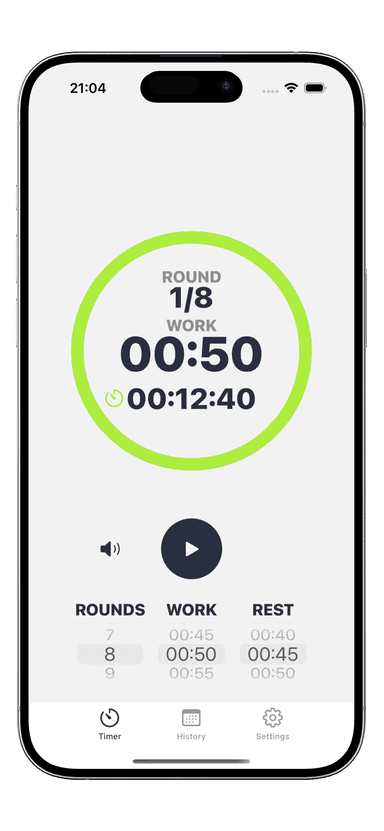
Guessing your rest periods leads to inconsistent results. A dedicated interval timer keeps you honest and takes the mental load out of your session.
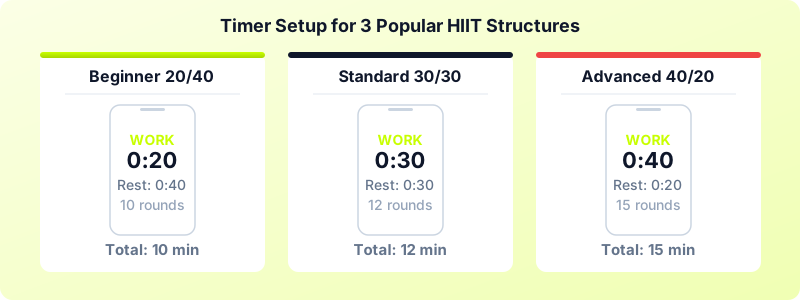
Here is how to set up your interval timer for different rest period structures:
For a 1:1 structure (30/30):
- Work interval: 30 seconds
- Rest interval: 30 seconds
- Rounds: 12
- Total time: 12 minutes
For a 1:2 beginner structure (20/40):
- Work interval: 20 seconds
- Rest interval: 40 seconds
- Rounds: 10
- Total time: 10 minutes
For an advanced 2:1 structure (40/20):
- Work interval: 40 seconds
- Rest interval: 20 seconds
- Rounds: 15
- Total time: 15 minutes
Interval Timer lets you program any work-to-rest combination, set the number of rounds, and get audio or vibration alerts so you never miss a transition. You focus on the effort while the app handles the clock.
Signs Your Rest Periods Need Adjusting
Your body gives clear signals when your interval training rest periods are off. Pay attention to these indicators:
Rest is too short:
- You cannot complete the work intervals at high intensity past round 3 or 4
- Your form breaks down (knees caving, back rounding, arms slowing)
- You feel dizzy or nauseous during the session
- Your performance drops more than 30% between the first and last round
Rest is too long:
- You feel fully recovered and bored before the rest ends
- Your heart rate drops below 60% of max during rest
- The session feels more like circuit training than HIIT
- You are not breathing hard when the next work interval starts
When to increase rest:
- After a week of poor sleep or high life stress
- During a deload or recovery week
- When learning new exercises that demand more coordination
- When increasing work interval intensity or duration
When to decrease rest:
- When the last 2-3 rounds feel just as easy as the first
- When your heart rate recovers to near-resting within 10 seconds
- When you have been at the same ratio for 3-4 weeks and want to progress
The best approach is to test a ratio for two weeks, track your performance across rounds, and adjust based on what the data tells you. Interval Timer tracks your workout history automatically, making it easy to spot trends in your session quality over time.
Find Your Perfect Rest Period
Dialing in the right rest period between HIIT intervals is not a one-time decision — it is a moving target that shifts with your fitness. Start with longer rest (1:2 ratio), prove you can sustain intensity across all rounds, then gradually shorten it. Use a timer to stay precise, and listen to your body when it tells you to adjust.
Download Interval Timer and program your ideal work-to-rest ratio for every HIIT session.