Signs of Overtraining From Too Much HIIT
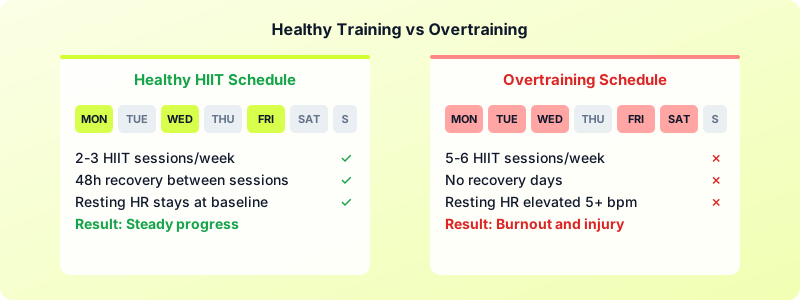
HIIT delivers incredible results in short sessions, but there is a tipping point. Push past it, and the signs of overtraining from too much HIIT start stacking up — lingering fatigue, stalled progress, and mood swings that make you dread the workout you used to love. Research shows that exceeding three to four high-intensity sessions per week without adequate recovery raises cortisol levels and suppresses your immune system.
The good news? Overtraining is reversible once you recognize the warning signs. This guide breaks down exactly what to look for, how to bounce back, and how to structure your HIIT schedule so you keep making gains without burning out.
What Is Overtraining and Why Does HIIT Cause It?
Overtraining syndrome happens when the volume and intensity of your training consistently outpace your body's ability to recover. It is not just feeling sore after a tough session — it is a chronic state where performance declines despite continued effort.
HIIT is especially prone to causing overtraining because every session pushes your cardiovascular system and muscles to near-maximum capacity. A single 20-minute HIIT workout can spike your heart rate to 85-95% of max for multiple rounds. Your nervous system needs 48 to 72 hours to fully recover from that kind of stress.
Unlike moderate-intensity exercise, HIIT triggers a significant cortisol response. Cortisol helps fuel your workout, but when levels stay elevated from back-to-back sessions, it breaks down muscle tissue and stores fat — the exact opposite of what you want.
Physical Signs You Are Doing Too Much HIIT
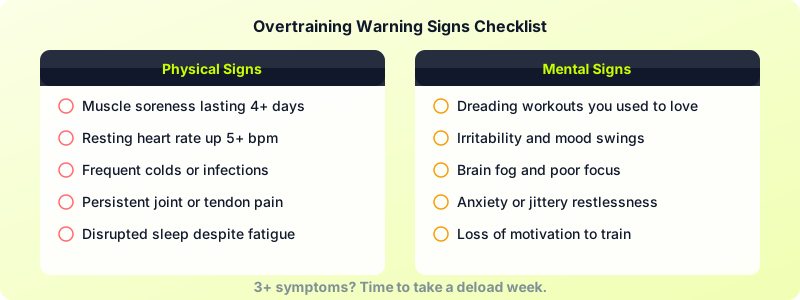
Your body sends clear signals when it needs more recovery time. Here are the physical red flags to watch for:
Lingering muscle soreness beyond 72 hours. Delayed onset muscle soreness (DOMS) typically peaks 24 to 48 hours after exercise and fades by day three. If your legs still ache four or five days after a session, your muscles are not repairing fast enough.
Elevated resting heart rate. Check your heart rate first thing in the morning before getting out of bed. An increase of five or more beats per minute above your baseline signals that your nervous system is still in overdrive. Many fitness trackers and the Apple Watch display this trend automatically.
Frequent colds and infections. Heavy training suppresses your immune system for three to 72 hours after each session — a window researchers call the "open window" period. Stack too many sessions close together and that window never fully closes.
Nagging joint pain. HIIT involves explosive movements like burpees, jump squats, and box jumps. Overloaded connective tissue does not recover as fast as muscle. Persistent knee, shoulder, or hip pain is a sign to back off.
Disrupted sleep. Excess cortisol from overtraining makes it harder to fall asleep and reduces deep sleep quality. You may feel wired at bedtime even though you are physically exhausted.
Mental and Emotional Overtraining Symptoms
Overtraining is not just physical. The mental symptoms often appear first and are easy to dismiss.
Loss of motivation. You used to look forward to your HIIT sessions. Now the thought of pressing start on your timer fills you with dread. This is your brain's protective mechanism telling you it needs a break.
Irritability and mood swings. Chronically elevated cortisol disrupts serotonin and dopamine balance. Small frustrations feel overwhelming, and you may snap at people for no reason.
Brain fog and poor concentration. Your central nervous system governs both physical performance and cognitive function. When it is overtaxed, both suffer. If you find it hard to focus at work or constantly lose your train of thought, overtraining could be the cause.
Anxiety or restlessness. Your body is stuck in fight-or-flight mode. Even on rest days, you may feel a jittery, restless energy that prevents you from relaxing.
How to Recover From HIIT Overtraining
If you recognize three or more of the symptoms above, it is time to take action. Recovery does not mean quitting — it means training smarter.
Take a full deload week. Drop your training volume by 50% and eliminate all high-intensity work for seven days. Replace HIIT sessions with walking, light yoga, or easy swimming. Your body will thank you by the end of the week.
Prioritize sleep. Aim for seven to nine hours per night. Sleep is when growth hormone peaks and muscle repair happens. Avoid screens for 30 minutes before bed and keep your room cool and dark.
Fix your rest periods between HIIT intervals. Many people cut rest periods too short in an effort to burn more calories. But incomplete recovery between rounds compounds stress across the entire session. A proper work-to-rest ratio of 1:2 or 1:3 gives your heart rate time to drop before the next round.
Reduce HIIT frequency to two sessions per week. The American College of Sports Medicine recommends no more than two to three HIIT sessions per week with at least 48 hours between them. Fill the other days with strength training, mobility work, or low-intensity cardio.
Track your resting heart rate daily. When your morning heart rate returns to baseline for three consecutive days, your body has recovered enough to resume higher intensity.
How to Prevent Overtraining With Smart Timer Use
Prevention is always easier than recovery. A well-programmed interval timer keeps your intensity structured and your rest periods honest.
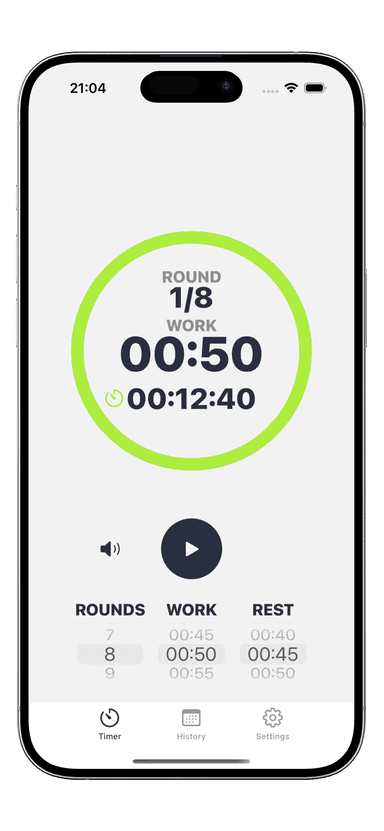
Program adequate rest intervals. Set your Interval Timer app to enforce 60 to 90-second rest periods between rounds. When you are breathing hard and the clock says rest, you rest — no exceptions. The timer removes the temptation to skip recovery.
Limit total session time. Set a hard cap of 20 to 25 minutes for your HIIT sessions. Research from the Journal of Sports Science and Medicine shows that benefits plateau beyond this window while injury risk keeps climbing. Use your timer's round counter to enforce this limit.
Use the timer for active recovery days too. Program a gentle interval sequence — 40 seconds of light movement followed by 20 seconds of rest — for recovery day mobility circuits. This keeps you moving without spiking your heart rate.
Review your workout history weekly. The Interval Timer app logs every session, so you can see at a glance if you have stacked four or five HIIT workouts into one week. If you have, swap your next planned session for a recovery day.
Overtraining from too much HIIT is common, but it is completely avoidable. Listen to your body, respect your rest days, and let your timer enforce the recovery intervals your muscles need.
Download Interval Timer and set up structured rest intervals to keep your HIIT training effective and sustainable.