Benefits of HIIT Training for Fat Loss
If your goal is fat loss, HIIT training delivers more results per minute than almost any other workout method. The benefits of HIIT training for fat loss go beyond just burning calories during the session. Your body continues working long after you stop, your metabolism stays elevated, and you hold onto the muscle that keeps you looking lean. Here is what the science actually says — and how to put it into practice.
How HIIT Burns Fat Differently Than Other Workouts
During a traditional steady-state cardio session, your body burns calories at a consistent rate and stops shortly after you finish. HIIT flips this model. By pushing your heart rate above 80 percent of maximum during work intervals, you create an oxygen debt that your body must repay afterward.
This triggers two fat-burning mechanisms that steady cardio cannot match at the same intensity:
Higher total calorie burn in less time. A 20-minute HIIT session can burn as many total calories as a 40 to 45 minute moderate jog — and sometimes more when you factor in the recovery period.
Increased fat oxidation after exercise. Studies show that fat oxidation rates are roughly 33 percent higher following HIIT compared to moderate continuous exercise. Your body shifts to burning a greater percentage of energy from fat during the hours after your workout.
This combination of in-session calorie burn plus elevated post-workout fat burning is what makes HIIT uniquely effective for fat loss. When you compare HIIT vs steady state cardio, HIIT consistently wins on time efficiency.
The Afterburn Effect and What It Really Means
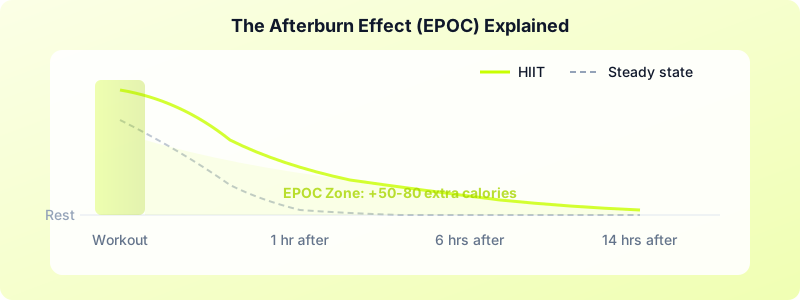
The afterburn effect — technically called EPOC (Excess Post-Exercise Oxygen Consumption) — is the most talked-about benefit of HIIT. After an intense session, your body works overtime to restore oxygen levels, repair muscle tissue, and replenish energy stores. This process burns extra calories.
Here is what the research shows:
- HIIT produces about 23 percent more calorie burn in the recovery period compared to steady-state cardio of equal duration.
- The effect is most pronounced in the first 60 minutes after exercise, but elevated calorie burn can persist for up to 14 hours.
- The extra calories from EPOC are typically 50 to 80 per session — meaningful over weeks and months, but not hundreds of calories like some marketing claims suggest.
The afterburn effect is real, but it is not magic. Think of it as a consistent bonus on top of your workout calories. Over a month of 3 HIIT sessions per week, those extra 50 to 80 calories per session add up to 600 to 960 additional calories burned — roughly the equivalent of one extra workout.
5 Proven Benefits of HIIT for Fat Loss
1. Time Efficiency
HIIT sessions typically last 15 to 25 minutes. For people with busy schedules, this removes the biggest barrier to consistent training. You do not need an hour of free time to get an effective fat-burning workout.
2. Muscle Preservation
Unlike long-duration cardio that can break down muscle tissue in a calorie deficit, HIIT activates fast-twitch muscle fibers and triggers hormonal responses that favor muscle retention. More muscle means a higher resting metabolic rate, which means you burn more calories even while sitting on the couch.
3. Improved Insulin Sensitivity
HIIT enhances your body's response to insulin, helping regulate blood sugar levels more efficiently. Better insulin sensitivity means your body is more effective at partitioning nutrients toward muscle and away from fat storage.
4. Appetite Regulation
Research suggests that HIIT may suppress appetite more effectively than moderate exercise. The intense effort temporarily reduces levels of ghrelin — the hunger hormone — which can make it easier to maintain a calorie deficit without feeling starved.
5. Cardiovascular Fitness
HIIT improves VO2 max — the maximum amount of oxygen your body can use during exercise — faster than steady-state cardio. A higher VO2 max means you can train harder in all your workouts, which accelerates fat loss across your entire program.
How to Structure HIIT for Maximum Fat Burning
Not all HIIT is equally effective for fat loss. The way you set your work-to-rest ratio directly impacts how much fat you burn.
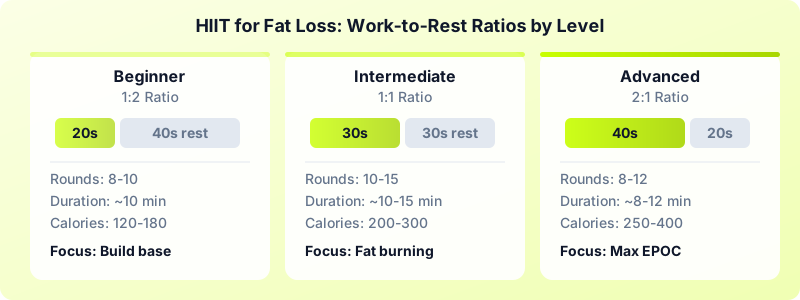
For beginners: Start with a 1:2 ratio — 20 seconds of work, 40 seconds of rest. This gives you enough recovery to maintain high intensity during every work interval. Do 8 to 10 rounds for a 10-minute session.
For intermediate: Move to a 1:1 ratio — 30 seconds of work, 30 seconds of rest. This increases the metabolic demand while still allowing partial recovery. Do 10 to 15 rounds for a 10 to 15-minute session.
For advanced: Push to a 2:1 ratio — 40 seconds of work, 20 seconds of rest. This maximizes calorie burn and EPOC but requires strong conditioning. Do 8 to 12 rounds.
Choose compound exercises that recruit large muscle groups: squat jumps, burpees, kettlebell swings, mountain climbers, and rowing sprints. The more muscle mass involved, the higher the calorie burn.
Limit HIIT to 2 to 3 sessions per week. More than that increases cortisol levels and can actually slow fat loss. Fill the remaining days with strength training and light HIIT timer intervals for weight loss or walking.
One important nuance: if you are already in a calorie deficit, the afterburn effect is reduced. Research shows that dieting can lower post-exercise calorie burn by 40 to 50 percent. This does not mean HIIT stops working — it means you should not rely on EPOC alone. Pair your HIIT sessions with a moderate calorie deficit and adequate protein intake for the best fat loss results.
Set Up Your Timer for a Fat Loss HIIT Workout
Precise timing separates effective HIIT from random high-effort exercise. When your rest periods are too long, you lose the metabolic stimulus. When they are too short, your form collapses and injury risk spikes.
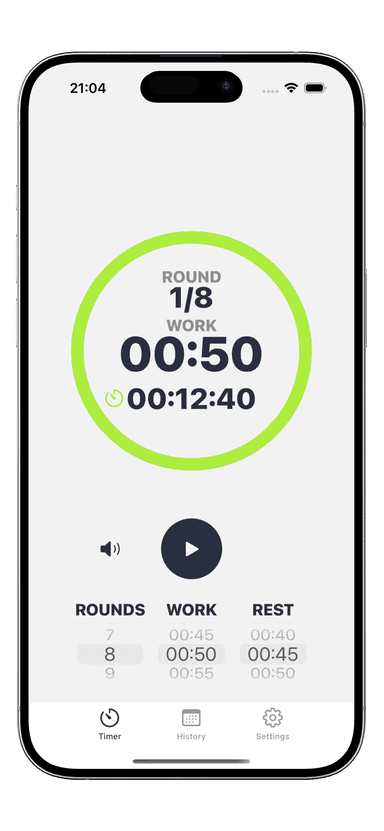
Use your Interval Timer to lock in your work and rest intervals. Set audible alerts so you can focus on maximum effort during each round without watching the clock. The timer handles the pacing — you handle the intensity.
A simple fat loss circuit to try today: set your timer for 30 seconds work, 30 seconds rest, 12 rounds. Alternate between squat jumps and push-ups. Finish in 12 minutes and enjoy the afterburn for hours.
The benefits of HIIT training for fat loss are backed by solid research — but only if you actually do the workouts consistently. Pick a schedule, set your timer, and show up.
Download Interval Timer and build your own fat-burning HIIT workouts with custom intervals and workout tracking.