Best Work Rest Ratios for Different Fitness Goals
Every interval workout hinges on one decision: how long you work and how long you rest. Get the best work rest ratios for different fitness goals right, and you train the exact energy system that drives results. Get them wrong, and you either burn out too fast or coast through sessions that barely move the needle.
This guide breaks down the science-backed ratios for fat loss, strength, endurance, and power — plus the exact timer settings you can plug into your next session.
Why Your Work-to-Rest Ratio Matters More Than You Think
Your body uses different fuel systems depending on how long and how hard you push. Short, explosive efforts (under 10 seconds) tap the phosphagen system. Efforts lasting 30-90 seconds rely on anaerobic glycolysis. Anything longer shifts toward aerobic metabolism.
The rest period between intervals determines which system recovers — and which system you train. A 1:1 ratio (equal work and rest) keeps your heart rate elevated and trains cardiovascular endurance. A 1:5 ratio gives your phosphagen system full recovery so you can repeat max-effort sprints.
Here is the principle in one sentence: shorter rest builds endurance and burns fat, while longer rest builds strength and power.
That is why copying someone else's workout without matching the ratios to your goal often backfires. A powerlifter resting 30 seconds between heavy sets will fail. A runner resting 3 minutes between 400-meter repeats will not improve VO2max. The ratio is the training variable that aligns your effort with your outcome.
For a deeper look at how these ratios apply specifically to HIIT, read the work-to-rest ratio explained guide.
Best Work Rest Ratios for Fat Loss
Fat loss training needs to maximize calorie burn during and after your session. The afterburn effect (excess post-exercise oxygen consumption, or EPOC) increases when you keep rest periods relatively short compared to work periods.
Recommended ratios:
- Beginner fat loss: 1:2 ratio — 30 seconds work, 60 seconds rest. This gives you enough recovery to maintain form while keeping total session intensity high.
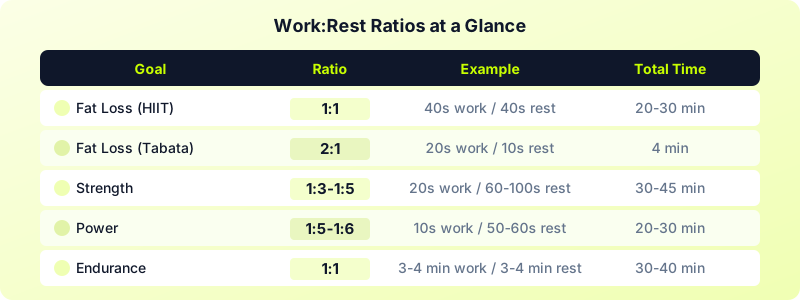
- Intermediate fat loss: 1:1 ratio — 40 seconds work, 40 seconds rest. A meta-analysis of HIIT studies found that equal work-to-rest intervals produced significant reductions in body fat percentage over 8-12 weeks.
- Advanced fat loss (Tabata): 2:1 ratio — 20 seconds all-out, 10 seconds rest. Dr. Izumi Tabata's original protocol showed greater fat loss and aerobic improvement in just 4 minutes compared to 60 minutes of moderate cardio.
The sweet spot for most people is the 1:1 ratio at moderate-to-high intensity. It is sustainable for 20-30 minutes, burns 250-400 calories per session, and creates enough EPOC to elevate your metabolism for hours after you stop.
If you are new to interval training, start with a beginner HIIT workout using the 1:2 ratio before progressing to 1:1.
Best Work Rest Ratios for Strength and Power
Strength and power training targets your phosphagen and anaerobic systems, which need longer recovery between efforts. Cutting rest short here means cutting load — and load is what drives strength gains.
Recommended ratios:
- Strength (heavy compound lifts): 1:3 to 1:5 ratio — 20 seconds of work (a set of 3-5 reps), followed by 60-100 seconds of rest. For sets above 85% of your one-rep max, extend rest to 2-3 minutes.
- Power (Olympic lifts, plyometrics): 1:5 to 1:6 ratio — 10 seconds of maximal effort, followed by 50-60 seconds of rest. Full phosphagen recovery takes roughly 30 seconds, but nervous system recovery needs more.
- Hypertrophy (muscle building): 1:2 ratio — 30-40 seconds of work (a set of 8-12 reps), followed by 60-90 seconds of rest. This creates enough metabolic stress while allowing sufficient recovery for the next set.
The common mistake is rushing through strength workouts. If you are training for a heavier squat or deadlift, those 2-3 minutes of rest are not laziness — they are letting your creatine phosphate stores refill so you can actually hit your target weight.
Use an interval timer to enforce consistent rest periods. Without one, most people either rest too long (checking their phone) or too short (feeling guilty about standing around).
Best Work Rest Ratios for Endurance and Conditioning
Endurance training with intervals focuses on improving VO2max, lactate threshold, and aerobic capacity. The key is spending more total time at high intensity than steady-state training allows.
Recommended ratios:
- Aerobic base building: 1:1 ratio — 3 minutes work at 80-85% max heart rate, 3 minutes active recovery. This trains mitochondrial density and capillarization.
- VO2max intervals: 1:1 ratio — 4 minutes at 90-95% max heart rate, 4 minutes easy. Classic Billat-style intervals that push your aerobic ceiling.
- Lactate threshold: 2:1 ratio — 8-10 minutes at tempo pace, 4-5 minutes recovery. Longer work bouts at threshold intensity teach your body to clear lactate faster.
- Sprint conditioning: 1:3 ratio — 30 seconds all-out, 90 seconds recovery. This builds anaerobic capacity and fast-twitch fiber endurance.
Runners, cyclists, and rowers benefit most from the 1:1 ratio at longer intervals (3-5 minutes). Shorter intervals with less rest (like 30/30 or 40/20) are better for general conditioning and sport-specific fitness.
How to Set Up Your Timer for Any Ratio
Once you know your target ratio, programming it into a timer takes less than a minute. Here is how to set up your interval timer for each goal:
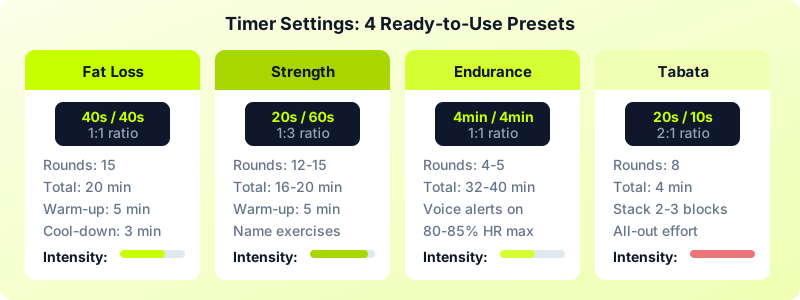
Fat loss (1:1 — 40s/40s):
- Work interval: 40 seconds
- Rest interval: 40 seconds
- Rounds: 15 (total 20 minutes)
- Add a 5-minute warm-up and 3-minute cool-down
Strength (1:3 — 20s/60s):
- Work interval: 20 seconds
- Rest interval: 60 seconds
- Rounds: 12-15 (adjust based on exercise count)
- Optional: name each exercise so the timer calls them out
Endurance (1:1 — 4min/4min):
- Work interval: 4 minutes
- Rest interval: 4 minutes
- Rounds: 4-5 (total 32-40 minutes)
- Use voice alerts to announce each phase
Tabata (2:1 — 20s/10s):
- Work interval: 20 seconds
- Rest interval: 10 seconds
- Rounds: 8 (total 4 minutes)
- Stack multiple Tabata blocks with 1-minute rest between them
The Interval Timer app lets you save each of these as a preset, so you can switch between fat-loss and strength ratios with one tap. No mental math, no guessing — just pick your goal, hit start, and train.
Download Interval Timer and dial in the exact work rest ratio for your fitness goal today.