Bodyweight Interval Training at Home: Full Guide
You do not need a gym membership, a rack of dumbbells, or even a pair of shoes to build serious fitness. Bodyweight interval training at home strips away every excuse and leaves you with the two things that actually matter: your body and a clock. In a space no bigger than a yoga mat, you can burn 300-500 calories, build functional strength, and improve cardiovascular health in under 30 minutes.
This guide covers everything you need to get started — from the best exercises and complete workouts to a weekly schedule that keeps you progressing without burning out.
What Is Bodyweight Interval Training?
Bodyweight interval training combines two proven fitness principles. First, you use your own body as resistance — push-ups, squats, lunges, and similar movements that build real-world strength. Second, you structure those exercises into timed intervals of work and rest instead of counting reps.
A typical format looks like this: perform an exercise at high intensity for 30 seconds, rest for 15-30 seconds, then move to the next exercise. Repeat for a set number of rounds. The timer drives the workout, not a rep count.
This approach keeps your heart rate elevated throughout the session, which triggers a metabolic effect called excess post-exercise oxygen consumption (EPOC). Your body continues burning calories at an elevated rate for hours after you finish. Research published in the British Journal of Sports Medicine found that interval training produced 28.5% greater reductions in body fat compared to steady-state cardio — and that held true for beginners and advanced athletes alike.
If you are new to this format, check out our HIIT workout for beginners for a gentle starting point.
Benefits of Training at Home With Intervals
Training at home with intervals offers advantages that a traditional gym session cannot match.
Time efficiency. A 20-minute at home interval workout delivers cardiovascular and strength benefits that would take 40-50 minutes of steady-state exercise. You spend less time working out and more time recovering.
Zero equipment cost. Every exercise in this guide uses your bodyweight alone. No dumbbells, no bands, no pull-up bar. Your living room floor is the entire gym.
Scalable intensity. The same exercise works for a beginner and an advanced athlete. A squat at a controlled pace is a strength builder. A squat jump at maximum speed is an explosive power exercise. You choose the intensity that matches your level.
Privacy and convenience. No commute, no waiting for equipment, no self-consciousness. You train on your schedule, in your space, wearing whatever you want.
Consistent progression. Because the timer controls your work and rest periods, you can track improvement objectively. Last week you did 8 push-ups in 30 seconds. This week you did 10. That is measurable progress.
10 Best Bodyweight Exercises for Interval Training
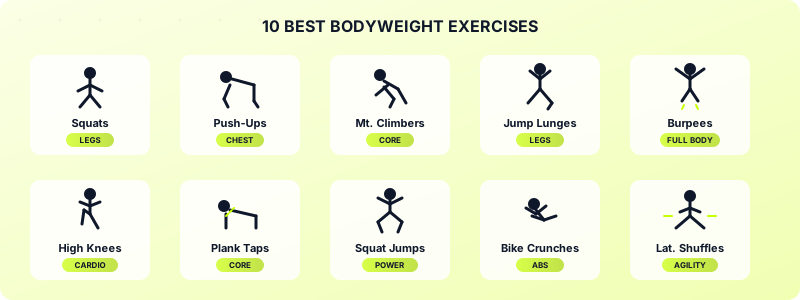
These ten movements cover every major muscle group and range from low-impact to explosive. Mix and match them to build your own no equipment interval training sessions.
-
Bodyweight squats — Stand with feet shoulder-width apart, lower your hips until thighs are parallel to the floor, and drive back up. Targets quads, glutes, and core.
-
Push-ups — Start in a high plank position and lower your chest to the floor. Modify on your knees or elevate your hands on a chair if needed. Works chest, shoulders, and triceps.
-
Mountain climbers — From a high plank, drive your knees toward your chest in a running motion. This one fires up your core, hip flexors, and shoulders while spiking your heart rate.
-
Jumping lunges — Step into a lunge position and explode upward, switching legs in mid-air. Builds lower body power and balance. Step-back lunges are the low-impact alternative.
-
Burpees — Drop to the floor, perform a push-up, jump your feet forward, and explode upward. The ultimate full-body interval exercise. Skip the push-up or the jump to scale down.
-
High knees — Run in place, driving your knees to hip height with each step. Keep your core tight and arms pumping. Great for cardio conditioning.
-
Plank to shoulder taps — Hold a high plank and tap your opposite shoulder with each hand, alternating sides. Builds core stability and shoulder endurance without any impact.
-
Squat jumps — Perform a regular squat and explode upward at the top. Land softly with bent knees. A powerful plyometric that targets your quads and glutes.
-
Bicycle crunches — Lie on your back, hands behind your head, and bring opposite elbow to opposite knee in a pedaling motion. Targets your obliques and rectus abdominis.
-
Lateral shuffles — Drop into a half-squat and shuffle side to side across your space. Engages your inner and outer thighs, glutes, and improves lateral agility.
3 Complete At-Home Interval Workouts (Beginner to Advanced)
Each bodyweight HIIT workout below uses exercises from the list above. Set your timer, press start, and follow along.
Beginner: The Foundation (15 minutes)
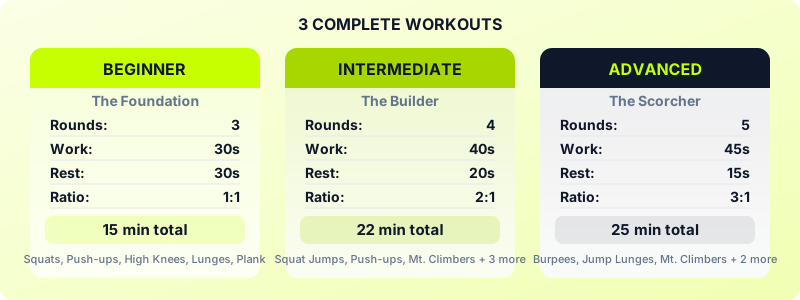
Timer settings: 30s work / 30s rest, 5 exercises, 3 rounds. Rest 60s between rounds.
- Bodyweight squats
- Incline push-ups (hands on a chair)
- High knees (marching pace)
- Reverse lunges (alternating)
- Plank hold
Total time: 15 minutes plus warm-up. This workout eases you in with a 1:1 work-to-rest ratio and no jumping. For more on choosing the right intervals, read our work-to-rest ratio guide.
Intermediate: The Builder (22 minutes)
Timer settings: 40s work / 20s rest, 6 exercises, 4 rounds. Rest 45s between rounds.
- Squat jumps
- Push-ups
- Mountain climbers
- Lateral shuffles
- Bicycle crunches
- High knees
Total time: 22 minutes plus warm-up. The 2:1 work-to-rest ratio increases the cardiovascular demand significantly. You should feel breathless at the end of each round.
Advanced: The Scorcher (25 minutes)
Timer settings: 45s work / 15s rest, 5 exercises, 5 rounds. Rest 30s between rounds.
- Burpees
- Jumping lunges
- Mountain climbers
- Plank to shoulder taps
- Squat jumps
Total time: 25 minutes plus warm-up. With a 3:1 work-to-rest ratio and explosive movements in every slot, this workout pushes your anaerobic threshold. If you want to try the most intense format, explore Tabata with no equipment — 20 seconds on, 10 seconds off, for 8 brutal rounds.
How to Structure Your Weekly Routine
Consistency beats intensity over the long run. A well-structured week balances hard interval sessions with recovery so your muscles repair and your nervous system resets.
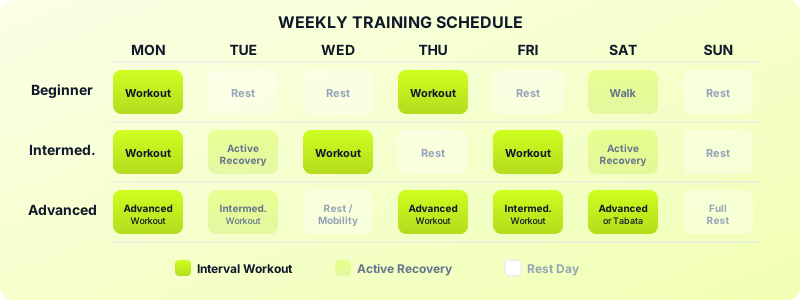
Beginner (Weeks 1-4): 2 Sessions Per Week
| Day | Activity |
|---|---|
| Monday | Beginner interval workout |
| Tuesday | Rest or gentle walk |
| Wednesday | Rest |
| Thursday | Beginner interval workout |
| Friday | Rest or light stretching |
| Saturday | 20-30 min walk or easy bike |
| Sunday | Rest |
Start with two sessions and add a third when you can complete the Beginner workout without needing extra rest.
Intermediate (Weeks 5-8): 3-4 Sessions Per Week
| Day | Activity |
|---|---|
| Monday | Intermediate interval workout |
| Tuesday | Active recovery (walk, yoga) |
| Wednesday | Beginner or Intermediate workout |
| Thursday | Rest |
| Friday | Intermediate interval workout |
| Saturday | Active recovery or light cardio |
| Sunday | Rest |
Three hard sessions per week is the sweet spot for most people. The fourth session is optional and should be at a lower intensity.
Advanced (Weeks 9+): 4-5 Sessions Per Week
| Day | Activity |
|---|---|
| Monday | Advanced interval workout |
| Tuesday | Intermediate workout (active recovery pace) |
| Wednesday | Rest or mobility work |
| Thursday | Advanced interval workout |
| Friday | Intermediate interval workout |
| Saturday | Advanced workout or Tabata session |
| Sunday | Full rest |
Never schedule two advanced sessions back-to-back. Your muscles need 48 hours to recover from high-intensity work.
Using an Interval Timer for Home Workouts
An interval timer transforms bodyweight training from guesswork into a structured system. Instead of glancing at a clock and estimating rest periods, you set your work and rest durations once and let the timer run the session.
Here is what to set up for each workout level:
- Beginner: 30s work, 30s rest, 5 exercises, 3 rounds
- Intermediate: 40s work, 20s rest, 6 exercises, 4 rounds
- Advanced: 45s work, 15s rest, 5 exercises, 5 rounds
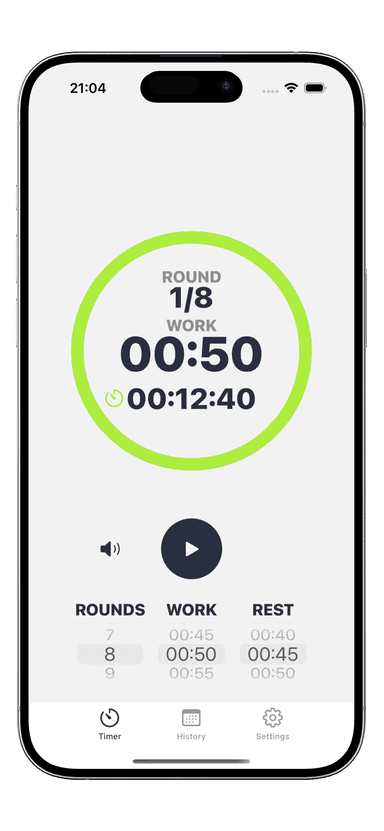
The Interval Timer app lets you build each of these as a custom preset, so you tap once and start training. It supports audio and vibration cues, which means you never need to look at your screen mid-burpee. Follow our timer setup guide for step-by-step instructions on creating custom presets.
You can also use the built-in Tabata mode for 20/10 intervals, EMOM mode for every-minute work, or create fully custom sequences with warm-up and cool-down phases built in.
Start Training Today
Bodyweight interval training at home is the most accessible, time-efficient way to build fitness without spending a dollar on equipment. Pick one of the three workouts above, set your timer, and press start.
You already have everything you need. Your body is the machine. The timer is the coach.
Download Interval Timer and build your first custom bodyweight interval workout in under a minute.