Boxing Workout Timer: How to Train With 3-Minute Rounds
A boxing workout timer with 3 minute rounds is not just a clock on the wall. It is the heartbeat of every boxing gym in the world — the bell that tells you when to throw and when to breathe. Whether you train at a gym or hit the heavy bag in your garage, structuring your sessions around timed rounds transforms a random workout into fight-ready conditioning.
Professional boxers have trained this way for over a century. The format works because it forces genuine intensity followed by genuine recovery. Three minutes of hard work, one minute of rest, repeat. No coasting, no guessing, no wasted time.
Why Boxers Train in 3-Minute Rounds
The 3-minute boxing round became standard through the Marquess of Queensberry Rules in the late 1800s. Before that, bare-knuckle fights had no time limits — bouts could stretch for hours. The 3-minute format struck the right balance: long enough for meaningful exchanges, short enough to maintain explosive power.
Today, every men's professional boxing match uses 3-minute rounds. Amateur and Olympic bouts follow the same format. Women's professional boxing uses 2-minute rounds, but many female fighters still train with 3-minute rounds to build deeper endurance.
Three minutes sounds short until you are throwing real punches. By the 2:30 mark, your shoulders burn with lactic acid, your legs feel heavy, and your brain screams "slow down." Training through that wall is what separates prepared fighters from exhausted ones.
The boxing round timer structure is also one of the oldest forms of interval training. Long before HIIT became a fitness trend, boxers were alternating between maximum effort and active recovery. A 2022 review in the American Journal of Lifestyle Medicine identified this natural interval structure as a key reason boxing outperforms many other exercise forms for both physical and mental conditioning.
How to Set Up a Boxing Round Timer
Setting up a boxing round timer is straightforward once you know the standard parameters. Here is what you need to configure:
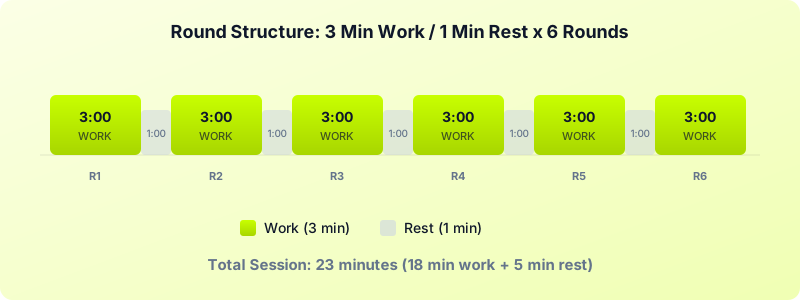
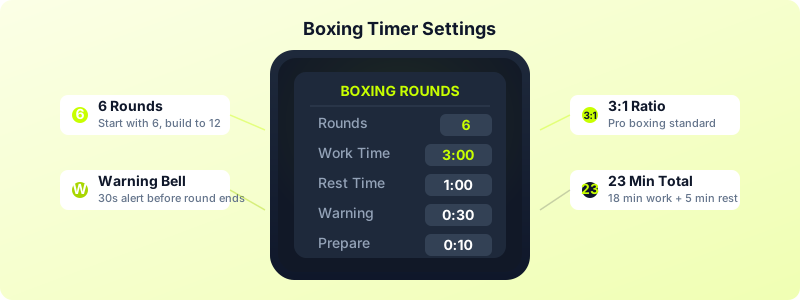
- Round length: 3 minutes (the professional standard)
- Rest period: 1 minute between rounds
- Number of rounds: 6-12 depending on your fitness level and session goal
- Warning bell: A 30-second warning before the round ends (this is critical for pacing)
- Preparation time: 10 seconds before round one starts
If you are new to boxing training, start with 6 rounds and work your way up. That gives you 18 minutes of active work and 5 minutes of rest — a solid 23-minute session. As your conditioning improves, add rounds rather than extending round length.
The warning bell deserves special attention. In a real fight, the 30-second warning tells you to either push for a big finish or conserve energy for the next round. Training with it builds an internal clock so you always know where you stand in a round.
You can learn more about configuring work and rest periods in our guide on how to set up an interval timer for any workout.
A Complete 6-Round Boxing Workout
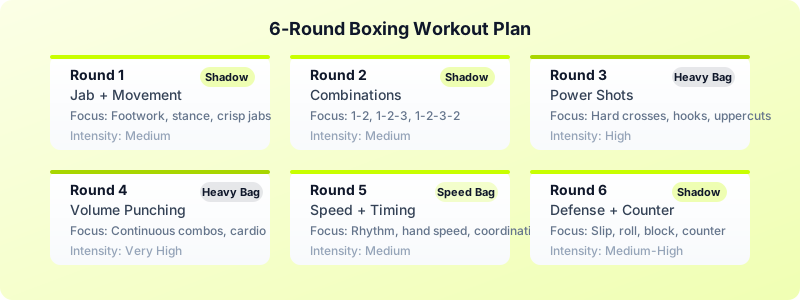
This 6-round workout hits all the fundamentals: technique, power, speed, defense, and conditioning. Each round has a specific focus so you develop well-rounded skills instead of just throwing wild punches.
Warm-up (5 minutes before round 1): Jump rope or jog in place for 3 minutes, then do 2 minutes of light stretching focusing on shoulders, hips, and wrists.
Round 1 — Jab and Movement (Shadow Boxing) Focus entirely on your jab. Step forward, throw a crisp jab, step back. Circle left, jab. Circle right, jab. Keep your feet active and your non-punching hand glued to your chin. This round wakes up your body and locks in your stance.
Round 2 — Combinations (Shadow Boxing) Build on your jab by adding the cross and hook. Work the classic 1-2 (jab-cross), 1-2-3 (jab-cross-hook), and 1-2-3-2 (jab-cross-hook-cross). Focus on smooth transitions between punches rather than pure power.
Round 3 — Power Shots (Heavy Bag) Move to the heavy bag and throw with intent. Sit down on your cross, rotate your hips on hooks, and drive upward on uppercuts. Aim for 8-10 hard combinations per minute with active footwork between bursts.
Round 4 — Volume Punching (Heavy Bag) Keep the heavy bag moving. Throw continuous combinations for 30-second stretches, then move and reset for 10 seconds. This round builds the cardiovascular endurance you need in the later rounds of a fight.
Round 5 — Speed and Timing (Speed Bag or Double-End Bag) Switch to the speed bag or double-end bag. Focus on rhythm and hand speed rather than power. Keep your hands high, elbows up, and maintain a steady tempo. If you do not have a speed bag, do rapid shadow boxing with 1-pound hand weights.
Round 6 — Defense and Counter (Shadow Boxing) Visualize an opponent throwing at you. Slip, roll, block, and immediately counter. Practice slipping a jab and returning a cross. Duck under a hook and come back with a body shot. This round sharpens defensive reflexes.
Cool-down (5 minutes after round 6): Light shadow boxing at 30% effort for 2 minutes, then stretch your shoulders, back, hips, and hamstrings.
Shadow Boxing, Heavy Bag, and Speed Bag Rounds
Each piece of boxing equipment serves a different purpose. Mixing them across your rounds builds a complete fighter — or a complete workout if you train boxing for fitness.
Shadow Boxing
Shadow boxing is where technique lives. Without a target, you can focus purely on form: foot position, hip rotation, hand retraction, and head movement. Start every session with at least one shadow boxing round as a warm-up.
Advanced shadow boxing means visualizing a real opponent. Throw combinations, move your head off the center line, cut angles, and counter imaginary punches. Three minutes of focused shadow boxing burns 20-30 calories and builds the muscle memory that shows up when you hit a real bag.
Heavy Bag
The heavy bag is where power meets conditioning. A 3-minute round on the heavy bag can burn 30-40 calories while building punching power, core stability, and upper body endurance. The key is mixing bursts of hard combinations with active movement around the bag.
Common mistake: standing flat-footed in front of the bag and just punching. Instead, treat the bag like an opponent. Circle it, change angles, throw and move. Use your work-to-rest ratio within the round — 20 seconds of hard output followed by 10 seconds of movement and breathing.
Speed Bag
The speed bag trains hand-eye coordination, rhythm, and shoulder endurance. Most boxers struggle with the speed bag at first, but once you find the rhythm, it becomes one of the most satisfying training tools in the gym.
Start with 2-minute rounds on the speed bag if 3 minutes is too demanding for your shoulders. Build up gradually. The constant overhead arm position is what makes it so effective — and so tiring.
Using Interval Timer for Boxing Training
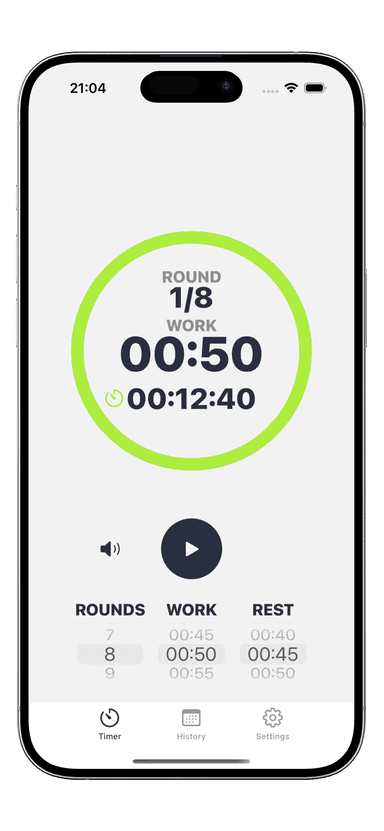
A boxing timer app on your phone replaces the wall-mounted gym clock and goes wherever you train. Interval Timer makes it simple to build a boxing round timer with the exact settings you need.
Set your round length to 3 minutes, rest to 1 minute, and choose your number of rounds. The app handles the countdown, the warning bell, and the rest periods so you can focus entirely on your technique and effort.
What makes a good boxing timer app different from a basic stopwatch is the warning system. Interval Timer gives you audio and vibration alerts so you know when 30 seconds remain — just like the clapper in a real boxing gym. You can also customize the number of rounds per session and track your workout history over time.
If you are new to interval-based training, our guide on beginner HIIT workouts covers the fundamentals of timed training that apply directly to boxing.
Build Your Boxing Routine One Round at a Time
You do not need a boxing gym membership or a personal trainer to train with 3-minute boxing rounds. A heavy bag, a pair of gloves, and a reliable boxing workout timer are enough to build real skills and serious conditioning.
Start with the 6-round workout above. Once you can complete it without feeling destroyed, add two more rounds and shorten your rest to 45 seconds. That progression alone will transform your fitness over 4-6 weeks.
Download Interval Timer and set up your first boxing round timer in seconds. Three minutes on, one minute off — the way boxing has been trained for over a hundred years.