Cycling Interval Training: Beginner Workout Plan
Cycling interval training is one of the fastest ways to improve your cardiovascular fitness, burn fat, and build leg strength — all with zero impact on your joints. Whether you're on a stationary bike, a Peloton, or riding outdoors, structured intervals transform a casual pedal into a high-performance workout.
The key word is "structured." Random hard efforts don't produce the same results as properly timed intervals with defined work and rest periods. A cycling interval training plan gives you the framework to push hard, recover fully, and repeat — which is exactly what drives adaptation.
Why Cycling Is Perfect for Interval Training
Cycling has a unique advantage over running-based HIIT: you control the resistance, not your body weight. That means you can dial in your effort precisely and reduce it instantly during rest periods — no slowing down required, just shift a gear.
This makes cycling intervals safer for beginners. You're less likely to trip, stumble, or hurt your knees than during sprint intervals on foot. And because you're seated, upper body fatigue doesn't limit how hard you push your legs.
The other advantage: cycling HIIT is extremely time-efficient. A 20-minute cycling interval session can deliver the same cardiovascular stimulus as 40-50 minutes of steady riding. That's the power of HIIT for fat loss applied to the bike.
Beginner Cycling Interval Workout Plan
Start here if you're new to interval training on the bike. This 4-week plan builds intensity gradually so your body adapts without burning out.
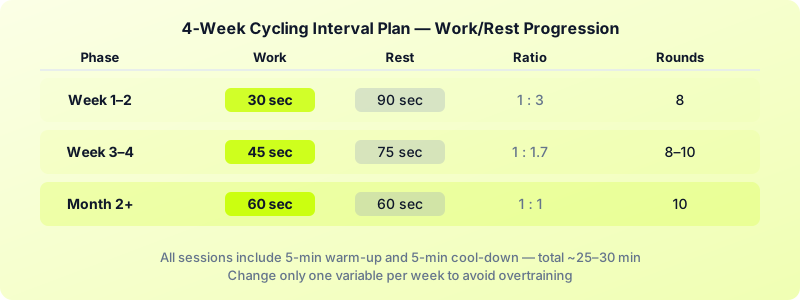
Week 1-2: Foundation Intervals
- Warm up: 5 minutes easy pedaling (50-60% effort)
- Work interval: 30 seconds hard (80% effort)
- Rest interval: 90 seconds easy (50% effort)
- Rounds: 8
- Cool down: 5 minutes easy
- Total time: ~25 minutes
Week 3-4: Building Intensity
- Warm up: 5 minutes easy
- Work interval: 45 seconds hard (80-85% effort)
- Rest interval: 75 seconds easy
- Rounds: 8-10
- Cool down: 5 minutes easy
- Total time: ~25-30 minutes
After Week 4: Intermediate Step
- Work interval: 60 seconds hard
- Rest interval: 60 seconds easy (1:1 ratio)
- Rounds: 10
- Total time: ~25 minutes (plus warm-up and cool-down)
The work to rest ratio shifts from 1:3 in week 1 to 1:1 by month two. This gradual compression of rest time is what builds your aerobic engine systematically.
How to Set Up Your Timer for Cycling Intervals
Watching a bike display while trying to count seconds is distracting and inaccurate. A dedicated interval timer handles the counting so you can focus entirely on your effort.
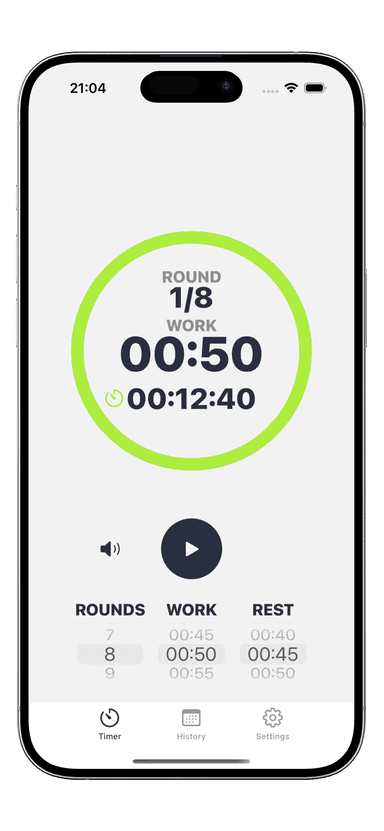
Set up your timer with:
- Work interval: 30 seconds (Week 1) → 45s → 60s as you progress
- Rest interval: 90 seconds (Week 1) → 75s → 60s
- Rounds: 8-10
- Audio alerts: On — so you hear the switch without looking away from the road or screen
With the Interval Timer app on your iPhone or Apple Watch, you get a vibration alert on your wrist the moment to switch — perfect for outdoor cycling where you can't safely look at your phone. Set it up before you clip in and forget about the timing.
For indoor cycling, prop your phone where you can glance at the countdown between pushes. Some riders mount their Apple Watch display facing up on the handlebar area — the vibration cue tells you when to shift effort.
Indoor vs Outdoor Cycling Intervals
Both work well, but they train slightly different things.
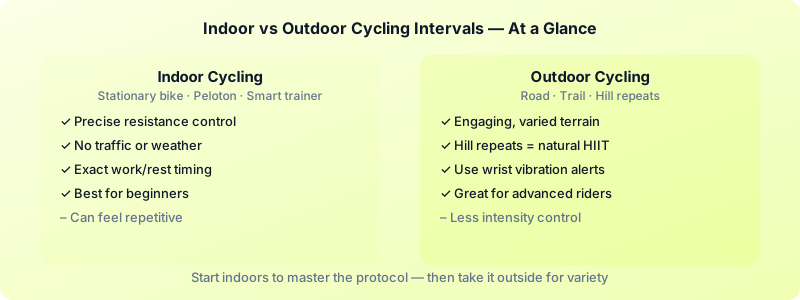
Indoor (stationary bike, Peloton, smart trainer):
- Perfect intensity control — you set the resistance and it doesn't change
- No traffic, weather, or terrain variables
- Great for structured beginner sessions where consistency matters
- Easier to follow exact work/rest timing
Outdoor cycling intervals:
- More engaging — hills, wind, and terrain add natural resistance variation
- Hill repeats are a natural form of cycling interval training: sprint up, recover on the descent
- Cadence-based intervals (sprint at 100+ RPM for 30 seconds) work well on flat roads
- Requires more situational awareness — use vibration alerts rather than audio cues
For pure beginner interval training, indoor is easier to control. Once you have the pattern locked in, take it outside for variety.
How to Progress Your Cycling Intervals
Progression is what separates a training plan from just riding your bike. Once a particular session starts to feel manageable — meaning your hard intervals feel like a 7/10 instead of a 9/10 — it's time to increase the challenge.
Three ways to progress:
- Shorten rest periods — Move from 1:3 ratio to 1:2 to 1:1 over 4-8 weeks
- Add more rounds — Go from 8 rounds to 10 to 12
- Increase resistance — Once your work/rest ratio is solid, add a gear during the work intervals
Don't change all three at once. Change one variable per week. This is the core principle behind setting up your interval timer for progressive training — the structure stays the same while one challenge increases.
Cadence and Resistance Tips
Two variables define a cycling interval: cadence (RPM) and resistance.
For power intervals (building leg strength): Lower cadence (70-80 RPM), higher resistance. This simulates climbing and builds muscular endurance.
For speed intervals (building cardio): Higher cadence (90-110 RPM), moderate resistance. Fast legs train your cardiovascular system and neuromuscular coordination.
For beginners, start with moderate resistance and cadence (80-90 RPM) at your work intervals. You don't need to maximize either variable yet — just push noticeably harder than your easy pace.
A practical guide: during work intervals, you shouldn't be able to hold a comfortable conversation. During rest intervals, you should be able to say a few sentences. If you can talk easily throughout, increase your work intensity. If you can't recover at all during rest, reduce your work effort slightly.
Cycling interval training is one of the most rewarding workouts you can do — measurable improvement comes fast, usually within 2-3 weeks of consistent sessions.
Download Interval Timer to set up your cycling intervals in seconds and get precise audio and vibration cues for every work and rest period, whether you're indoors or out.