Deload Week: When and How to Take One

You have been pushing hard for weeks. Every session feels heavier, your joints ache, and the weights that used to fly off the floor now grind to a halt. A deload week might be exactly what your body is asking for. This planned reduction in training stress lets you recover without losing progress — and it can actually make you stronger in the long run.
What Is a Deload Week and Why Does It Matter?
A deload week is a planned period — usually 5 to 7 days — where you reduce your training volume, intensity, or both. You still train. You still show up. But you dial things back by 40 to 60 percent to give your muscles, joints, and nervous system time to recover.
Think of it like a pit stop in a race. You are not quitting. You are refueling so you can push harder in the next training block.
Research shows that one week of reduced training does not cause measurable muscle loss. Muscle protein synthesis stays active during a deload, and any minor detraining effect reverses within one to two sessions at full intensity. So you are not losing gains — you are setting up bigger ones.
Signs You Need a Deload Week
Not every tough workout means you need to back off. But when several of these signals stack up, it is time to listen to your body.
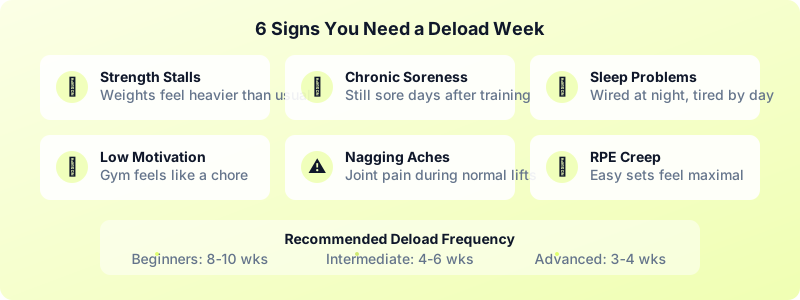
- Strength stalls or drops. Weights that felt manageable two weeks ago now feel like max attempts.
- Chronic soreness. You are still sore from Monday's session when Thursday rolls around.
- Sleep problems. You feel wired at night or wake up exhausted despite getting enough hours.
- Motivation tanks. The gym feels like a chore instead of a challenge.
- Nagging aches. Your shoulders, knees, or elbows hurt during movements that are normally pain-free.
- RPE creep. A set that should feel like a 7 out of 10 effort suddenly feels like a 9.
If you are following a structured program, a good rule of thumb is to schedule a deload every 4 to 6 weeks. Beginners can stretch this to 8 to 10 weeks since they recover faster between sessions. Athletes in a calorie deficit should deload more frequently — every 3 to 5 weeks — because recovery demands increase when food is low.
How to Structure Your Deload Week
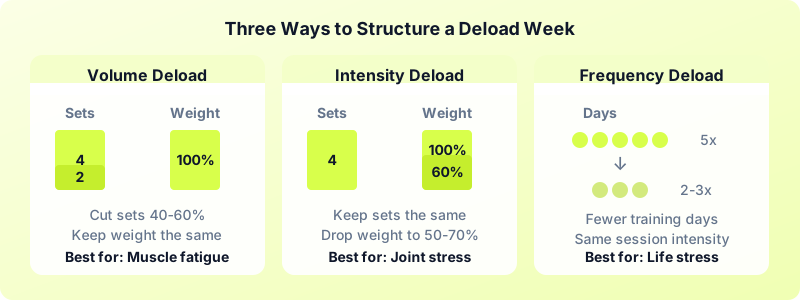
There are three proven approaches. Pick the one that matches your biggest source of fatigue.
Volume Deload
Cut your total sets by 40 to 60 percent while keeping the weight the same. If you normally do 4 sets of squats at 100 kg, do 2 sets at 100 kg. This works best when muscular fatigue is the main issue.
Intensity Deload
Keep your sets and reps the same but drop the weight to 50 to 70 percent of normal. If you squat 100 kg for 4 sets of 6, switch to 60 kg for 4 sets of 6. This approach is ideal when joint stress and connective tissue fatigue are your concern.
Frequency Deload
Reduce training days from 4 or 5 per week to 2 or 3. Each session stays the same, but the total weekly workload drops. This gives your body more complete rest days and works well when overall life stress is high.
Whichever method you choose, keep your exercises the same. A deload is not the time to try new movements. It is a great time to focus on technique and movement quality since fatigue is low and weights are lighter.
Deload Week Workout Examples
Here are two sample deload sessions you can plug into your week.
Upper Body Deload (Volume Method)
- Bench Press — 2 sets of 6 at your normal working weight
- Bent-Over Row — 2 sets of 8 at normal weight
- Overhead Press — 2 sets of 8 at normal weight
- Face Pulls — 2 sets of 15 (light)
Lower Body Deload (Intensity Method)
- Back Squat — 4 sets of 6 at 60 percent of your normal load
- Romanian Deadlift — 3 sets of 8 at 60 percent
- Walking Lunges — 2 sets of 10 per leg (bodyweight)
- Calf Raises — 2 sets of 15
Each session should take 30 to 40 minutes. Keep rest periods at 2 to 3 minutes between compound lifts. For isolation moves and accessories, 60 to 90 seconds is plenty. You should leave each workout feeling refreshed, not drained.
Use your deload week to sharpen your technique. With lighter loads and less fatigue, you can pay closer attention to bar path, bracing, and positioning. Many lifters come back from a deload not just recovered but moving better.
Maintain your normal calorie and protein intake during a deload. Your body needs fuel to repair — this is when muscle growth and tissue repair happen. Cutting calories during a recovery week undermines the entire purpose of backing off.
How to Use a Timer During Your Deload Week
Consistent rest periods matter even more during a deload. When the weights feel easy, it is tempting to rush through sets or scroll your phone for 5 minutes between them. A timer keeps you honest.
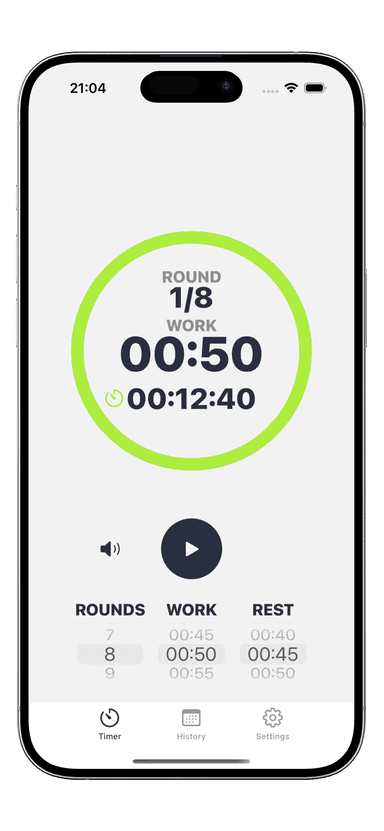
Set your Interval Timer to a simple work-rest structure. For compound lifts, use 2 to 3 minute rest intervals. For accessory work, use 60 to 90 seconds. The timer alerts you when rest is over so you stay on pace without watching the clock.
You can also use your timer to cap total session length. Set a countdown for 35 or 40 minutes. When it sounds, you are done — no extra sets, no "just one more." This prevents the common deload mistake of accidentally doing a full-intensity workout because you feel good.
If you track your rest periods between intervals, you can compare deload-week data with your heavy weeks. Over time, you will notice patterns in how your body responds to different recovery strategies.
During your deload, consider adding light active recovery workouts on your off days. A 20-minute walk, gentle yoga, or mobility session keeps blood flowing without adding training stress. Watch for signs of overtraining that might suggest you need a longer break.
The week after your deload, you should feel stronger, more motivated, and ready to hit new personal records. That is the whole point — train smarter so you can train harder.
Download Interval Timer and use timed rest periods to make your deload week as effective as your heaviest training blocks.