Hip Flexor Stretches for People Who Sit All Day
If you sit at a desk for eight or more hours a day, your hip flexors are paying the price. These powerful muscles — the iliopsoas, rectus femoris, and tensor fasciae latae — spend your entire workday locked in a shortened position. Over time, that leads to lower back pain, poor posture, and reduced mobility that follows you out of the office and into your workouts. The right hip flexor stretches for people who sit all day can reverse the damage in as little as five minutes twice daily.
Studies show that targeted hip flexor stretching reduces lower back discomfort by up to 42% over eight weeks when done consistently. You do not need a gym, special equipment, or even to change out of your work clothes. Just a timer, a few minutes, and these six stretches.
Why Sitting All Day Destroys Your Hip Flexors
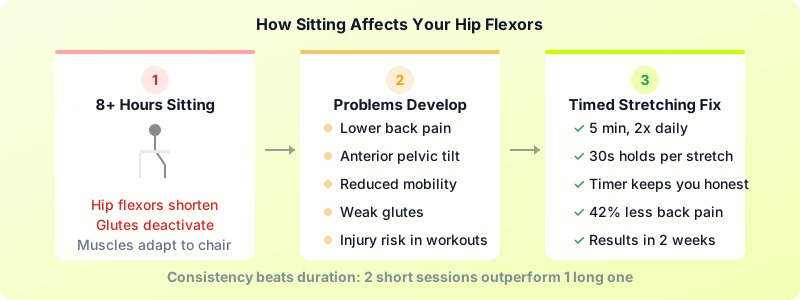
Your hip flexors connect your spine to your legs and are responsible for lifting your knees and bending at the waist. When you sit, these muscles stay in a compressed, shortened position for hours on end.
Chronic shortening causes real problems. After months of daily sitting, your hip flexors physically adapt by shortening their resting length. This pulls your pelvis forward into anterior pelvic tilt — the classic desk worker posture where your lower back arches excessively and your belly pushes forward.
Tight hip flexors shut down your glutes. Your body operates on a principle called reciprocal inhibition. When your hip flexors are chronically tight, they send signals that inhibit your glute muscles from firing properly. Weak glutes combined with tight hip flexors is the number one cause of lower back pain in office workers.
The damage compounds during workouts. If you go from eight hours of sitting directly into a HIIT session or run, your tight hip flexors limit your range of motion, reduce power output, and increase injury risk. A proper stretching routine before HIIT becomes even more critical when you sit all day.
6 Best Hip Flexor Stretches for Desk Workers
These stretches target the primary hip flexor muscles from different angles. Hold each stretch for 30 seconds per side for maximum benefit.
1. Kneeling Hip Flexor Stretch Kneel on your left knee with your right foot flat on the floor in front of you, knee bent at 90 degrees. Shift your weight forward until you feel a deep stretch in the front of your left hip. Keep your torso tall and squeeze your left glute to deepen the stretch. This is the single most effective hip flexor stretch for desk workers.
2. Standing Lunge Stretch Stand tall and step your right foot forward into a lunge position. Lower your hips until your right thigh is parallel to the floor. Keep your left leg extended behind you with a straight knee. You should feel the stretch through the front of your left hip and thigh. This variation works when you cannot kneel at the office.
3. Seated Figure-Four Stretch Sit upright in your chair. Cross your right ankle over your left knee, creating a figure-four shape. Place both hands on your right knee and gently lean forward with a straight back. Hold for 30 seconds and switch sides. This stretch targets your deep hip rotators and outer hip flexors — and you can do it without leaving your desk.
4. Couch Stretch Kneel facing away from a wall or couch. Place your left knee on the ground with your left shin resting against the wall behind you. Step your right foot forward into a lunge. The closer your left knee is to the wall, the deeper the stretch. This is the most intense hip flexor stretch on the list and delivers the fastest results.
5. 90/90 Hip Switch Sit on the floor with your right leg bent at 90 degrees in front of you and your left leg bent at 90 degrees behind you. Keeping your chest tall, rotate to switch both legs to the opposite position. Perform 8-10 switches per set. This dynamic movement improves rotational hip mobility that static stretching alone misses.
6. Supine Hip Flexor Stretch Lie on your back at the edge of a bed or bench. Pull your left knee to your chest and let your right leg hang off the edge. Gravity pulls your right thigh down, creating a gentle stretch through the hip flexor. Hold for 30 seconds per side. This is the most relaxing option and works well as part of a bedtime routine.
A 5-Minute Timed Hip Flexor Routine
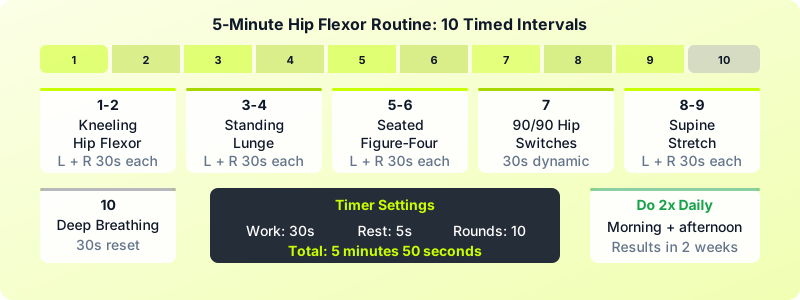
This quick routine covers all the major hip flexor muscles. Set your timer to 30-second intervals with a 5-second transition beep between stretches.
| Order | Stretch | Duration | |-------|---------|----------| | 1 | Kneeling hip flexor — left | 30 sec | | 2 | Kneeling hip flexor — right | 30 sec | | 3 | Standing lunge — left | 30 sec | | 4 | Standing lunge — right | 30 sec | | 5 | Figure-four — left | 30 sec | | 6 | Figure-four — right | 30 sec | | 7 | 90/90 hip switches | 30 sec | | 8 | Supine stretch — left | 30 sec | | 9 | Supine stretch — right | 30 sec | | 10 | Deep breathing reset | 30 sec |
Total time: 5 minutes. Do this routine once in the morning and once in the afternoon for the best results. After two weeks of consistent practice, most people notice significantly less stiffness when standing up from their desk.
How Often Should You Stretch Your Hip Flexors?
Frequency matters more than duration when it comes to reversing the effects of sitting. Here are the evidence-based guidelines:
Minimum effective dose: Two sessions per day, 5 minutes each. Physical therapists recommend changing positions every 30 to 45 minutes, but even two dedicated stretching breaks make a measurable difference.
Optimal frequency: Three to four micro-sessions spread throughout your workday. A 2-minute stretch break every two hours is more effective than a single 10-minute session at the end of the day.
Hold duration: 30 seconds per stretch, per side. Research shows that holding a stretch for 30 seconds produces the same flexibility gains as holding for 60 seconds, making shorter holds more time-efficient.
Combine stretching with strengthening. Tight hip flexors often pair with weak glutes. Add glute bridges and clamshells to your routine — even 10 reps of each after your stretches — to address both sides of the imbalance. Check out this 5-minute mobility routine for a complete mobility approach.
Using a Timer to Build a Stretching Habit at Work
The biggest challenge with desk stretching is not knowing the exercises — it is remembering to do them. A timer solves both problems.
Set recurring reminders. Use your phone or watch to alert you every two hours during the workday. When the alert fires, do the 5-minute routine above. Five alerts across an 8-hour day give you 25 minutes of total hip flexor work.
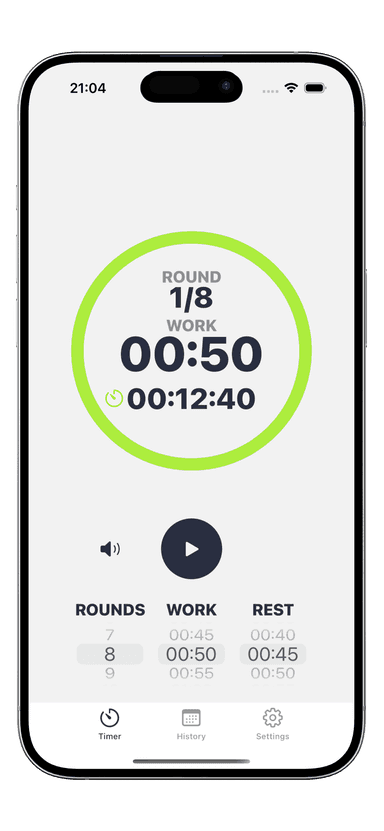
Program your stretching intervals. Open your Interval Timer app and set 30-second intervals with a 5-second transition for 10 rounds. Save it as a "Hip Flexor" preset. When your reminder goes off, load the preset and follow along — no thinking required.
Track your consistency. The Interval Timer app logs each session in your workout history. After a week, you can see exactly how many stretching sessions you completed. Tracking builds accountability, and accountability builds habits.
Use timed stretches during cool-down stretches with a timer after workouts too. Your hip flexors need extra attention after any lower-body exercise, especially if you spent the preceding eight hours sitting.
Your hip flexors did not get tight overnight, and they will not loosen up overnight either. But five minutes twice a day with a structured timer routine is enough to undo the damage of a desk job and keep your hips mobile for every workout.
Download Interval Timer and set up timed stretching intervals to keep your hip flexors healthy at work and at the gym.