How to Increase VO2 Max with Interval Training
VO2 max — your body's maximum oxygen uptake capacity — is the single best predictor of cardiovascular fitness and long-term health outcomes. It determines how fast you can run, how long you can sustain hard efforts, and how quickly you recover between intervals. Interval training is the most effective method to increase it.
Here's the science, the specific protocols, and how to structure training to produce measurable VO2 max gains.
What VO2 Max Actually Measures
VO2 max measures the maximum volume of oxygen your body can use per minute per kilogram of bodyweight (ml/kg/min). It represents the ceiling of your aerobic system's output.
Average values by fitness level:
- Sedentary adult: 30-35 ml/kg/min
- Recreationally active: 40-50 ml/kg/min
- Competitive endurance athlete: 55-70 ml/kg/min
- Elite level (cycling, running): 70-90 ml/kg/min
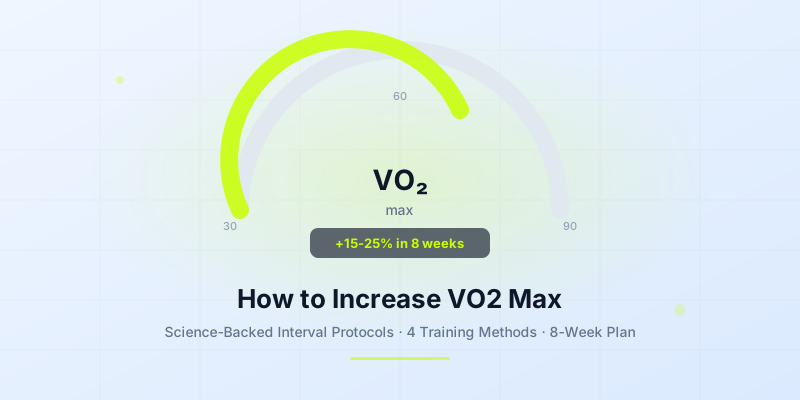
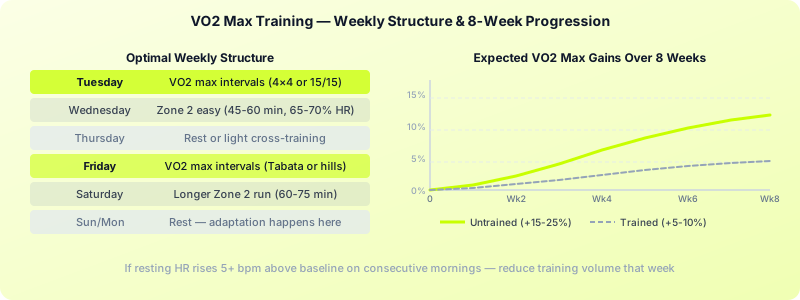
VO2 max is trainable. Research consistently shows that untrained individuals can improve VO2 max by 15-25% over 8-12 weeks of structured interval training. Trained athletes see smaller gains (5-10%) but still respond positively.
The limiting factor in most people is cardiac output — how much blood the heart pumps per minute. Interval training increases stroke volume (blood pumped per beat) and cardiac output, directly raising the ceiling of oxygen delivery to working muscles.
Why Interval Training Beats Steady-State for VO2 Max
To improve VO2 max, you must train at or near VO2 max intensity. This requires working at approximately 90-100% of your maximum heart rate — an effort you cannot sustain for more than 3-8 minutes continuously.
Interval training solves this problem by breaking the high-intensity work into repeatable segments separated by partial recovery. Instead of a single 4-minute maximal effort (which is brutal and unsustainable), you perform 4-6 intervals of 3-4 minutes each at near-maximum intensity with recovery periods in between.
Steady-state running at 70-75% max heart rate burns calories and builds base fitness but doesn't sufficiently stress the cardiac output system to produce meaningful VO2 max improvements. Zone 2 cardio vs HIIT serves a different purpose — base building — but won't move the VO2 max ceiling significantly.
The Best Interval Protocols for VO2 Max
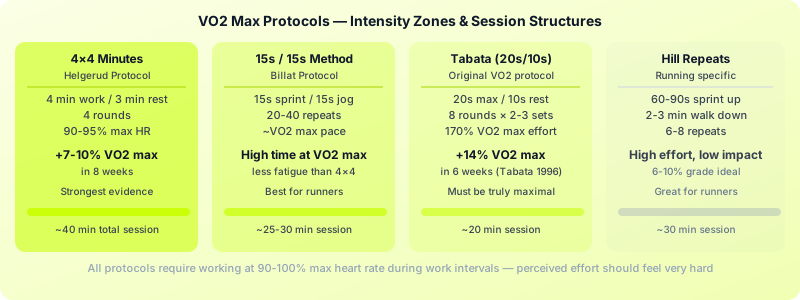
Protocol 1: Classic VO2 Max Intervals (4×4 Minutes)
This protocol, developed by Norwegian sports scientist Jan Helgerud, has the strongest research evidence for VO2 max improvement.
Structure:
- Warm-up: 10 minutes easy running or cycling
- Work: 4 minutes at 90-95% max heart rate
- Recovery: 3 minutes active recovery (easy jogging, ~60-65% HR)
- Repeat: 4 times
- Cool-down: 5-10 minutes easy
Total session: ~40 minutes. Studies using this exact protocol showed 7-10% VO2 max improvements in 8 weeks.
Intensity check: At the end of each 4-minute interval, you should be unable to maintain a conversation. If you can speak in full sentences, you're not working hard enough.
Protocol 2: Short Intervals (15s/15s Method)
Developed by Veronique Billat, this protocol uses very short work periods at near-VO2-max pace with equal rest:
Structure:
- Warm-up: 10 minutes easy
- Work: 15 seconds at VO2 max pace (very fast)
- Rest: 15 seconds easy jogging
- Repeat: 20-40 times (5-10 minutes total)
- Cool-down: 5 minutes easy
This format accumulates significant time at VO2 max intensity without the extreme fatigue of longer intervals. It's particularly effective for runners because the short bursts allow near-race-pace running without full anaerobic depletion.
Protocol 3: Tabata-Style VO2 Max (20s/10s)
The classic Tabata protocol was originally designed for VO2 max improvement, not just fat loss. Dr. Izumi Tabata's original research showed that 4 minutes of 20s/10s work at 170% of VO2 max improved VO2 max by 14% in 6 weeks.
Structure:
- 20 seconds all-out effort
- 10 seconds rest
- 8 rounds (4 minutes)
- 2-3 sets with 4-minute rest between sets
The key: the 20-second effort must be genuinely maximal — a level of intensity most people underestimate. This is genuinely difficult and should leave you near-unable to continue by round 7-8.
Protocol 4: Hill Repeats (Running)
For runners, hill repeats produce strong VO2 max stimulus because the incline forces higher effort at lower speeds, reducing impact while maintaining cardiovascular demand:
- Find a hill with 6-10% grade
- Sprint up for 60-90 seconds at maximum effort
- Walk or jog down (2-3 minutes recovery)
- Repeat 6-8 times
Setting Up Your Timer for VO2 Max Intervals
VO2 max training requires precise interval timing — especially for the 15s/15s and Tabata protocols where seconds matter.
Timer settings for 4×4 Protocol:
- Work interval: 4 minutes
- Rest interval: 3 minutes
- Rounds: 4
- Prep countdown: 10 seconds
Timer settings for 15s/15s:
- Work: 15 seconds
- Rest: 15 seconds
- Rounds: 30 (= 15 minutes total)
Timer settings for Tabata:
- Work: 20 seconds
- Rest: 10 seconds
- Rounds: 8 per set
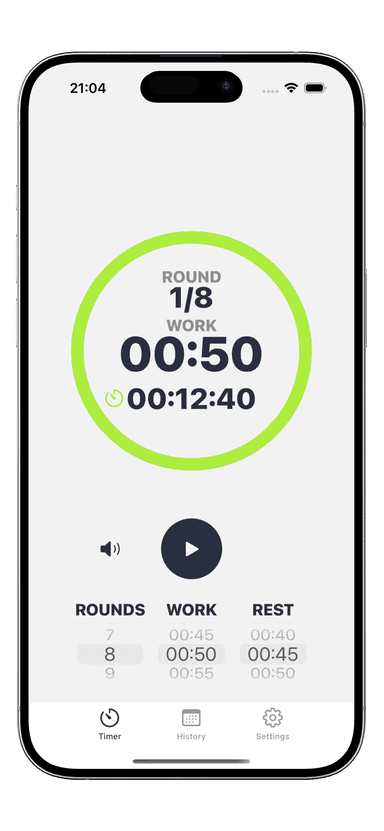
The Interval Timer app handles all of these formats. The audio cues are essential for VO2 max work — when you're at 95% heart rate, looking at a screen is the last thing you want to do.
How Long Does It Take to See Results?
VO2 max improvements follow a predictable timeline:
Weeks 1-2: Cardiovascular stress adaptation begins. Sessions feel extremely hard. Weeks 3-4: Heart rate during identical sessions starts to drop slightly — early sign of improvement. Weeks 5-8: Measurable VO2 max gains (typically 5-10% in untrained individuals, 3-5% in trained). Weeks 9-12: Continued gains if training load is progressively increased. Plateau prevention requires either more intervals per session or higher work intensity.
After 12 weeks, additional VO2 max gains require more advanced periodization — alternating high-volume and high-intensity phases — similar to how cycling interval training programs structure progressive overload.
Frequency and Recovery for VO2 Max Training
VO2 max intervals are extremely demanding. Unlike moderate HIIT, they require 48-72 hours of recovery between sessions.
Recommended frequency:
- 1-2 VO2 max sessions per week maximum
- Fill remaining days with Zone 2 base training (easy running, cycling at 65-70% HR)
- At least one full rest day per week
The 30-20-10 sprint protocol can supplement VO2 max training on lighter days — it generates cardiovascular stimulus without the full recovery demand of 4×4 intervals.
Signs of overtraining: If resting heart rate increases by 5+ beats above your baseline on consecutive mornings, reduce training volume that week. VO2 max gains come from adaptation during rest, not from accumulating more stress.
Tracking Progress
VO2 max can be estimated without lab testing:
Cooper Test: Run as far as possible in 12 minutes. Use the formula: VO2 max ≈ (distance in meters − 504.9) / 44.73. Test every 4 weeks to track improvement.
Resting heart rate: Drops as VO2 max improves. Track first thing in the morning before getting out of bed.
Heart rate at standard effort: Run the same route at the same pace every 2 weeks. If your heart rate at that pace decreases, your cardiovascular fitness (and likely VO2 max) is improving.
Most fitness trackers (Apple Watch, Garmin, Polar) also estimate VO2 max from heart rate data during runs. While not lab-accurate, the trend over weeks is useful for tracking progress direction.
Download Interval Timer to run the 4×4, 15s/15s, or Tabata VO2 max protocols with precise audio cues — set your protocol once and let the timer handle the session structure.