How to Track Workout Progress at Home
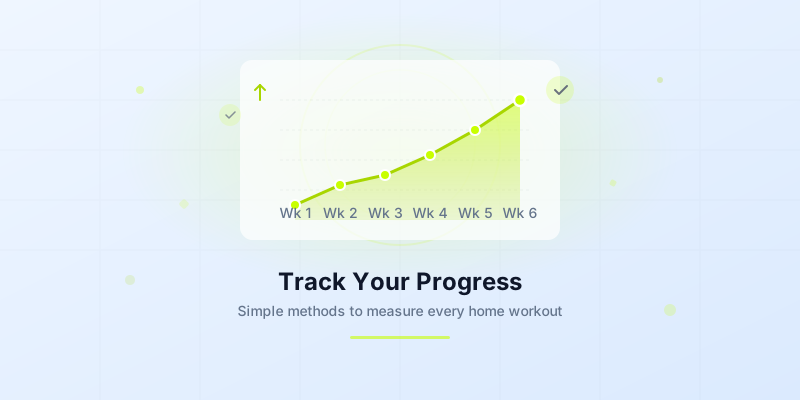
You finished a tough 20-minute circuit in your living room. You're drenched in sweat, heart pounding, feeling great. But next week, you won't remember how many rounds you completed, how long your rest periods were, or whether you actually pushed harder than last time. If you want to know how to track workout progress at home, the answer starts with one simple rule: write it down before you forget.
Tracking turns random effort into a plan. It shows you what's working, what's stalling, and where to push next. And you don't need fancy lab equipment or a personal trainer to do it. You just need a system that takes less than two minutes after each session.
Why Tracking Your Workouts Matters
People who consistently track their workouts are significantly more likely to reach their fitness goals than those who wing it. The reason is straightforward: tracking creates a feedback loop. You record what you did, review it later, and adjust your next session based on real data instead of guesswork.
Without tracking, you fall into one of two traps. You either repeat the same workout at the same intensity for months and wonder why you've plateaued. Or you push too hard too fast because you have no reference point for what your body can handle.
Tracking also unlocks the most important principle in fitness: progressive overload. To get stronger, faster, or leaner, you need to gradually increase the demands on your body. You can't progressively overload what you don't measure. If you did 6 rounds of a bodyweight interval circuit last Tuesday, your goal this Tuesday is 7 rounds or shorter rest periods. That only works if you have last Tuesday's numbers.
The mental benefits matter too. On days when motivation dips, opening your log and seeing four straight weeks of consistent sessions is the push you need to lace up and start the timer.
5 Simple Ways to Track Progress at Home
You don't need to track home workouts with expensive gadgets. The best tracking method is one you'll actually use every single session. Here are five approaches ranked from simplest to most detailed.
1. Workout journal. A plain notebook next to your workout area. After each session, jot down the date, exercises, rounds, and how you felt. It takes 90 seconds and gives you a permanent paper record. No battery required.
2. Phone notes app. Open the notes app you already have. Create one note per week. Type the same data you'd write in a journal, but with the advantage of search. Three months from now, you can search "push-ups" and see every session that included them.
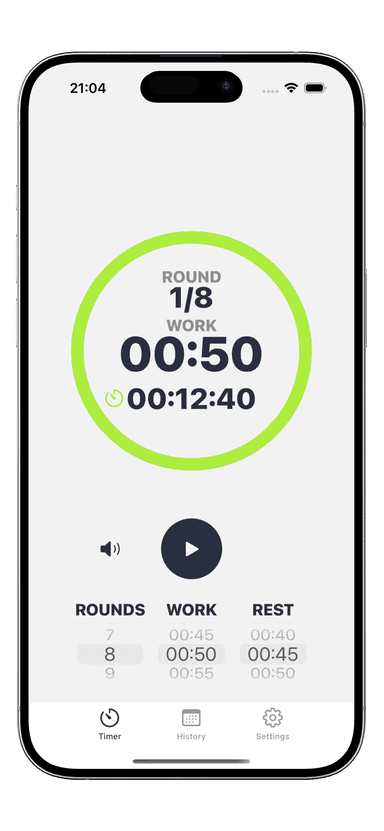
3. Timer app with history. A workout timer that logs your sessions automatically removes the friction of manual entry. Interval Timer saves your workout history — every round, every rest period, every total time — so you can review past sessions without writing anything down.
4. Progress photos. Take a front and side photo every two weeks, same time of day, same lighting, same clothing. Photos capture changes that scales and measuring tapes miss — improved posture, visible muscle definition, reduced midsection. Store them in a dedicated album on your phone.
5. Fitness benchmark tests. Pick 3-4 simple tests and repeat them every four weeks: max push-ups in 60 seconds, wall sit hold time, plank duration, and a timed 1-kilometer run or walk. These standardized tests cut through day-to-day variability and reveal genuine improvement.
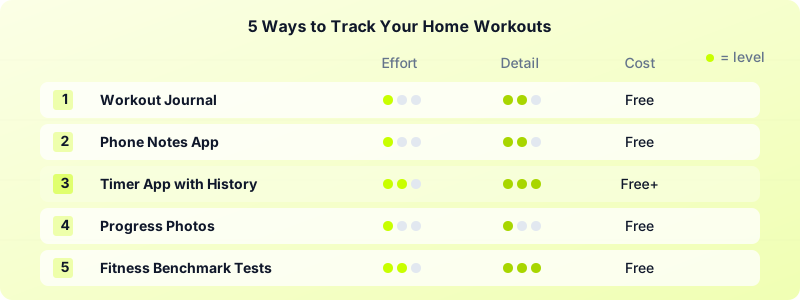
The best approach? Combine a daily logging method (journal, app, or timer) with a monthly benchmark test. Daily tracking captures the details. Monthly testing confirms the trend.
What to Track in Every Workout Session
Workout progress tracking works only when you capture the right data. Too little and you can't spot patterns. Too much and logging becomes a chore you abandon by week three.
Here's what to record after every session:
- Date and time. Lets you spot patterns — do you perform better in the morning or evening?
- Exercises performed. List every movement in the order you did them.
- Work and rest intervals. Record the exact durations. Were you doing 30 seconds on and 15 seconds off, or 40 on and 20 off?
- Rounds completed. The single most important performance metric for interval training.
- Total session time. Tracks whether your workouts are getting longer, shorter, or staying consistent.
- Difficulty rating (1-5). A quick subjective score. If last week's session felt like a 4 and this week it feels like a 3 with the same workout, you're getting fitter.
- Notes. Anything unusual — sore knee, slept poorly, felt strong, tried a new exercise. These details explain outliers when you review your log.
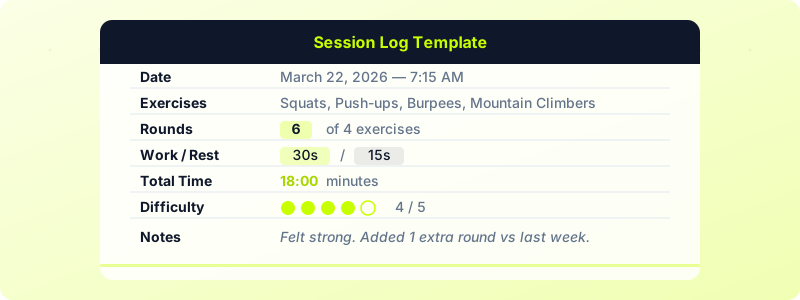
Keep the format identical every session. Consistency in your log makes comparison easy. If you set up a home workout routine with timed intervals, your log entries will naturally follow the same structure each time.
How a Workout Timer Helps You Track Progress
A dedicated workout timer does more than beep when your rest period ends. It creates the structure that makes tracking automatic.
When you set up an interval timer, you define exact work periods, rest periods, and round counts before you start. That structure becomes your baseline — a precise, repeatable format you can compare session to session.
Here's what a timer-driven approach gives you:
Objective time data. No guessing whether your rest was 15 seconds or 25 seconds. The timer enforces exact intervals, so your performance comparisons are apples-to-apples.
Automatic session records. Interval Timer stores your workout history on your device. After a month of consistent training, you can scroll back through past sessions and see exactly how your capacity has grown — more rounds in the same time, or the same rounds with shorter rest.
Progressive overload by design. Want to push harder this week? Shave 5 seconds off your rest period or add one extra round. The timer makes these incremental changes precise and trackable.
Pacing control. Without a timer, most people start too fast and fade by round three. A structured timer keeps your effort distributed evenly across the session, which produces more consistent data for tracking.
Building a Tracking Habit That Sticks
The biggest challenge with home fitness tracking isn't knowing what to track — it's doing it consistently. Here's how to make tracking stick long term.
Log immediately after your workout. Not later that evening. Not tomorrow morning. The moment you finish your last round, grab your notebook or phone and record the session while the numbers are fresh. Waiting even an hour costs you accuracy.
Start with three data points. In your first two weeks, only record exercises, rounds, and difficulty rating. That's it. Once logging feels automatic, add work/rest intervals and total time. Trying to capture everything on day one leads to tracking burnout.
Review weekly. Every Sunday, spend five minutes scanning the week's entries. Look for trends: are your round counts going up? Are difficulty ratings going down for the same workout? Are you training consistently or skipping days? A weekly review turns raw data into actionable insight.
Set a monthly benchmark date. Pick the first Saturday of every month as your test day. Run your 3-4 benchmark tests, record the results, and compare them to the previous month. Seeing concrete improvement — five more push-ups, a 20-second longer plank — reinforces the habit.
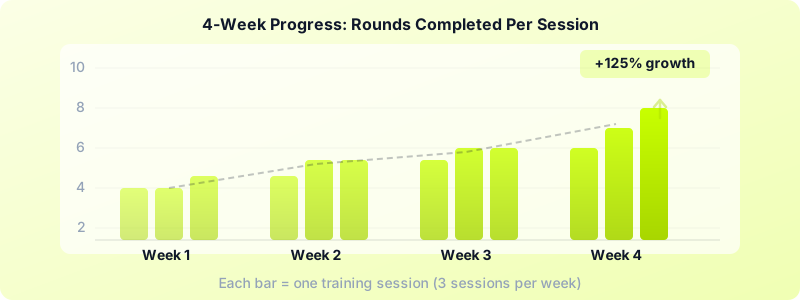
Celebrate the streaks. Mark every completed workout in your calendar. After two weeks, you'll have a visual chain you won't want to break. After four weeks, tracking will feel as natural as the workout itself.
The tools don't need to be complicated. A notebook, a timer app, and five minutes of review per week will give you more insight into your fitness than most gym-goers ever get. Start your next session with a plan, end it with a log entry, and watch your progress climb.
Download Interval Timer and start tracking every round, rest period, and session automatically.