Is HIIT Cardio or Strength Training? The Real Answer

Ask five personal trainers whether HIIT counts as cardio or strength training, and you will get five different answers. The confusion makes sense — a HIIT session can include burpees (cardio), goblet squats (strength), and box jumps (both). So is HIIT cardio or strength training? The honest answer: it is both, and the balance depends entirely on how you design your workout.
Understanding where HIIT falls on the cardio-to-strength spectrum helps you program it correctly, avoid overtraining one system, and get better results from every session.
Why HIIT Does Not Fit Neatly Into One Category
Traditional cardio means sustained, moderate-intensity effort — jogging, cycling, swimming at a steady pace. Traditional strength training means lifting heavy loads with longer rest periods to build muscle and force production.
HIIT breaks both rules. You work at near-maximal intensity for short bursts, then rest, then repeat. That pattern trains your cardiovascular system (heart rate spikes and recovers repeatedly) while also demanding muscular output (your legs and arms do real work against resistance — even if that resistance is just your body weight).
The result is a hybrid stimulus. Your heart and lungs improve because they must rapidly shift between high and low demand. Your muscles improve because each burst requires meaningful force production. Neither adaptation is as deep as pure cardio or pure strength training would produce, but you get a meaningful dose of both in a fraction of the time.
This is why HIIT is popular: it delivers roughly 80% of the cardiovascular benefit of steady-state cardio and a meaningful strength stimulus for beginners and intermediates — all in 15-25 minutes.
The Cardio Side of HIIT
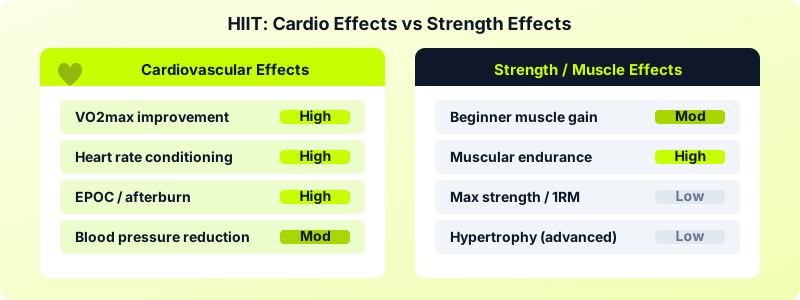
The cardiovascular adaptations from HIIT are well documented. Repeated high-intensity intervals push your heart rate to 80-95% of max, then drop it during rest. This oscillation strengthens your heart muscle, improves stroke volume, and increases VO2max — the gold standard measure of aerobic fitness.
A meta-analysis comparing HIIT to moderate-intensity continuous training found that HIIT produced greater improvements in VO2max, particularly in sessions using intervals of 3-4 minutes at 90% effort.
Here is what happens on the cardio side during a HIIT session:
- Heart rate climbs to 85-95% max during work intervals.
- Oxygen consumption spikes, training your body to deliver and use oxygen faster.
- EPOC (afterburn) elevates metabolism for 12-24 hours post-workout, burning an extra 50-150 calories depending on intensity and duration.
- Blood pressure improves over time as your cardiovascular system becomes more efficient.
If your primary goal is heart health and aerobic capacity, HIIT delivers. For a structured starting point, try a beginner HIIT workout with bodyweight movements and a 1:1 work-to-rest ratio.
The Strength Side of HIIT
HIIT can build muscle — but with important caveats. The strength stimulus depends on the exercises you choose and the resistance you use.
Bodyweight HIIT (jump squats, push-ups, mountain climbers) builds muscular endurance and some initial strength in beginners. If you have never trained before, bodyweight HIIT alone can produce visible muscle gains for the first 8-12 weeks as your body adapts to a new stimulus.
Weighted HIIT (kettlebell swings, dumbbell thrusters, barbell complexes) adds genuine strength training to the mix. The load creates mechanical tension — the primary driver of muscle growth — while the interval format keeps your heart rate elevated.
However, HIIT falls short of pure strength training in three ways:
- Load is limited. You cannot safely do max-effort deadlifts in a circuit with 20-second rest intervals. HIIT uses moderate loads (40-70% of your one-rep max), which builds endurance more than peak strength.
- Fatigue compromises form. As intervals stack up, technique degrades. Strength training at heavy loads requires fresh muscles and focused reps.
- Volume per muscle group is low. A 20-minute HIIT circuit spreads work across your whole body. Dedicated strength sessions focus 10-15 sets on one or two muscle groups.
The bottom line: HIIT builds functional strength and lean muscle, especially for beginners. It does not replace dedicated strength training for advanced lifters chasing maximum size or one-rep-max numbers.
How to Shift HIIT Toward Cardio or Strength
The beauty of interval training is its flexibility. By adjusting a few variables, you can tilt any HIIT session toward your primary goal.
To emphasize cardio:
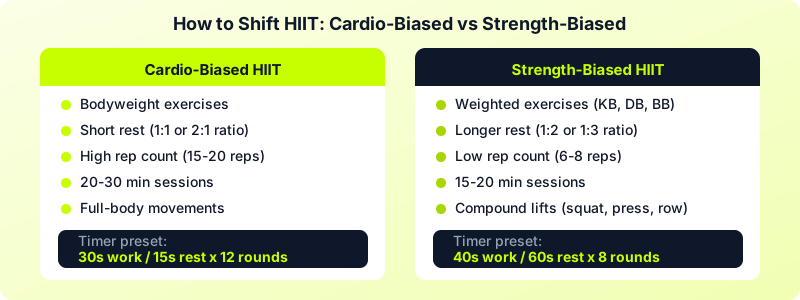
- Use bodyweight or light-load exercises (jumping jacks, burpees, high knees).
- Shorten rest periods — a 2:1 or 1:1 work-to-rest ratio keeps your heart rate elevated.
- Increase total session time to 20-30 minutes.
- Choose exercises that involve large muscle groups and full-body movement.
To emphasize strength:
- Add external resistance — kettlebells, dumbbells, or a barbell.
- Lengthen rest periods to a 1:2 or 1:3 ratio so muscles recover between sets.
- Keep reps low per interval (6-8 reps at moderate-to-heavy weight instead of 15-20 at light weight).
- Focus on compound movements: squats, presses, rows, deadlifts.
To get a balanced hybrid:
- Alternate cardio-focused and strength-focused intervals within the same workout.
- Example: 30 seconds of kettlebell swings (strength) followed by 30 seconds of mountain climbers (cardio), 15 seconds rest, repeat for 8 rounds.
How to Build a Balanced HIIT Program
The most effective approach for general fitness combines dedicated HIIT sessions with some pure strength work. Here is a sample weekly structure:
| Day | Session Type | Focus |
|---|---|---|
| Monday | Weighted HIIT | Strength-biased intervals |
| Tuesday | Rest or mobility | Recovery |
| Wednesday | Bodyweight HIIT | Cardio-biased intervals |
| Thursday | Strength training | Heavy lifts, long rest |
| Friday | Tabata or sprint HIIT | Pure cardio conditioning |
| Saturday | Active recovery | Walking, yoga, mobility |
| Sunday | Rest | Full rest |
This layout gives you two HIIT sessions (one cardio-biased, one strength-biased), one pure strength day, and one sprint day — covering both energy systems without overtraining either.
Use the Interval Timer app to save a different timer preset for each session type. Your cardio HIIT preset might be 30/15 with 12 rounds. Your strength HIIT preset might be 40/30 with 8 rounds at heavier weight. Having the right timer ready means you set up your interval timer once and reuse it every week.
HIIT is not cardio. HIIT is not strength training. HIIT is a training method that delivers both — and how much of each depends on the choices you make before you hit start.
Download Interval Timer and build HIIT workouts that match your exact fitness goal.