Pilates Interval Training Workout for Beginners
Pilates interval training applies timed work-rest structure to Pilates movements — turning what is typically a flowing, continuous practice into something with more defined effort and recovery phases. For beginners, this format is useful because it removes the ambiguity of "how long should I hold this" and replaces it with a timer that tells you exactly when to work and when to rest.
The result is a workout that builds core strength, hip stability, spinal mobility, and body awareness — without impact on joints, without equipment, and in sessions that can be as short as 15 minutes.
What Makes Pilates Work in an Interval Format
Traditional Pilates uses controlled repetitions with an emphasis on breath and precision. Interval Pilates keeps this emphasis but structures it around time blocks rather than rep counts.
Why timed intervals work for Pilates:
- Removes counting fatigue: Beginners often lose focus counting reps. A timer lets you focus entirely on movement quality.
- Creates progressive challenge: Shortening rest periods or extending work periods increases difficulty without changing the movements.
- Builds endurance alongside strength: Sustained effort within each interval trains the core muscles to maintain tension over time — which transfers directly to posture and athletic performance.
- Scales to ability: If you can't complete the full interval at first, you rest early and resume. The timer still runs, so you're training your body toward the target duration.
The key difference from HIIT: Pilates intervals are not maximum effort. You work at a controlled, precise pace — every rep counts, form doesn't collapse at the end of the interval. If you're rushing and losing form, slow down. The timer doesn't require speed, it requires sustained engagement.
Core Pilates Movements for Interval Training
These movements work well in timed intervals because they can be sustained for 30–45 seconds without becoming sloppy:
Anterior core:
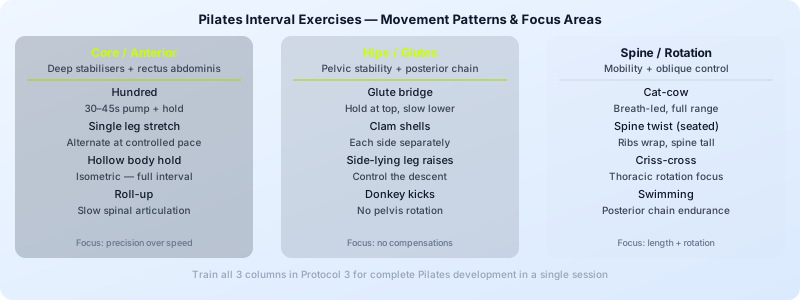
- Single leg stretch: On your back, knees to chest, extend one leg while pulling the other in. Alternate at a controlled pace.
- Hundred: Lying on back, legs at 45°, arms pumping up and down in small pulses. Classic Pilates endurance exercise.
- Roll-up: Slow spinal articulation from lying to seated to lying. One per 4–5 seconds.
- Hollow body hold: Maintain a concave shape with lower back pressed to floor, arms overhead and legs extended. Isometric hold.
Hip and glute stability:
- Clam shells: On your side, feet together, open top knee without rotating pelvis. Controlled and precise.
- Side-lying leg raises: Full leg raise from hip, controlled descent.
- Glute bridge: Hips up, hold at top, lower under control. Slow tempo.
- Donkey kicks: On all fours, kick one leg straight back and up. Don't rotate the pelvis.
Spinal mobility and extension:
- Swimming: Prone position, opposite arm and leg raises, alternating rapidly. Works posterior chain.
- Swan prep: Gentle spinal extension from prone, using back muscles not arms to lift.
- Cat-cow: Spinal flexion and extension on all fours. Controlled breathing and movement.
Rotation:
- Spine twist (seated): Sit upright, arms extended, rotate torso side to side. Ribs wrap, spine lengthens.
- Criss-cross: Bicycle crunch variation with emphasis on thoracic rotation rather than speed.
Three Beginner Pilates Interval Protocols
Protocol 1: Foundation (15 minutes)
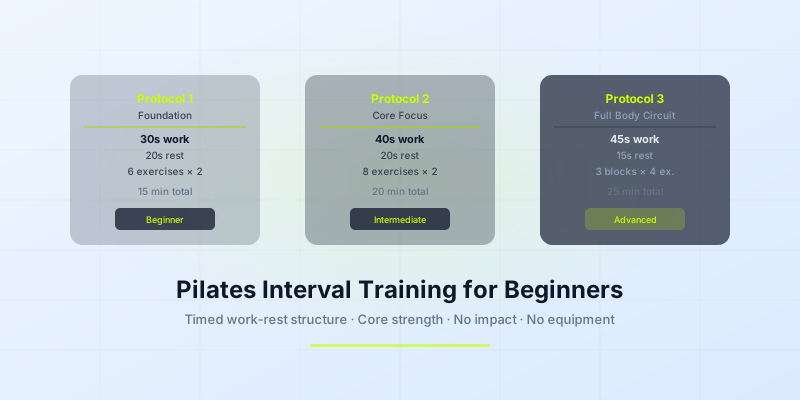
Simple 30s work / 20s rest structure across 6 exercises, done twice:
Round 1 and 2:
- 30s Single leg stretch / 20s rest
- 30s Glute bridge / 20s rest
- 30s Clam shells (right) / 20s rest
- 30s Clam shells (left) / 20s rest
- 30s Cat-cow / 20s rest
- 30s Hollow body hold / 20s rest
Rest 60 seconds between rounds. Total: ~15 minutes.
Timer settings: Work 30s, Rest 20s, 12 rounds (6 exercises × 2 rounds).
Protocol 2: Core Focus (20 minutes)
40s work / 20s rest across 8 exercises targeting anterior core and rotation:
- 40s Hundred / 20s rest
- 40s Single leg stretch / 20s rest
- 40s Criss-cross / 20s rest
- 40s Spine twist seated / 20s rest
- 40s Side-lying leg raises (right) / 20s rest
- 40s Side-lying leg raises (left) / 20s rest
- 40s Swimming / 20s rest
- 40s Glute bridge / 20s rest
Repeat once with 90s rest between rounds. Total: ~20 minutes.
Protocol 3: Full Body Pilates Circuit (25 minutes)
Three 8-minute blocks with 1-minute rest between blocks. Each block has 4 exercises at 45s work / 15s rest:
Block 1 — Core and spine: Hundred / Roll-up / Hollow body hold / Cat-cow
Block 2 — Hips and glutes: Glute bridge / Clam shells right / Clam shells left / Donkey kicks
Block 3 — Mobility and rotation: Swan prep / Spine twist / Criss-cross / Single leg stretch
Total: ~25 minutes. This covers all primary Pilates movement patterns in one session.
Setting Up Your Timer
The precise work-rest structure is what distinguishes interval Pilates from a free-flowing class. Set your interval timer before starting:
For Protocol 1: Work 30s, Rest 20s, 12 rounds For Protocol 2: Work 40s, Rest 20s, 8 rounds (repeat manually) For Protocol 3: Work 45s, Rest 15s, 4 rounds per block × 3 blocks
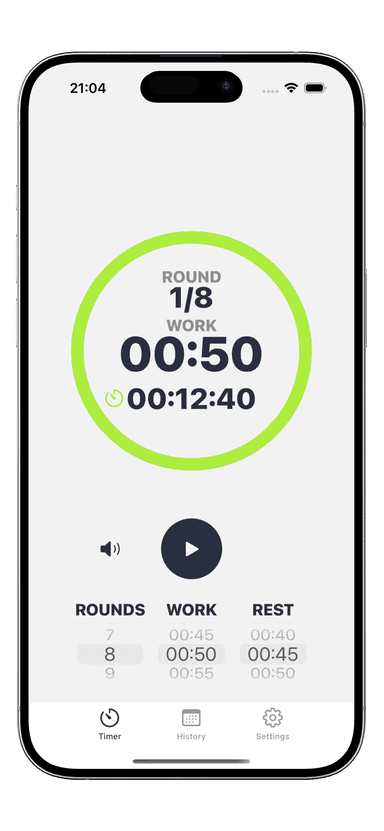
The Interval Timer app handles all these configurations with audio cues for transitions — useful when you're focused on movement quality and can't watch the screen.
Unlike HIIT workouts at home where audio cues signal a change in intensity, Pilates interval audio cues signal a change in exercise — which helps you mentally prepare the next movement during the rest period rather than watching the clock.
Programming Pilates Intervals into Your Week
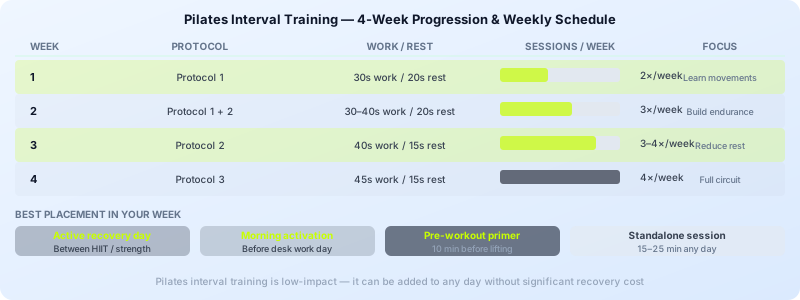
Pilates interval training is low-impact and recovers quickly. It can be done daily if the sessions are moderate length. Useful placements:
- Active recovery days between strength or HIIT sessions — it maintains movement quality and body awareness without adding training stress
- Morning sessions as a standalone 15–20 minute practice for posture and core activation before a desk-work day
- Pre-workout primer — 10 minutes of Pilates intervals activates deep stabilizers before strength training vs cardio sessions
As part of a weekly workout schedule, 2–3 Pilates interval sessions per week alongside 2–3 higher-intensity sessions provides excellent movement balance.
What to Expect as a Beginner
Week 1–2: Some movements will feel unfamiliar. Focus on understanding the movement pattern rather than maintaining perfect form throughout the full interval. Rest early when needed.
Week 3–4: Endurance within each interval improves. You'll complete more reps per 30–40 second interval, and the transitions between exercises become smoother.
After 4–6 weeks: Core stability transfers noticeably to daily life — sitting posture improves, lower back fatigue decreases, and hip stability during other exercises (running, squats) becomes more apparent.
The progression in Pilates interval training is primarily about precision and endurance within intervals, not about adding load. The same exercises become more challenging when rest periods shorten from 20s to 10s, or when work periods extend from 30s to 45s.
Download Interval Timer to run Pilates interval sessions with precise timing — set your work and rest periods once, then focus entirely on movement quality.