Setting Realistic Fitness Goals for Beginners
Setting realistic fitness goals for beginners is the single biggest factor that separates people who build lasting habits from those who quit after three weeks. The problem is not motivation — most beginners have plenty of that on day one. The problem is setting goals that are too vague, too ambitious, or disconnected from daily life.
Why Most Beginner Fitness Goals Fail
The most common beginner mistake is going all-in on day one. You sign up for a gym, commit to working out six days a week, overhaul your diet, and burn out before the month ends. Research consistently shows that extreme changes rarely stick.
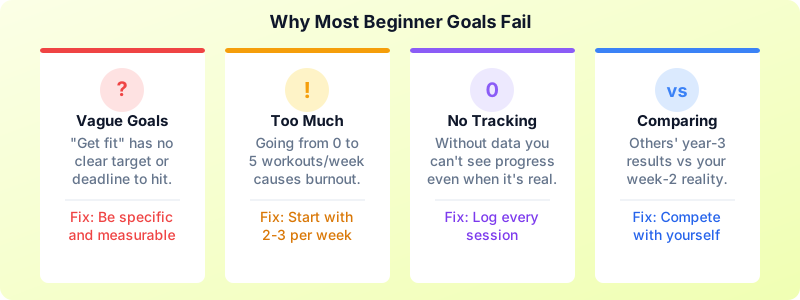
Here is why typical beginner goals fall apart:
"Get fit" is not a goal. It is a wish. Without a specific target, you have no way to measure progress, no deadline to work toward, and no clear next step when you wake up on a Tuesday morning.
Too much too soon. Going from zero workouts to five per week is a shock to your body and your schedule. Soreness, fatigue, and time conflicts pile up fast, and skipping one session feels like failure.
No tracking system. If you are not measuring anything, you cannot see progress. And if you cannot see progress, motivation disappears — even when your body is actually adapting.
Comparing yourself to others. Social media is full of transformation photos and advanced workout routines. But someone else's year-three results have nothing to do with your week-two reality.
The fix is straightforward: set smaller, specific goals that fit your life, track them consistently, and build momentum through small wins.
How to Set Realistic Fitness Goals That Stick
The SMART framework is the most reliable method for fitness goal setting. Every goal you set should be:
Specific — Define exactly what you want to achieve. Not "exercise more" but "complete three 20-minute workouts per week."
Measurable — Attach a number to it. Workouts per week, minutes per session, reps completed, or distance covered. If you cannot measure it, you cannot track it.
Achievable — Your goal should stretch you slightly beyond your current ability, not launch you into the stratosphere. If you currently do zero workouts, aiming for three per week is achievable. Aiming for seven is not.
Relevant — The goal should connect to something you actually care about. Training for a 5K works if you enjoy running. If you hate running, pick a different vehicle — there are plenty of ways to get fit.
Time-bound — Give yourself a deadline. "By the end of 8 weeks" creates urgency and a clear checkpoint for evaluation.
Here is an example of a vague goal turned SMART:
- Vague: "I want to get stronger"
- SMART: "I will complete three 20-minute strength workouts per week for the next 8 weeks, tracking my reps each session"
The time-bound element is crucial because it gives you a natural point to review, adjust, and set the next goal. Progress is not linear, and your goals should evolve as you do.
5 Beginner Fitness Goal Examples That Work
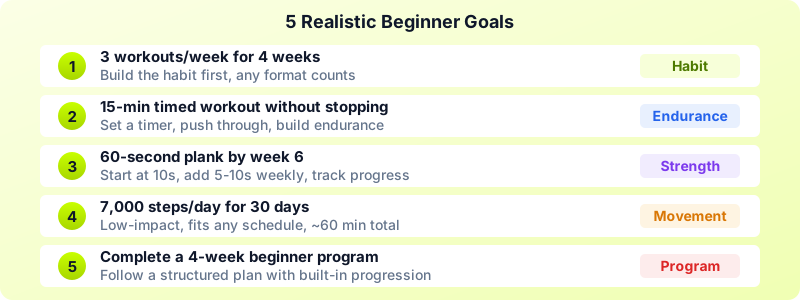
These realistic workout goals are designed for people starting from scratch. Each one follows the SMART structure:
1. Complete three workouts per week for 4 weeks. This is the foundation goal. It does not matter what the workouts are — a walk, a beginner HIIT workout, a yoga session. Three times per week for four weeks builds the habit. Once the habit is locked in, you can increase intensity.
2. Do a 15-minute timed workout without stopping. Pick any format — bodyweight circuit, interval training, or a simple jog. Set a timer for 15 minutes and complete the full session. This teaches you to push through discomfort and gives you a measurable benchmark to beat later.
3. Hold a plank for 60 seconds by week 6. Start wherever you are — even 10 seconds is fine. Add 5-10 seconds each week. This single-exercise goal builds core strength and proves that consistent effort produces measurable results.
4. Walk 7,000 steps per day for 30 days. Walking is the most underrated fitness tool for beginners. It is low-impact, requires no equipment, and fits into any schedule. 7,000 steps is roughly 3 miles and takes about 60-70 minutes spread across the day.
5. Complete a structured 4-week beginner program. Following a program removes the daily decision of "what should I do today?" Programs like Couch to 5K or a 4-week HIIT plan give you a clear path with built-in progression. An interval timer makes these programs easy to follow by handling the work and rest periods automatically.
How to Track Your Fitness Goals
What gets measured gets managed. Tracking does not need to be complicated — but it does need to be consistent.
The simple method: Keep a workout log. After each session, write down what you did, how long it took, and how it felt on a scale of 1-10. A notebook or phone note works fine.
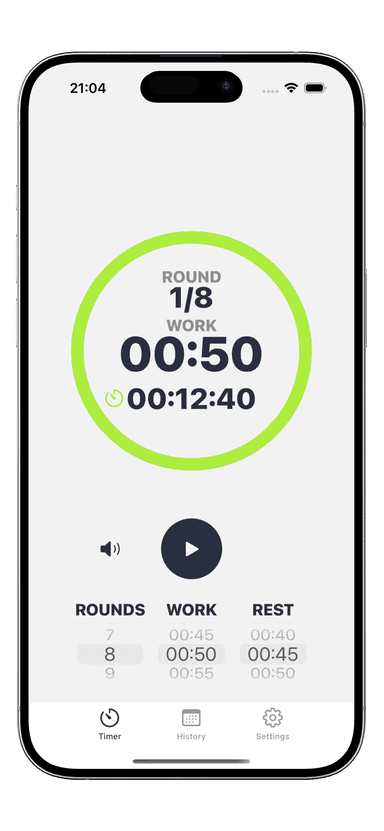
The app method: Use Interval Timer to time your workouts and track workout progress automatically. The app logs your workout history, so you can see how many sessions you completed each week and whether your performance is trending up.
Weekly check-ins: Every Sunday, review your week. Did you hit your target number of workouts? If yes, acknowledge the win. If not, identify what got in the way and adjust the plan — not the goal.
The 80% rule: Aim to hit your target 80% of the time, not 100%. If your goal is three workouts per week, hitting it in 3 out of 4 weeks means you are on track. Perfection is the enemy of consistency.
You can also set up an interval timer for your workouts so every session is structured and easy to repeat. When your workout is pre-programmed, you just press start and follow the cues.
What to Do When You Fall Off Track
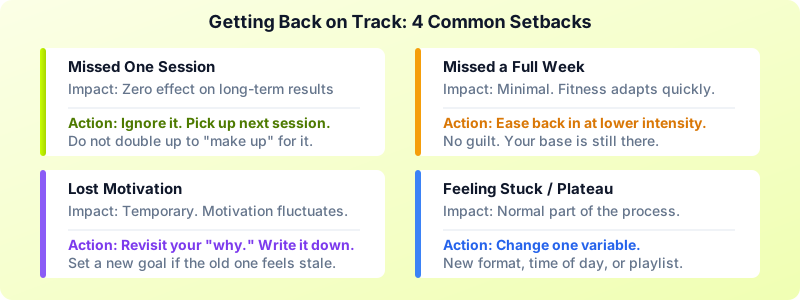
Every beginner misses workouts, has bad weeks, and questions whether the effort is worth it. This is normal and expected. What matters is how you respond.
Miss one session? Ignore it. One missed workout has zero impact on your long-term results. Do not try to make it up by doubling the next session. Just pick up where you left off.
Miss a full week? Reset without guilt. Life happens — travel, illness, work deadlines. When you come back, drop the intensity slightly for the first session to ease back in. You have not lost your progress. Fitness adapts quickly when you have a foundation.
Lost motivation? Revisit your why. Ask yourself why you started. Write it down. If the original reason no longer resonates, set a new goal that does. Goals should energize you, not drain you.
Feeling stuck? Change one variable. If your routine feels stale, try a different workout format, a new time of day, or a fresh playlist. Small changes can reignite your energy without overhauling the entire plan.
The people who build lasting fitness habits are not the ones who never fall off — they are the ones who get back on faster each time.
Start With One Goal Today
Setting realistic fitness goals for beginners comes down to starting small, being specific, and tracking what matters. Pick one goal from the list above, write it down, set a deadline, and take the first step today. You do not need a perfect plan — you need a plan you will actually follow.
Download Interval Timer and time your first structured workout with built-in tracking to keep your fitness goals on course.