Progressive Overload Explained: Beginner's Guide to Strength Training

Progressive overload is the most important principle in strength training — and the one most beginners either ignore or apply incorrectly. Without it, your body has no reason to adapt. With it, consistent strength and muscle gains become almost inevitable over months and years.
Here's what progressive overload actually means, the different ways to apply it, and how to build it into your training from day one.
What Progressive Overload Means
Progressive overload is the gradual increase in training stress over time to continually challenge the body and force adaptation.
Your body is remarkably efficient at adapting to demands placed on it. When you first do 3 sets of 10 squats at 60kg, that's a significant challenge — your muscles work hard, recover, and come back slightly stronger. The second week, the same 3×10 at 60kg is slightly easier. By week four, it barely registers as a challenge at all.
This is adaptation — and it's exactly what you want. The problem is that adaptation without progression means your body has reached homeostasis with the current training load. To keep getting stronger and building muscle, you have to keep increasing the demand.
Progressive overload provides that increasing demand in a systematic, manageable way.
The Five Ways to Apply Progressive Overload
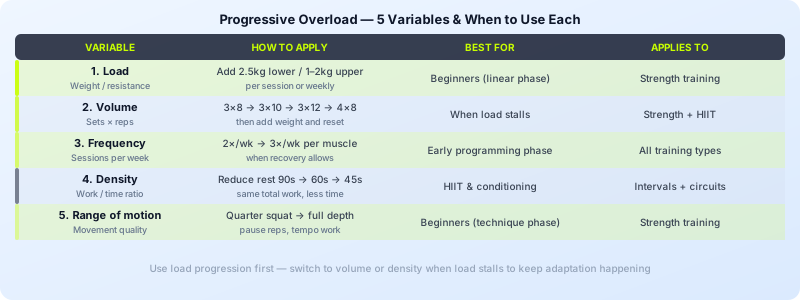
Most people think progressive overload means "add more weight every week." That's one method, but there are five distinct variables you can manipulate:
1. Load (Weight)
The most straightforward form: add weight to the bar or select a heavier dumbbell. For beginners, this often works week to week — add 2.5kg to lower body lifts, 1–2.5kg to upper body lifts per session.
When to use: When you can complete all sets and reps with good form and have 2–3 reps "in reserve" on each set.
When to stop: When you cannot complete the target reps with the added load. Don't increase weight before your technique and strength are ready.
2. Volume (Sets × Reps)
Add more total work without changing the weight:
- 3×8 → 3×10 → 3×12 → 4×8 (then add weight)
- Adding a fourth set at the same weight and reps
This is useful when load progression stalls or when you want to build volume capacity before pushing intensity.
3. Frequency (Sessions per Week)
Training a muscle group 3× per week instead of 2× per week is a form of progressive overload — more total stimulus for that muscle in the same timeframe.
For beginners, moving from 2 to 3 training days per week often produces rapid gains before load manipulation is needed.
4. Density (Same Work in Less Time)
Completing the same training volume in less time increases the relative intensity. Reducing rest between sets from 3 minutes to 2 minutes, then to 90 seconds, is a form of progressive overload.
This works well for conditioning-focused training and is how interval training relates to progressive overload — reducing rest intervals is a measurable progression. With HIIT workouts, cutting rest from 60s to 45s to 30s is a direct application of density progression.
5. Technique and Range of Motion
Performing the same weight through a greater range of motion is harder. A squat to full depth is more demanding than a quarter squat at the same load. Pausing at the bottom of a bench press removes the stretch-reflex advantage and increases difficulty.
This form of overload is especially important for beginners whose early technique improvements are themselves a form of progressive overload.
How to Apply Progressive Overload as a Beginner
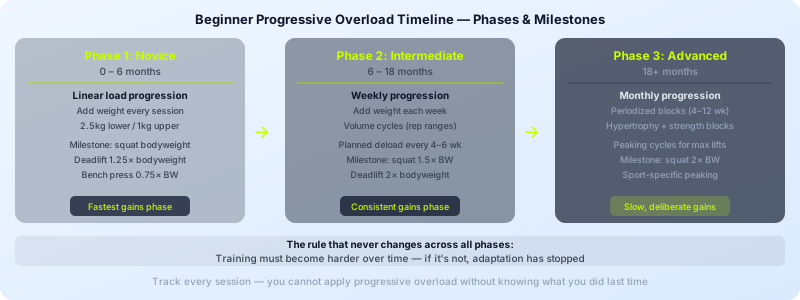
Beginners have what's called "newbie gains" — a period (typically 6–12 months) where strength increases rapidly because the nervous system is learning movement patterns alongside actual muscular adaptation. During this phase, linear progression works extremely well.
Linear progression: Add a fixed amount of weight every session or every week. The classic novice program structure:
- Session 1: Squat 60kg × 3×5
- Session 2: Squat 62.5kg × 3×5
- Session 3: Squat 65kg × 3×5
This continues until stalls appear — typically after 3–6 months of consistent training. At that point, weekly progression replaces session-to-session progression, and eventually monthly progression.
Practical beginner approach:
- Start lighter than you think you should — technique first
- Add weight only when you complete all target reps with good form
- Track every session: weight, sets, reps. No tracking = no progression
- When a weight stalls (fail to complete reps twice), deload 10% and rebuild
Tracking Progressive Overload
You cannot apply progressive overload without tracking. Your memory is unreliable for weight, reps, and sets across weeks of training.
Minimum tracking: A simple notebook or phone note with date, exercise, weight, and reps for every working set.
What to track:
- Weight used per exercise per session
- Reps completed per set (not just target reps)
- Any notes on form breakdown or fatigue
This data tells you when to progress (all reps completed, feeling strong), when to hold (reps dropped but form held), and when to deload (multiple consecutive failed sessions).
Progressive Overload and Interval Training
The same principle applies to cardio and HIIT. In interval training, progressive overload means:
- Reducing rest periods (from 60s to 45s between rounds)
- Adding rounds (6 intervals → 8 intervals)
- Increasing work duration (20s work → 30s work)
- Increasing effort density within the same time block
For Tabata training, progression from Protocol 1 (single exercise) to Protocol 2 (alternating) to Protocol 3 (three blocks) is structured progressive overload applied to interval training.
For running and cycling intervals, the 30-20-10 protocol is itself a form of within-session progressive overload — intensity increases within each 60-second block.
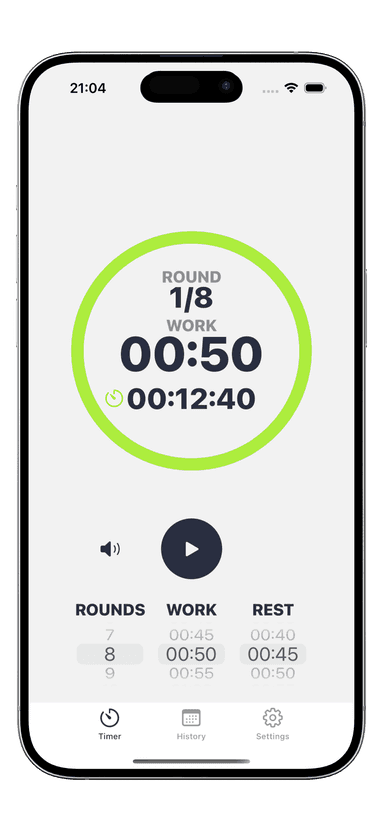
Using an interval timer supports this process — consistent timing means your rest periods don't drift longer as you get tired. The Interval Timer app holds rest periods precisely, so when you decide to cut rest from 60s to 45s, that's exactly what happens.
Common Progressive Overload Mistakes
Adding weight before technique is solid: Load progression with broken form builds strength in the wrong patterns and increases injury risk. Master the movement first.
Progressing too fast: Adding 5kg per session to upper body lifts leads to rapid stalls and ego-driven bad form. Small increments compound over time.
Skipping deloads: After 4–6 weeks of consistent loading, a planned deload week (reduce volume by 40–50%) allows recovery and often leads to a new PR the following week. Grinding through fatigue without deloading is a common intermediate mistake.
Only using load as the overload variable: When load stalls, many lifters get stuck. Switching to volume progression (more reps or sets at the same weight) keeps adaptation happening.
Ignoring sleep and nutrition: Progressive overload creates the stimulus for growth. Sleep and protein intake determine whether growth actually happens. Insufficient protein (under 1.6g per kg bodyweight) or chronic sleep deprivation blunt the adaptation response regardless of training quality.
The Long View
Progressive overload works on a timescale of months and years, not days and weeks. A beginner who applies it consistently for two years will be dramatically stronger than one who trains intensely but randomly.
The how to program your own workout schedule post covers how to structure a week that allows consistent progressive overload across multiple muscle groups without accumulating too much fatigue.
Download Interval Timer to apply progressive overload to your cardio and HIIT sessions — precise timing makes rest period manipulation a reliable, trackable variable in your progression.