Best Time of Day to Work Out: Morning vs Evening

The question of when to work out gets more attention than it deserves in fitness discussions. The research is clear on one thing: consistent training at any time produces far better results than occasional training at the "optimal" time. That said, there are real physiological differences between morning and evening exercise, and understanding them helps you make a better choice for your schedule and goals.
What the Research Actually Shows
Exercise science has studied training time extensively. Key findings:
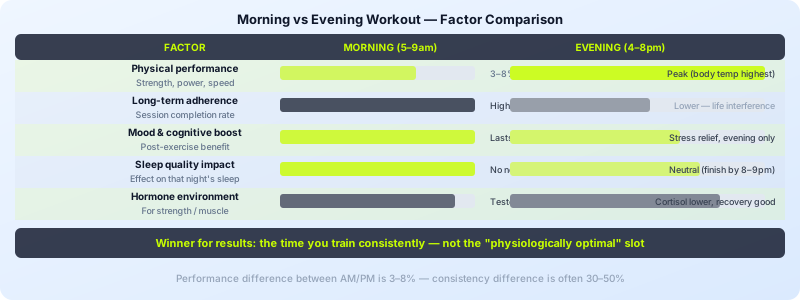
Core body temperature peaks in the afternoon. Muscle strength, power output, and reaction time all correlate with core temperature — meaning most people perform physically best between 2–6pm. Afternoon and early evening workouts often feel easier and produce slightly higher outputs than the same session done early morning.
Testosterone peaks in the morning. For resistance training, the hormonal environment in the morning is favorable for muscle protein synthesis. Some research suggests morning strength sessions produce comparable or better long-term muscle building results despite the performance disadvantage.
VO2 max and aerobic performance tend to be higher in the afternoon. For endurance and interval training, afternoon sessions may produce marginally better outputs.
Sleep is most affected by late-evening exercise. High-intensity training within 2–3 hours of sleep can raise core temperature and cortisol, disrupting sleep onset and quality. This is individual — some people sleep fine after 9pm workouts, others don't.
The practical implication: the performance differences between morning and evening training are real but small (typically 2–5%). They matter for competitive athletes. For everyone else, the more important variable is adherence — which session time you'll actually keep consistently over months and years.
The Case for Morning Workouts
Consistency advantage: Morning workouts happen before the day accumulates competing demands. Meetings, social plans, and fatigue don't cancel a 6am session. Research consistently shows morning exercisers have higher adherence rates over time.
Mental clarity and mood: Morning exercise raises endorphins, serotonin, and cortisol (in a beneficial acute way) — producing a measurable improvement in mood and cognitive performance that lasts several hours. Many people report better focus and productivity on days they train in the morning.
Appetite regulation: Some research suggests fasted morning cardio may improve fat oxidation, though the effect on body composition over time is modest and depends on total calorie intake.
Habit formation: Pairing exercise with a morning routine creates a strong behavioral anchor. Waking up → workout is a simpler habit loop than fitting training into variable afternoon schedules.
The downside: Morning performance is lower. Strength and power output may be 3–8% below afternoon levels. Injury risk may be slightly higher if the warm-up is compressed. A proper warm-up before morning workouts is especially important — cold muscles and stiff joints need more preparation than afternoon sessions.
The Case for Evening Workouts
Peak physical performance: Body temperature, muscle power, and cardiovascular efficiency are higher in the afternoon and early evening. Sprint times, lifting maxes, and interval performance tend to be better.
Stress relief: Exercise at the end of the workday is a proven stress buffer. It separates work from personal time and reduces cortisol accumulated during the day.
Social options: Group classes, sports leagues, and training partners are more available in the evening.
Better sleep (with caveats): Moderate evening exercise (finishing before 8–9pm) can actually improve sleep quality by reducing anxiety and lowering cortisol by bedtime. Only high-intensity training very close to bedtime tends to disrupt sleep.
The downside: Cancellation rate is higher. Afternoon meetings, social plans, tiredness, and general life interference make evening sessions harder to protect. If HIIT sessions are on the schedule, completing them after a long day requires more willpower than morning sessions.
Matching Workout Type to Time of Day
If you have flexibility in your schedule, matching workout type to time of day can optimize results:
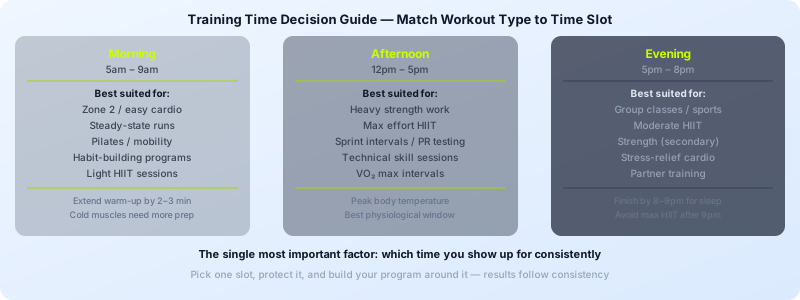
Morning (better suited for):
- Lower-intensity cardio and Zone 2 training
- Steady-state runs
- Pilates and mobility work
- Habit-building early in a new program
Afternoon / Early evening (better suited for):
- Maximum strength work (heavy lifts, PRs)
- High-intensity interval training (HIIT, Tabata, sprint intervals)
- Competitive performance or testing
- Technical skill-based training
This isn't a rule — plenty of people squat heavy at 6am and run their best 30-20-10 intervals before 7am. The time-of-day effect is real but secondary to the effort and consistency you bring to the session.
The Consistency Factor
The most important variable isn't time of day — it's how often you train over weeks and months. A weekly workout schedule that you follow 80–90% of the time beats a theoretically optimal schedule you follow 50% of the time.
Ask yourself:
- Which time do I actually complete sessions, not just intend to?
- Which time leaves me with enough energy to train effectively?
- Which time has fewer conflicts with my regular schedule?
The answers point to your optimal training time more reliably than any physiological research.
Splitting Workouts: Morning and Evening
Some people split their training across two daily sessions — morning and evening. This can work well for higher-volume programs:
- Morning: strength training or lower-intensity work
- Evening: cardio, intervals, or accessory work
The split approach allows better recovery within each session and can support higher weekly volume. For most people doing HIIT workouts at home, one well-timed daily session is sufficient.
Practical Recommendations
If you're starting out: Choose morning. Adherence is higher, the habit loop is simpler, and the performance difference doesn't matter when you're building baseline fitness.
If you're an intermediate or advanced athlete: Experiment with afternoon sessions for your hardest workouts — VO2 max intervals, heavy strength days, and performance testing. Use morning slots for easier training days.
If your schedule forces a specific time: Stop optimizing for when to train and focus on what to do when you train. A morning HIIT session or an evening strength workout both produce excellent results when done consistently with effort.
The timer doesn't care what time it is. Set your intervals, complete your session, and repeat over months — that's what produces results regardless of the clock.
Download Interval Timer to structure your sessions at any time of day — precise work/rest intervals work just as well at 6am as they do at 6pm.